
Beyond the Office Watercooler: How ESN Transforms Knowledge Management
Enterprise social networking: A knowledge management perspective
This study investigates the value of Enterprise Social Networking (ESN) through a Knowledge Management (KM) lens using a mixed-methods approach. By analyzing platforms like Yammer, it identifies five core ESN uses—problem solving, ideas/work discussion, events/updates, task management, and informal talk—demonstrating that idea generation and discussion are the primary drivers of perceived organizational value.
TL;DR
Is Enterprise Social Networking (ESN) just a digital distraction or a powerhouse for productivity? This research provides a definitive answer: ESN creates significant value by acting as a "market for ideas." While work-related discussions are the main value drivers, the "informal talk" often dismissed as clutter is actually the vital social lubricant that makes utilitarian collaboration possible.
The "Digital Noise" Dilemma
Organizations often deploy tools like Yammer or Slack with the hope of boosting productivity by 20-25%. However, managers frequently worry that these platforms devolve into "digital watercoolers" where employees waste time on non-work topics. The core tension lies in the struggle to define what actually makes an ESN "valuable" for an individual's daily knowledge work. The authors of this study argue that we cannot understand ESN value without first categorizing how people actually talk on these platforms.
Methodology: Decoding the Corporate Stream
The researchers used a robust two-step process to crack this code:
- Genre Analysis: They manually coded nearly 6,000 messages to identify repeating patterns of communication.
- Quantitative Validation: They surveyed 233 users to see which of these communication "genres" actually correlated with the perceived value of the platform.
Core Findings: The 5 Faces of ESN
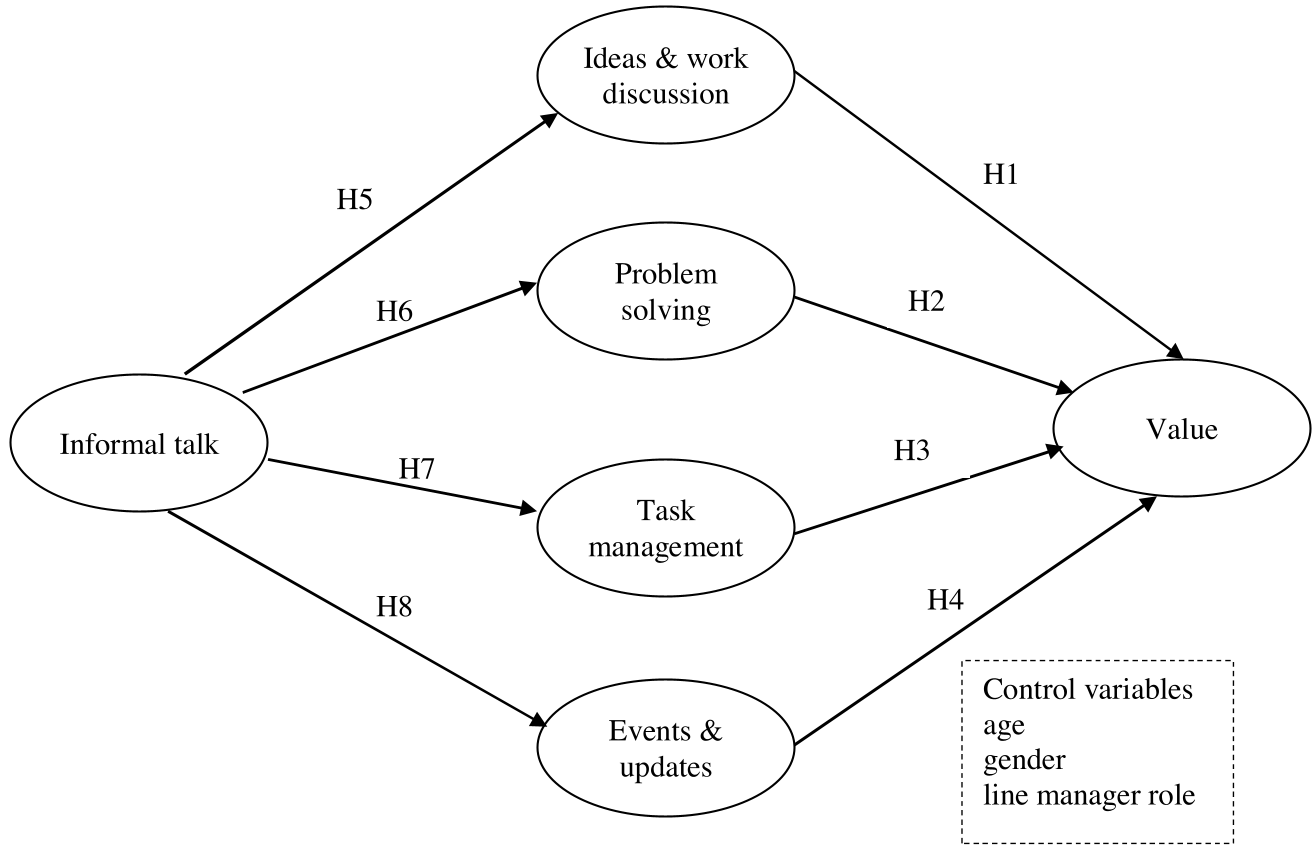
The study identified five distinct ways employees use ESN:
- Ideas & Work Discussion: Brainstorming and solarizing opinions on company matters.
- Problem Solving: Ad-hoc internal crowdsourcing to find specific solutions.
- Task Management: Coordinating progress and reporting completions.
- Events & Updates: Creating "ambient awareness" of what is happening in the office.
- Informal Talk: Discussing hobbies, news, or humor.
The "Social Lubricant" Effect
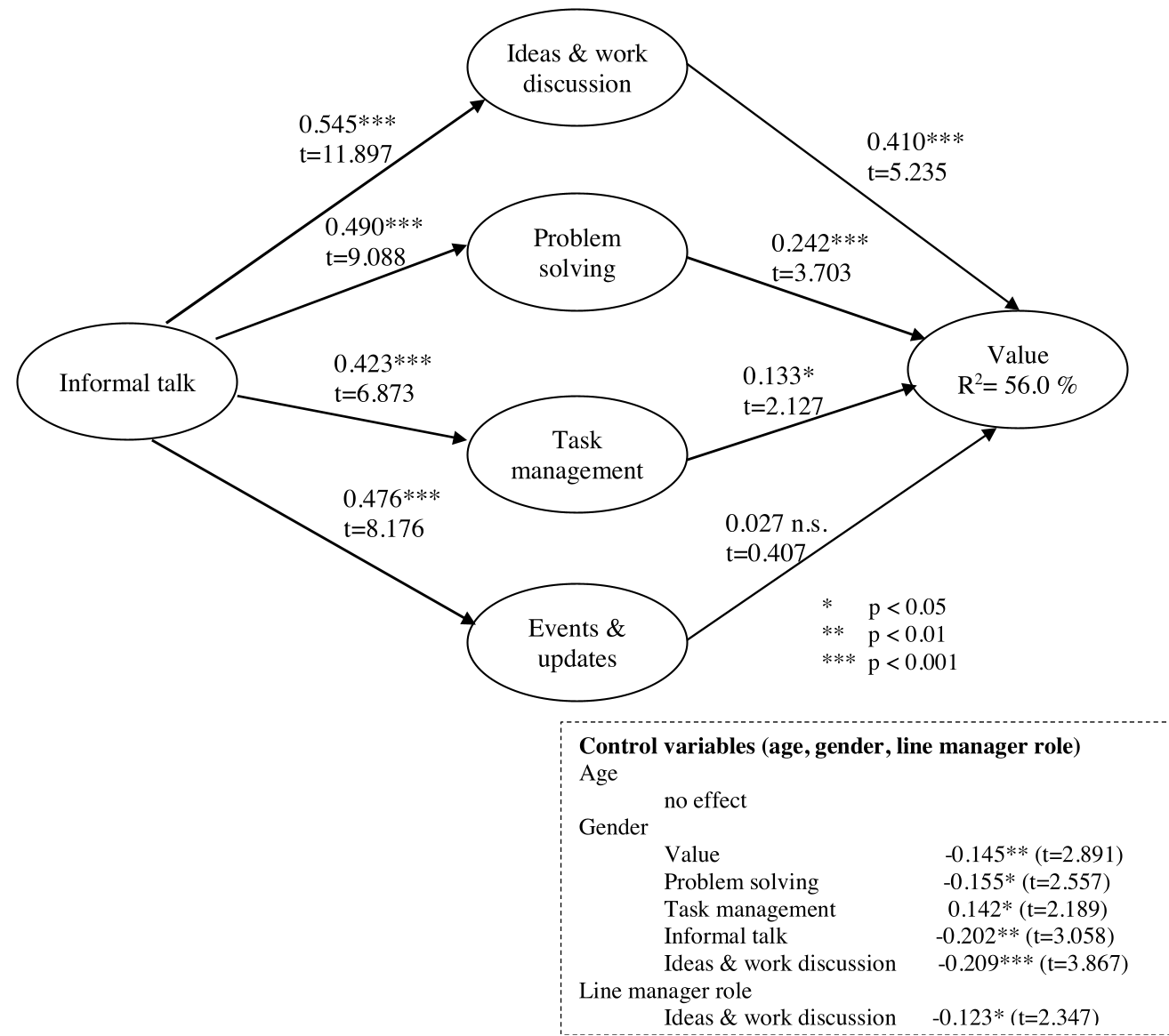
One of the most profound insights is the role of Informal Talk. While it doesn't directly solve a work problem, it builds Social Capital. The data shows that informal talk acts as a lubricant (as seen in Fig 2 below), making it easier for employees to later engage in high-value activities like brainstorming or troubleshooting. Without the "noise," the social connection required for "signal" never forms.
Analysis: Why "Ideas" Trump "Updates"
The survey results revealed that Ideas & Work Discussion were the strongest predictors of value (Path Coefficient = 0.446), followed by Problem Solving (0.244). Interestingly, Events & Updates had no significant impact on perceived value.
This suggests that ESNs are most valuable when they function as malleable spaces for knowledge creation rather than mere notification centers. Employees value the platform when it helps them address unstructured, ill-defined problems through serendipitous discovery—finding the person "who knows what" in a way that traditional, rigid databases cannot.
Critical Insight & Practical Implications
- Don't Silence the "Noise": Managers who ban non-work channels are likely sabotaging their platform's ROI. Social and work goals are "intertwined"—the social bonds formed over sports talk are the same bonds used to solve a critical technical glitch later.
- Support "Knowledge Conversations": Since idea generation is the primary value driver, ESN policies should emphasize "innovating" and "brainstorming" rather than just "reporting."
- The Gender Nuance: The study noted that female users generally perceived higher value in ESN for problem-solving and idea sharing than their male counterparts, suggesting ESN might offer an important inclusive space for organizational voice.
Conclusion
This study reframes ESN from a simple communication tool to a sophisticated Personal Knowledge Management asset. By enabling "multi-finality"—the ability to meet social and professional goals at the same time—ESN facilitates a continuous, organic flow of information that traditional corporate intranets simply cannot replicate.
Keywords: Enterprise Social Networking, Knowledge Management, Social Capital, Yammer, Organizational Communication.