
Trust and Privacy: The Dual Engine of Enterprise Professional Networking
An Enterprise Social Recommendation System for Connecting Swedish Professionals
The paper introduces an enterprise social recommendation system tailored for Swedish professionals, named to connect co-workers through a trust-based framework. It leverages a multifaceted correlation engine combining profile data and social actions (blogs, likes, comments) with a unique dual-layer privacy and explicit trust control mechanism.
TL;DR
Connecting professionals within an enterprise requires more than just simple matching algorithms. This paper presents a trust-based social recommendation system designed for the Swedish professional landscape. By combining implicit behavioral metrics (like blog interactions) with explicit privacy controls, the system ensures that recommendations are both relevant and respect the user's "right to be forgotten" or "right to be hidden."
The Professional Dilemma: Over-Exposure vs. Networking
In the corporate world, tools like "People You May Know" are widely used (65%+ on LinkedIn), but they often operate as "black boxes." Users feel a lack of agency: they cannot control who sees their profile, nor do they understand why a stranger is being recommended.
The researchers identified that professional networking relies on Social Trust. Unlike general social media, professional connections are built on shared competence, organizational proximity, and verified interactions. The challenge lies in quantifying this trust while maintaining a "Privacy-First" architecture.
Methodology: Engineering Implicit and Explicit Trust
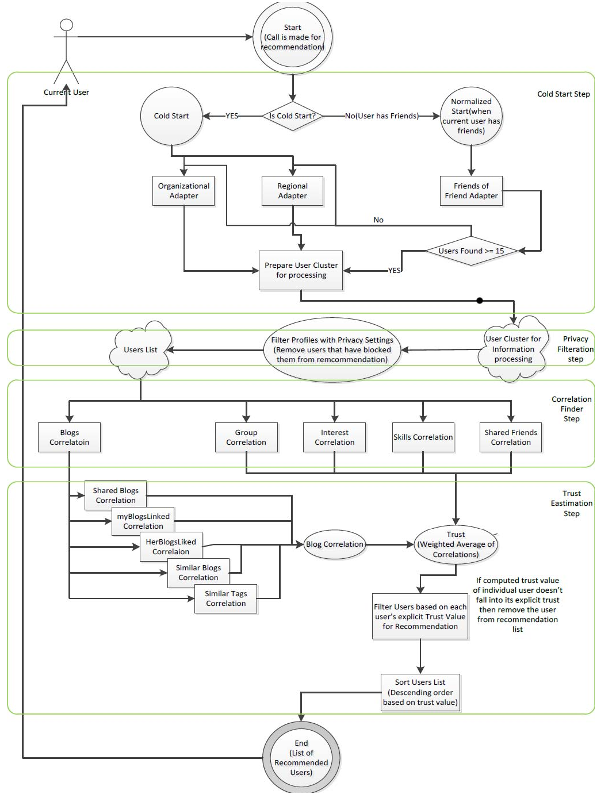
The system's core is a recommendation engine that processes data through various Correlation Functions.
1. The Multi-Factor Correlation Engine
The engine doesn't just look at one metric; it uses a weighted average of:
- Interest/Skill Similarity: Uses the Damerau-Levenshtein distance to account for variations in how professionals tag their skills (e.g., "DevOps" vs "Dev-Ops").
- Community & Organization: Factors in shared departments and regional offices to solve the "Cold Start" problem for new employees.
- Blog Activity: A sophisticated weighted formula that analyzes shared likes, comments, and tagging behaviors to capture "latent" professional interests.
2. The Privacy and Visibility Dial
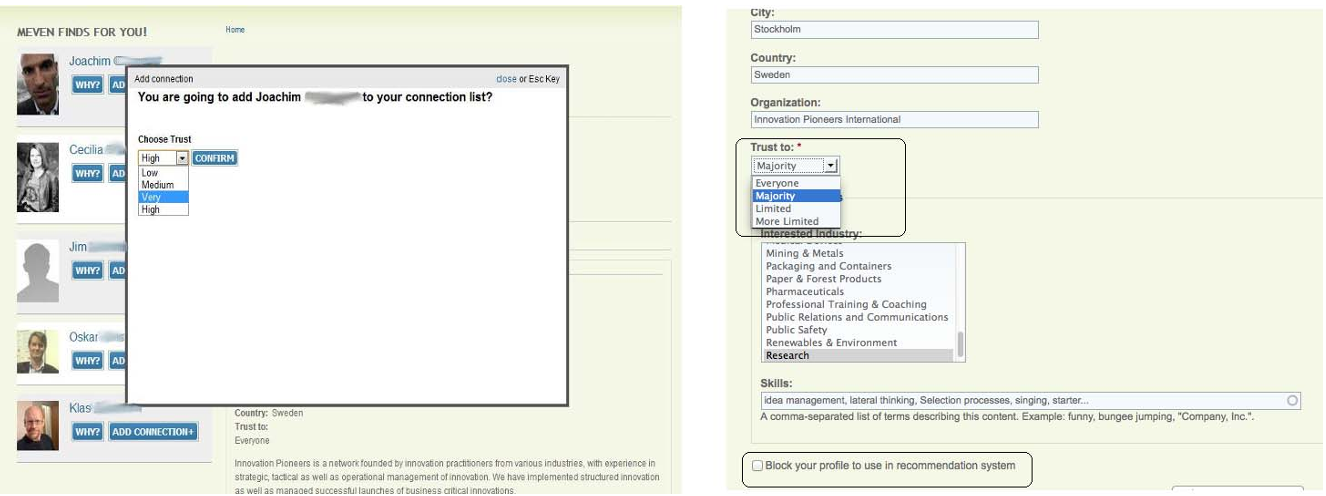
A standout feature of this framework is the Explicit Trust Level. Users can set a threshold (Level 1 to 4). If the system calculates an implicit trust score between User A and User B that is lower than User A's threshold, User A simply won't be recommended to User B. This puts the user back in the driver's seat of their professional network exposure.
Experimental Insights: Does Privacy Kill Utility?
The researchers tested their system on a dataset of Swedish innovators. Two key findings emerged:
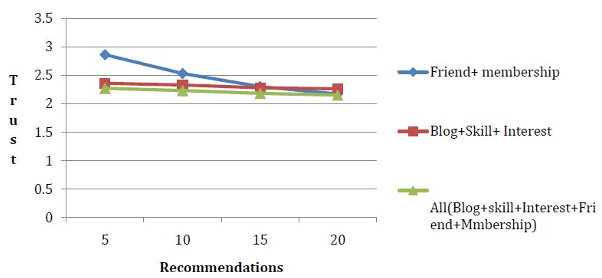
- The Stability of Fusion: When using single metrics (like just "Interests"), trust scores were volatile. However, when all correlation functions were combined (the green line in the performance plots), the average trust value became highly stable, regardless of the size of the recommended group.
- The Cost of Privacy: There is a clear "Privacy-Utility Trade-off." As more users opted to hide their profiles, the pool of potential connections shrank linearly. For one test user, increasing the number of hidden users caused their recommendation list to be cut in half.
Critical Analysis & Conclusion
This work highlights a critical evolution in Recommender Systems: moving from Algorithm-Centric to User-Centric design.
Key Takeaways:
- Context Matters: In an enterprise, organizational data is a powerful tool to overcome the "Cold Start" problem for new hires.
- Stable Trust: Diversity of data (blogs + skills + location) leads to more robust recommendations than any single signal.
- Future Outlook: While the current system uses heuristic weights, future iterations could use reinforcement learning to "learn" the optimal weights for trust based on whether recommended professionals actually connect.
However, the system has a Limitation: it relies heavily on users being active in blogging and tagging. In cultures where employees are less vocal online, the "Implicit Trust" calculated from content might be too low, leading to sparse recommendations.