
SKB: Capturing the Invisible Pulse of Enterprise Wisdom
Enterprise Wisdom Captured Socially
This paper introduces Social Network as Knowledge Base (SKB), a novel framework designed to capture and manage enterprise wisdom from informal social communications. It leverages semantically enriched user-generated content and metadata to build dynamic expertise profiles and measure user similarity within a multidimensional semantic space.
TL;DR
In modern enterprises, critical knowledge is often trapped in transient emails, chat logs, and microblogs. This paper proposes SKB (Social Network as Knowledge Base), a system that transforms these informal "noise" streams into a structured, multidimensional knowledge repository. By calculating semantic similarity across "social dimensions," SKB enables organizations to find experts and best practices that traditional databases miss.
The "Buried Knowledge" Problem
Enterprises are drowning in data but starving for knowledge. Current Knowledge Management (KM) systems suffer from three fatal flaws:
- Static Nature: Manuals and FAQs become obsolete the moment they are written.
- Siloed Sources: Expertise is fragmented across e-mail, Slack, and internal social tools.
- Context Blindness: Traditional search looks for keywords, not the "who, why, and how" of problem-solving.
The authors argue that engineers spend nearly half their time just looking for information. The solution isn't a better search engine, but a Social Network as Knowledge Base.
Methodology: The Enriched Multi-Layered Social Network
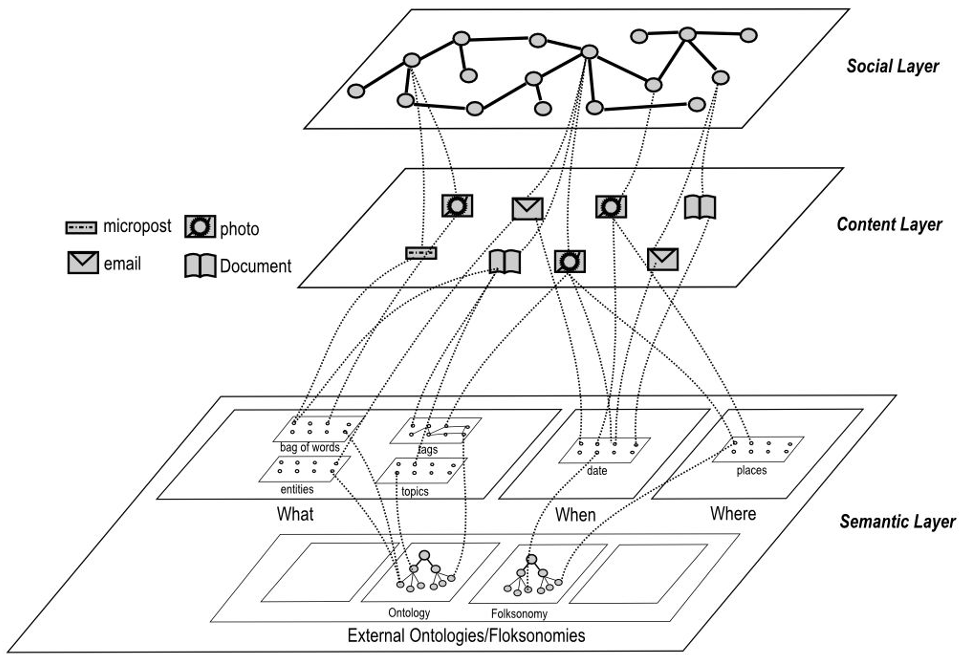
SKB moves beyond the simple "Friend-of-a-Friend" graph. It structures data into three distinct yet interconnected layers:
- Social Layer: The "glue" that maps explicit and implicit relationships (who talks to whom).
- Content Layer: The raw data from status updates, bookmarks, and emails.
- Semantic Layer: The intelligence layer that links content to ontologies, named entities, and topics.
Mathematical Intuition: Social Dimensional Distance
To handle the complexity of user interests, the authors define Social Dimensional Distance (). Unlike symmetric cosine similarity, this uses an adapted Hausdorff point set distance.
The intuition here is powerful: Expertise is asymmetric. If User A knows everything about "Cloud Computing" (a broad set), and User B knows "AWS Lambda" (a subset), User B is very similar to User A in that specific dimension, but the reverse might not be true.
Key Use Cases: Beyond Search
1. Context-Aware Expert Identification
Imagine Alice needs an expert in "Semantic Web" who also uses "Jena" and is located in the "Palo Alto" office. Traditional systems yield a global list of names. SKB filters this through the social and location layers to find the most relevant, reputable, and reachable expert.
2. Discovery of Best Practices
By monitoring how many people successfully use a specific solution (e.g., choosing MySQL over Jena for a specific task) across various communication channels, SKB can "crowdsource" the identification of best practices without requiring anyone to manually document them.
Critical Insight & Conclusion
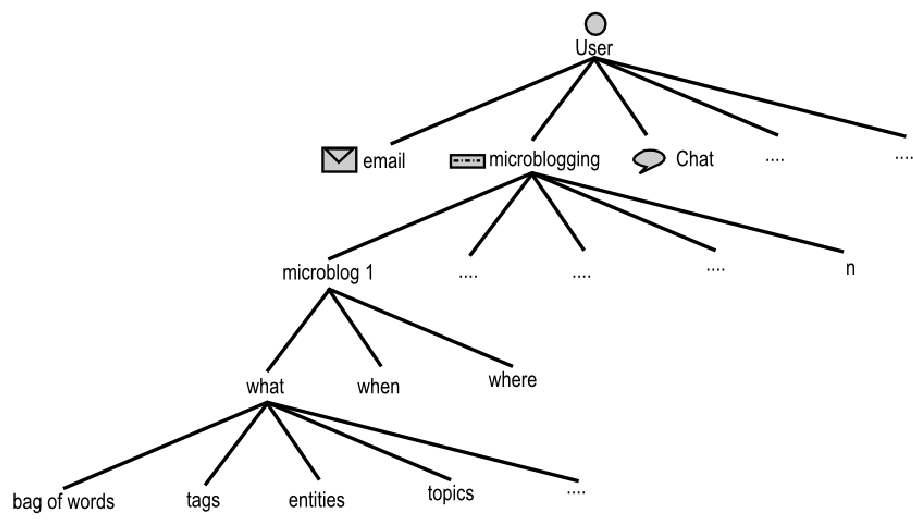
The true value of this work lies in the Social Indexing paradigm. Rather than indexing documents (the What), SKB indexes the Context (the Who, When, and Where).
Limitations: The paper identifies the potential for noise in informal communication (e.g., personal status updates). Future work needs to focus on more robust "knowledge vs. chatter" filters, potentially using the advanced NLP/LLM techniques we have today.
Final Takeaway: In the AI-driven enterprise, the social graph is the ultimate feature set for discovering collective intelligence.