
EnTrace: Peeking into the Black-Box of Self-Aware Computing Systems
EnTrace: Achieving Enhanced Traceability in Self-Aware Computing Systems
EnTrace is an open-source, MQTT-based platform designed to provide "enhanced traceability" for self-aware computing systems. By integrating Explainable AI (XAI), interactive data visualization, and human-computer interaction principles, it enables developers and administrators to monitor, understand, and interact with adaptation decisions in real-time.
TL;DR
EnTrace is a new open-source platform that brings "Enhanced Traceability" to self-aware systems. By leveraging XAI and high-performance visualization, it allows developers to see why a system adapts, monitor distributed topologies in real-time via MQTT, and even intervene in the decision-making process—all while maintaining a sub-100ms response time.
The "Black-Box" Problem in Autonomic Computing
Self-aware computing systems are designed to manage themselves based on high-level goals. However, as these systems scale, the gap between "design-time intent" and "runtime behavior" widens. When a system reconfigures its network or changes its power state, administrators are often left wondering: Why did it do that?
The challenge isn't just showing data; it’s providing transparency. Existing tools are either too specialized or fail when faced with the high-frequency data streams of decentralized systems.
Methodology: What is "Enhanced Traceability"?
The authors define Enhanced Traceability as a fusion of three disciplines:
- Explainable AI (XAI): Moving from symbolic black boxes to white boxes by making causality visible.
- Data Visualization: Using vector-based graphs (Network, Metric, and State views) to tell a story rather than just dumping tables of numbers.
- Human-Computer Interaction (HCI): Implementing Shneiderman’s "Overview first, zoom and filter, then details-on-demand" mantra.
System Architecture
EnTrace uses a decoupled backend. Instead of a hard-wired connection, it listens to the target system via MQTT. This allows it to aggregate data from distributed sensor nodes or microservices without significant overhead.
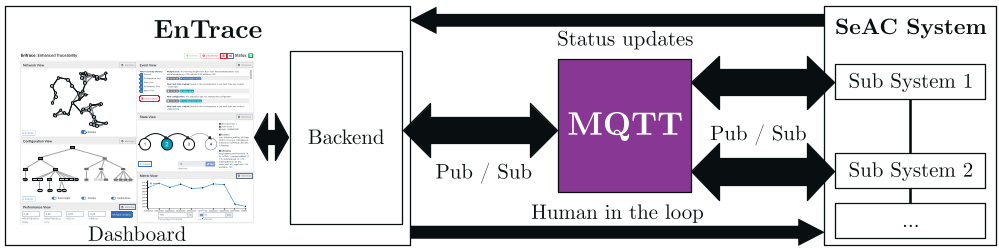 Fig 1: The architecture decouples the self-aware system from the dashboard via an MQTT broker, enabling human-in-the-loop actions.
Key Features: Beyond Simple Monitoring
- The State View: One of the most innovative features is the automatic generation of a state-transition graph. By discretizing continuous system attributes, EnTrace can highlight "loops"—where a system keeps switching between two configurations—a common bug in self-adaptive logic.
- Human-in-the-Loop (HITL): Users can "freeze" specific features or adjust the weights of non-functional goals (e.g., prioritizing "Latency" over "Energy Efficiency") directly from the dashboard and observe the immediate impact.
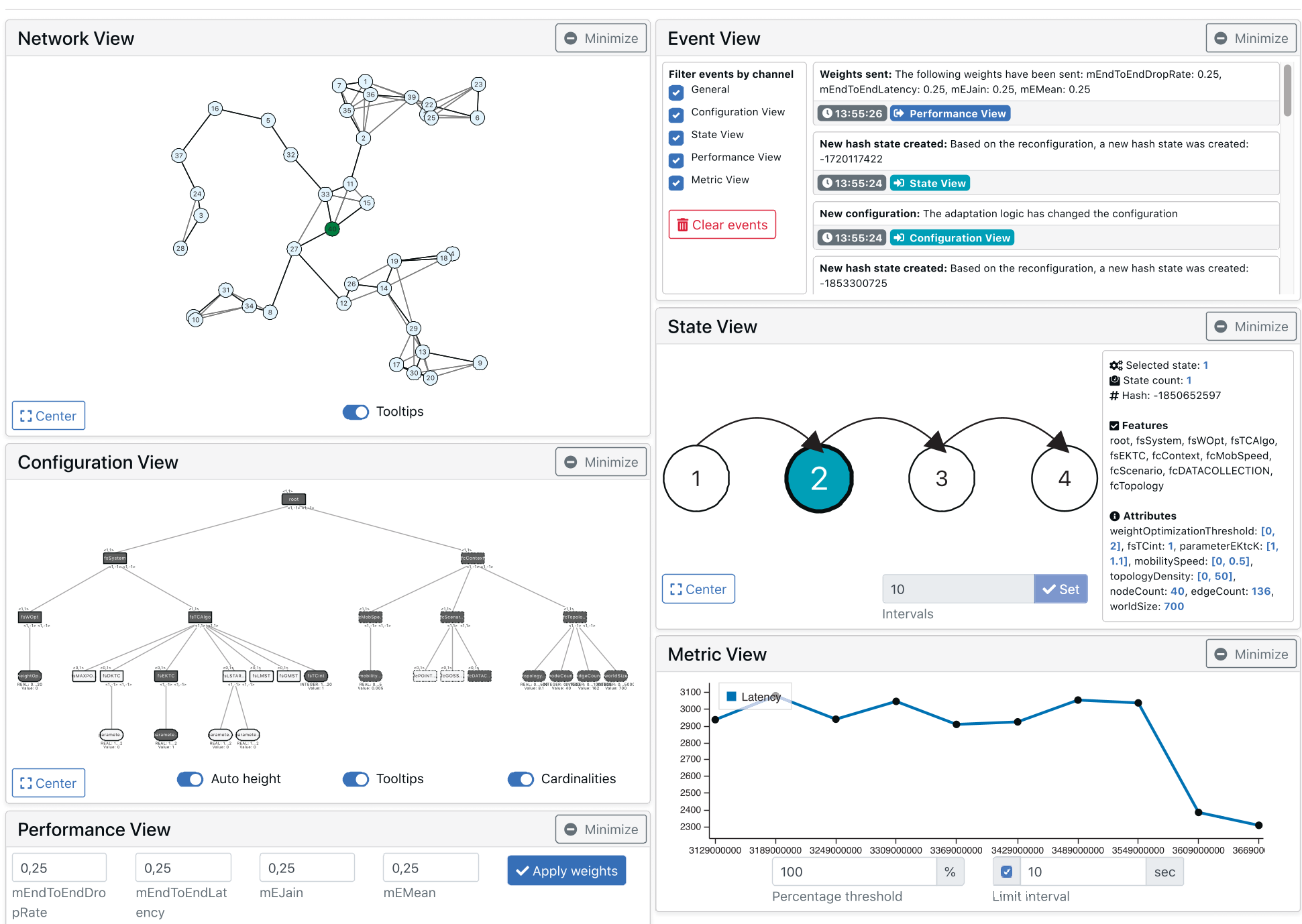 Fig 2: The EnTrace Dashboard showing network topology, metric progression, and the interactive State-Transition view.
Proof in the Performance
Responsiveness is critical for trust. If a dashboard lags behind the actual system by seconds, it's useless for debugging. The authors tested EnTrace against its predecessor, CoalaViz, using a Wireless Sensor Network (WSN) replay.
The results were conclusive: EnTrace maintained a stable response time, whereas CoalaViz frequently spiked above the 100ms "instantaneous perception" threshold.
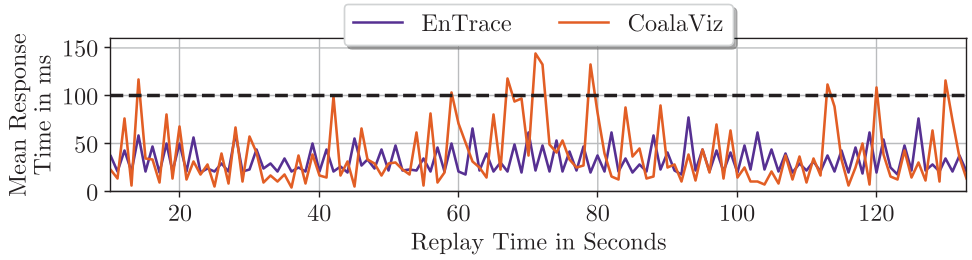 Fig 3: EnTrace (dark line) shows significantly lower and more stable latency compared to the previous state-of-the-art tool.
Critical Insight & Conclusion
EnTrace represents a significant step forward because it treats traceability as a first-class citizen rather than a post-hoc logging feature. While it currently relies on discretization for its state views (which might lose some nuance in highly complex systems), its ability to handle distributed, decentralized data via MQTT makes it ready for modern IoT and Cloud-Native environments.
For developers of autonomous systems, EnTrace offers the "eyes" needed to trust the "brain" of their software.