
The Core Value Gap: Why Most Entrepreneurs Are Missing the UN Sustainability Mark
Exploring the Core Values of Entrepreneurs: A Comparison to the United Nations 17 Sustainable Development Goals
This exploratory study investigates the alignment between the core values of 1,467 international entrepreneurs and the United Nations 17 Sustainable Development Goals (SDGs). Utilizing Latent Dirichlet Allocation (LDA) and text mining, the research reveals a significant gap between entrepreneurial motivations and global sustainability targets, with only "Education" and "Health" showing explicit engagement.
Executive Summary
TL;DR: An analysis of 1,467 entrepreneurs reveals a stark disconnect between their "timeless guiding principles" and the United Nations 17 Sustainable Development Goals (SDGs). While community and development are mentioned, critical issues like climate change and gender equality remain largely absent from the entrepreneurial subconscious.
Academic Positioning: This work bridges the gap between Strategic Management (core values theory) and Developmental Economics (SDGs). It moves away from the "What" of business models to the "Why" of founder psychology, providing a baseline measure of how "normative" sustainability has actually become in the global startup ecosystem.
Problem & Motivation: The "Social" Niche Trap
For years, the UN has hailed entrepreneurship as the vanguard of the 169 targets within the 17 SDGs. However, the academic community has largely focused on "Social Entrepreneurs" or "Ecopreneurs"—groups that are sustainable by definition. This creates a survivor bias in research.
The authors argue that to achieve the 2030 Agenda, we must understand the average entrepreneur. If their Core Values—defined by Collins and Porras as the "intrinsic importance" that guides an organization—don't align with the SDGs, then sustainable outcomes are likely accidental rather than intentional.
Methodology: Digging into the Entrepreneurial Mind
The study leverages the S-E-A-M database, utilizing data from the "Entreprenerdy" management system. To process the unstructured text of 1,467 value cards, the researchers employed Latent Dirichlet Allocation (LDA).
LDA is a probabilistic model that treats documents as mixtures of topics and topics as mixtures of words. By analyzing the "Topic Simplex," the researchers identified the overarching themes that define modern entrepreneurship.
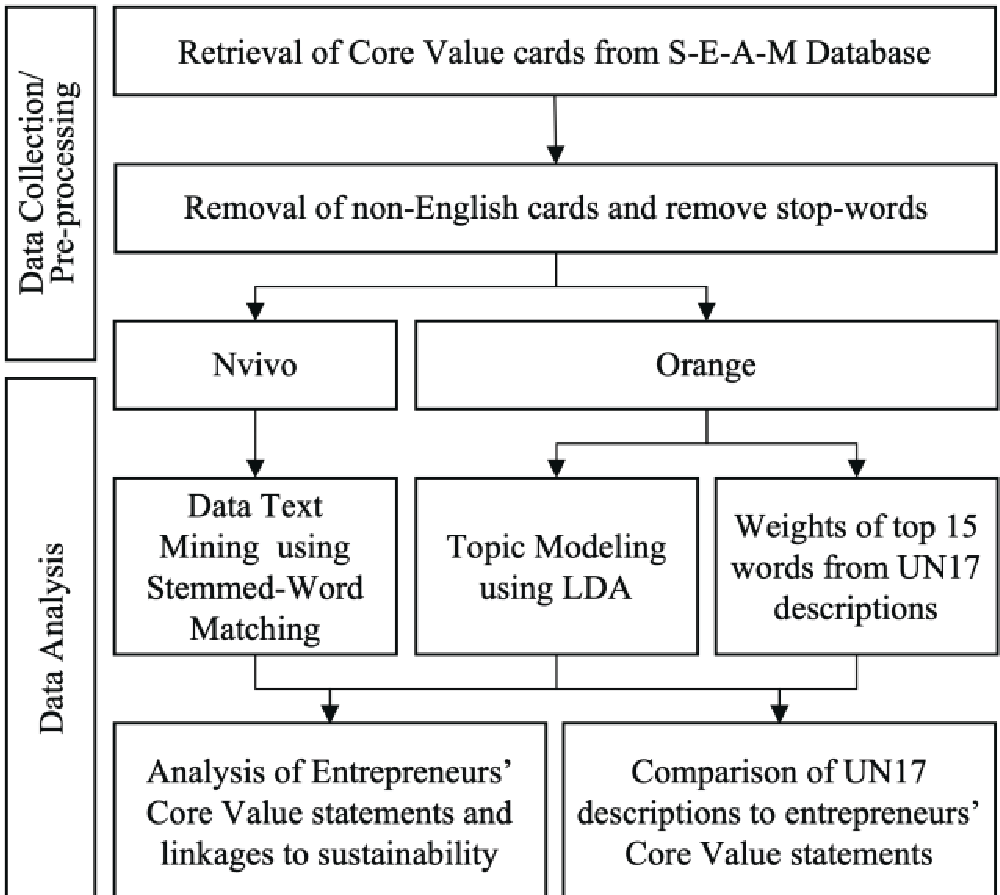
Key Findings: The Five Pillars of Entrepreneurial Values
The LDA analysis distilled thousands of words into five distinct thematic topics:
- Service: Focused on honesty and serving others.
- Community: Centered on customers, community, and health.
- Creativity: Emphasizing education and global systems.
- Development: Targeting personal and organizational growth.
- Quality: Prioritizing integrity and reliability.
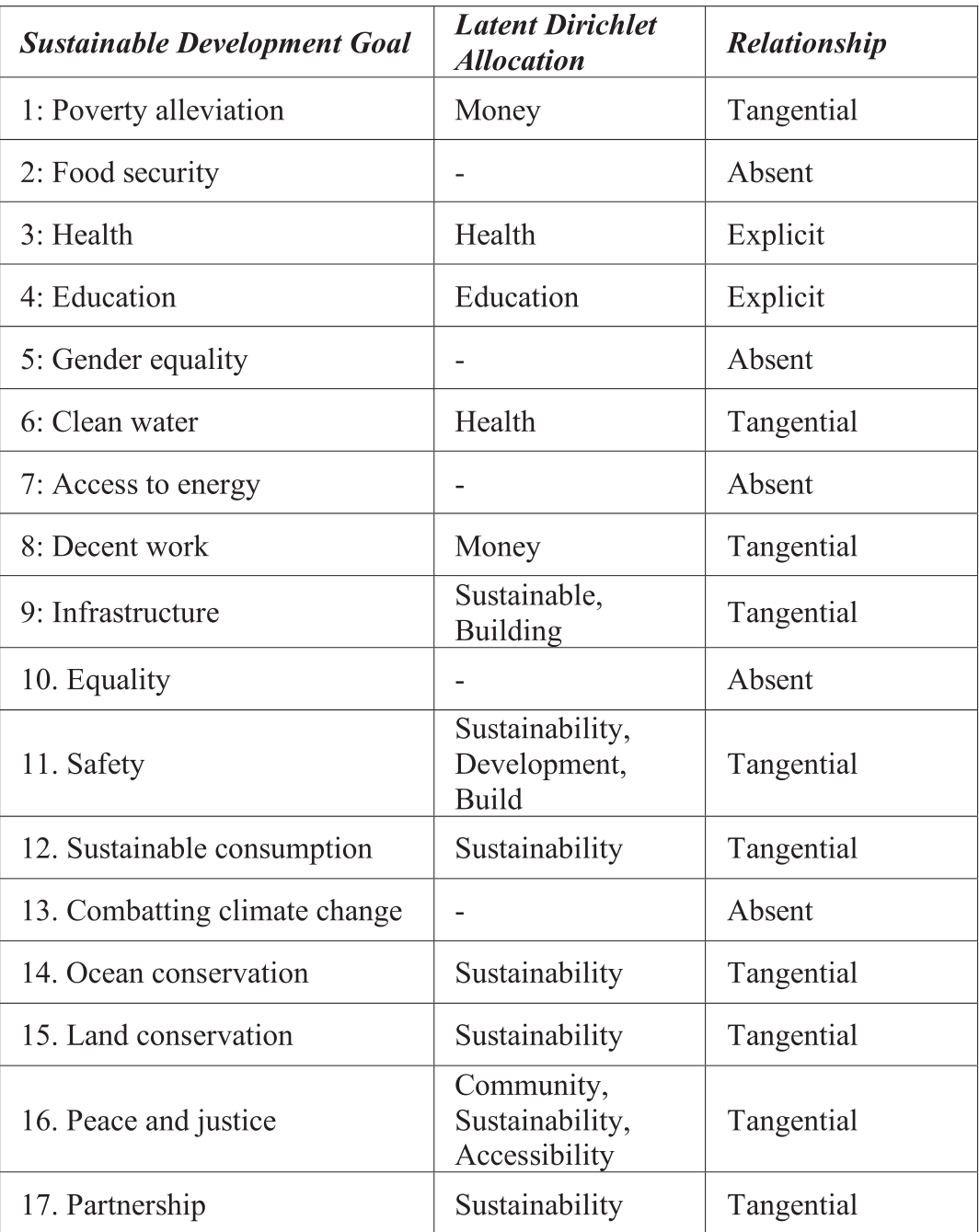
While these pillars are robust, their overlap with the SDGs is surprisingly thin. As shown in the table below, when mapping these topics to the UN goals, most results returned as "Absent".
The "Explicit" Winners and "Silent" Losers
- The Winners: Health (Goal 3) and Education (Goal 4). These are explicitly represented, likely because they are traditionally viewed as both services and business opportunities.
- The Losers: Climate Action (Goal 13), Gender Equality (Goal 5), and Clean Energy (Goal 7). These critical global crises are almost entirely missing from the self-reported values of the entrepreneurs studied.
Critical Analysis & Conclusion
This paper serves as a "reality check" for policymakers. The data reveals that "Sustainability" is often used as a buzzword (appearing in frequency counts) but doesn't always cluster into the structural "Topics" that define a founder's core mission.
Takeaway for the Industry: Incremental change isn't enough. If the innovation engine (entrepreneurship) is disconnected from the global survival roadmap (SDGs), the 2030 targets will remain out of reach. We need a shift in Entrepreneurial Training—moving from teaching "how to scale" to "how to align values with global needs."
Limitations: The study was limited to English-speaking entrepreneurs and lacked demographic granularity. Furthermore, core values are self-reported; there may be a gap between what an entrepreneur claims to value and their actual operational impact.
Future Outlook: Future research should investigate the "SDG Intervention"—do entrepreneurs change their values after being formally introduced to the UN framework? This could prove whether the SDGs are a source of Entrepreneurial Opportunity or merely a political constraint.