
Cognitive Maps for Global Markets: Why Most Entrepreneurs Miss the Boat
The role of the entrepreneur in identifying international expansion as a strategic opportunity
This research investigates the internationalisation of firms as a two-stage process: opportunity identification and exploitation. Using Spain's natural stone industry as a case study, it explores how entrepreneurs' cognitive variables—such as alertness, prior experience, and causal logic—influence their ability to gather information and recognize international expansion as a strategic opportunity.
TL;DR
International expansion is often framed as a logistical or financial challenge, but this research argues it is fundamentally a cognitive hurdle. Using the Spanish natural stone industry as a lens, the authors reveal that entrepreneurs are frequently "blind" to global opportunities not due to a lack of resources, but due to low entrepreneurial alertness and a failure to systematically gather information, leaving their international strategy to mere chance.
The Problem: The Information Paradox
Why do some firms in the same sector aggressively expand abroad while others remain stagnant? Traditional models suggest a sequential path (the Uppsala model), but they don't account for the human factor—the entrepreneur.
The core pain point identified here is the Information Paradox: Entrepreneurs claim they want to go international, yet they spend almost no time looking for the data to do it. They operate within a "bounded rationality," where their existing biases and limited "center of attention" filter out critical signals about foreign market appeal, barriers, and available government support.
Methodology: The Initial Framework
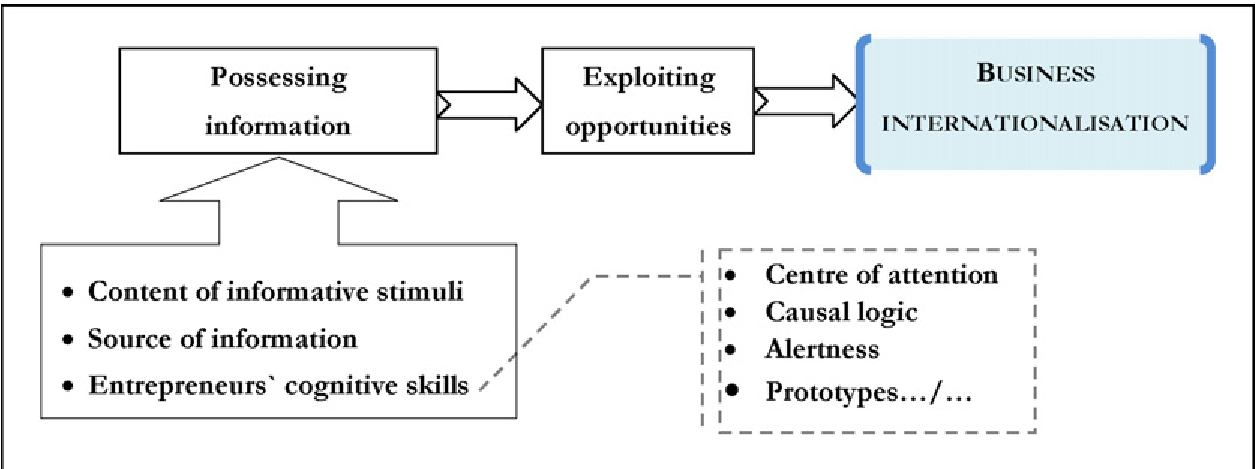
The authors break down internationalisation into a logical flow governed by cognitive skills and environmental triggers.

The framework rests on two pillars:
- Possessing Information: This is the identification phase. Here, "Alertness" (the proactive search) and "Causal Logic" (how an entrepreneur links events to outcomes) determine what information actually enters the strategic agenda.
- Exploiting Opportunities: Once information is filtered, the entrepreneur’s orientation toward risk-taking, innovation, and proactivity takes over.
Deep Dive: Findings from the Stone Industry
The study focused on the Spanish natural stone sector—a traditional, SME-heavy industry. Through interviews and surveys, the research uncovered a startling gap between reality and perception.
The "Chance" Factor
Experts across the board agreed: information reaches these managers by accident.
- Market Appeal: Awareness is tied almost exclusively to Prior Experience. If they haven't been there, they don't see the opportunity. For instance, many recognized the French market but were oblivious to the massive growth potential in China or the US.
- Barriers: Information about obstacles is gathered through social networks. If their immediate circle doesn't talk about it, the barrier "doesn't exist" until they hit it.
- Support Programs: Entrepreneurs had only a superficial and often confused understanding of the institutional help (grants, missions, etc.) available to them.
Critical Insight: The Filter of "Situated Cognition"
The most profound takeaway is that an entrepreneur's "Alertness" is not a fixed trait—it is Situated Cognition. It is molded by the institutional environment and social networks.

The research shows that cognitive qualities vary by the type of stimulus:
- Experience is the best teacher for identifying Where to go (Appeal).
- Networks are the best teachers for identifying How hard it will be (Barriers).
- Campaigns are the only way they learn about Help (Support).
Conclusion & Future Outlook
This paper serves as a wake-up call for both business owners and policy-makers.
- For Entrepreneurs: Recognition of a global opportunity is a proactive cognitive task. If your "Alertness" is low, you aren't just missing data; you are missing the future of your company.
- For Policy-makers: Providing financial support is useless if entrepreneurs don't have the cognitive "schema" to recognize it. Institutional efforts should focus on awareness-raising and expanding the entrepreneur's social circle to include international actors.
Limitations: The study is exploratory and focused on a single, traditional industry. Future work must validate these cognitive links across high-tech sectors where information moves at a much faster pace, potentially heightening the impact of cognitive biases.