
Beyond the Firm: Mastering Performance through Institutional Ambidexterity
Entrepreneurial Intensity and Firm Performance: The Role of Institutional Ambidexterity
This paper introduces the concept of Institutional Ambidexterity to examine how multilayered environmental pressures (exploration vs. exploitation) influence Entrepreneurial Intensity (EI) and firm performance. Using a large-scale longitudinal dataset of over 24,000 observations from the French wine industry, it demonstrates that balanced institutional layers significantly moderate the relationship between entrepreneurial actions and both objective (price) and perceptual (quality ratings) performance metrics.
TL;DR
While most management theories suggest that "ambidexterity" (the ability to both explore and exploit) is an internal skill, this paper argues it is actually an environmental property. By analyzing 12 years of data from the French wine industry, the researchers show that firms perform best when they strategically navigate the conflicting pressures of their broad regional heritage and their immediate local regulations.
The "Inside-Out" Fallacy
For decades, the standard academic advice for "Ambidexterity" was simple: balance your internal R&D (Exploration) with your current production efficiency (Exploitation). However, this "Inside-Out" view ignores a critical reality—firms do not exist in a vacuum. They are subject to Institutional Complexity.
In the French wine industry, for instance, a firm in Bordeaux faces a "Broad Environment" that is heavily exploitative (steeped in tradition and reputation), while its specific local "Appellation" might demand exploration to survive. This paper asks: Does the environment's ambidexterity matter as much as the firm's?
Methodology: The Multilayered Institutional Model
The authors break down the environment into a 2x2 matrix to categorize how institutional pressures overlap.
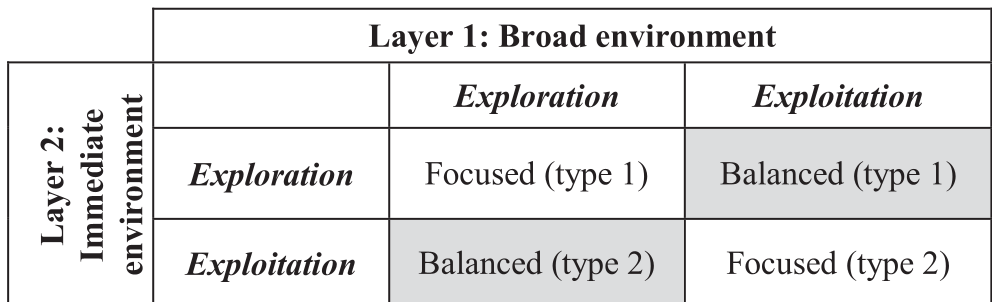
Key Constructs:
- Broad Environment (Region): Bordeaux (Exploitative) vs. Languedoc-Roussillon (Explorative).
- Immediate Environment (Appellation): Measured by the age of the AOC and the strictness of planting density/yield specifications.
- Entrepreneurial Intensity (EI): A two-dimensional measure of how much (innovation/risk) and how often (frequency) a firm acts entrepreneurially.
Results: The Strategy-Performance Fit
The study reveals a fascinating "trade-off" in how environment shapes success:
1. The Reputation vs. Profit Trade-off
- Perceptual Performance (Quality Rating): Firms achieved the highest ratings in Ambidextrous/Balanced environments. When the broad environment was explorative but the local environment provided exploitative structure (Type-2 Balanced), the "fit" boosted perceived quality.
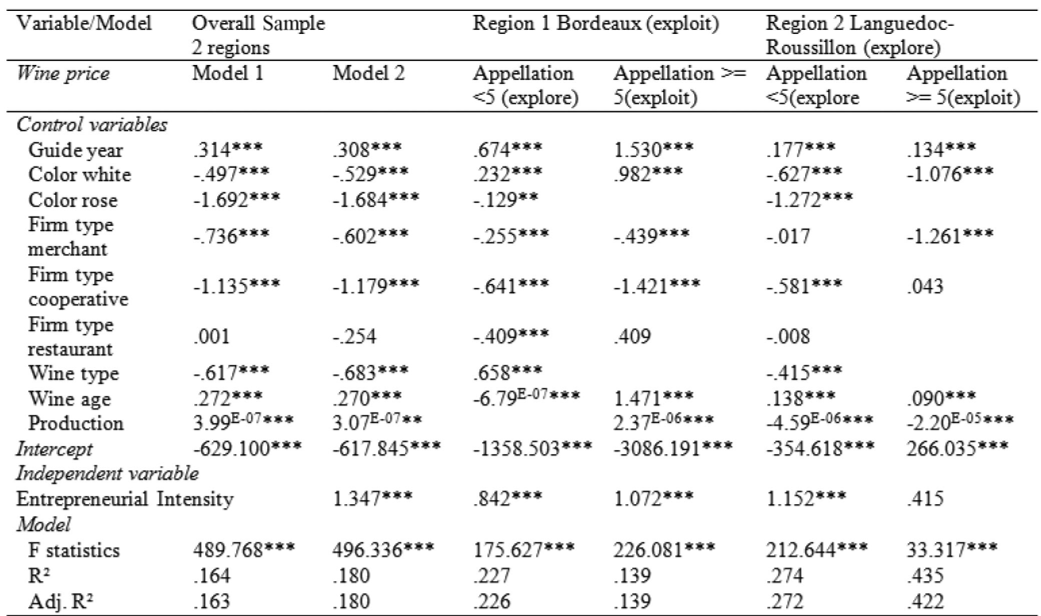
- Objective Performance (Price): The highest price premiums were found in Focused/Non-ambidextrous environments. When the region and the local rules were aligned (both exploitative or both explorative), firms could charge more, suggesting market clarity.
2. The Driver of Intensity
Surprisingly, higher scores in the "Immediate Environment" (local rules) led to higher entrepreneurial degree. Local stability provides the "platform" upon which firms feel safe enough to innovate.
Critical Insights & Takeaways
This research shifts the burden of ambidexterity from the manager's desk to the ecosystem's map.
- For Practitioners: Don't just "innovate." Look at your institutional layers. If you are in a traditional region with modern local rules, lean into your reputation. If you are in a modern region with traditional rules, use that tension to drive quality ratings.
- For Researchers: This paper validates that exploration and exploitation are not always mutually exclusive; they can coexist across different layers of an ecosystem, and this "orthogonal" relationship is what drives firm resilience.
Conclusion
The study concludes that Institutional Ambidexterity acts as a powerful moderator. Whether you seek sustainability (quality) or profitability (price), your success depends on how well you calibrate your entrepreneurial frequency to the "vibe" of your institutional surroundings.