
Agentic Arbitrage: Driving E-Market Evolution through Multiagent Intervention
Entrepreneurial Intervention in an Electronic Market Place
This paper presents a multiagent-based electronic market framework designed to facilitate "Entrepreneurial Intervention" and market evolution. It leverages BDI (Belief-Desire-Intention) agent architectures and data mining to transform raw Internet and market signals into strategic advice for actors, achieving a more dynamic and efficient B2B environment.
TL;DR
This research explores the construction of an electronic marketplace where multiagent systems don't just facilitate trades, but actively drive market evolution. By utilizing a three-layer BDI (Belief-Desire-Intention) architecture and an "Actor's Assistant" powered by data mining, the system models how entrepreneurs find "arbitrage" opportunities—transforming stagnant e-exchanges into dynamic, evolving ecosystems.
The "Price-Only" Trap: Why E-Exchanges Fail
The early 2000s saw a graveyard of Internet e-exchanges. The paper identifies a critical flaw: a preoccupation with single-issue negotiation (price). This "ruthless bidding war" destroys supplier incentives and ignores vital factors like quality, reliability, and long-term business relationships.
More importantly, traditional models assume market equilibrium. In reality, markets grow and innovate because they are not in equilibrium. Evolution happens when an "entrepreneur" identifies a gap—a "hunch" about political instability or a unique combination of services—and intervenes. The challenge is: how do we build a software architecture that supports this messy, "emergent" human intuition?
Methodology: The BDI Engine and the Actor's Assistant
The core of this work is a robust multiagent process management system. The author argues that in an unreliable environment like the Internet, every transaction must be managed as a resilient business process.
1. The Architecture of Agency
The system utilizes a hybrid BDI architecture. Unlike simple reactive agents, these agents perform deliberative reasoning:
- Beliefs: Data from the e-market and the wider Internet.
- Desires (Goals): What the actor wants to achieve (e.g., "Buy steel at the best price by Tuesday").
- Intentions: A concrete plan to achieve those goals.

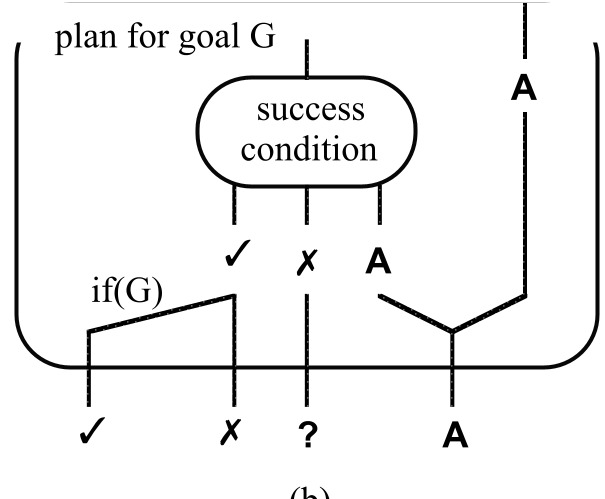
2. The Four-Exit Plan Logic
A standout feature is the Almost-Failure-Proof Operation. Standard code usually assumes a binary Success/Failure. Debenham introduces a four-exit structure for goals: Success, Failure, Aborted, and Unknown. This allows the agent to adapt intelligently if a seller reneges or a network goes down—crucial for "critical" business transactions.
From Basic Trading to Market Evolution
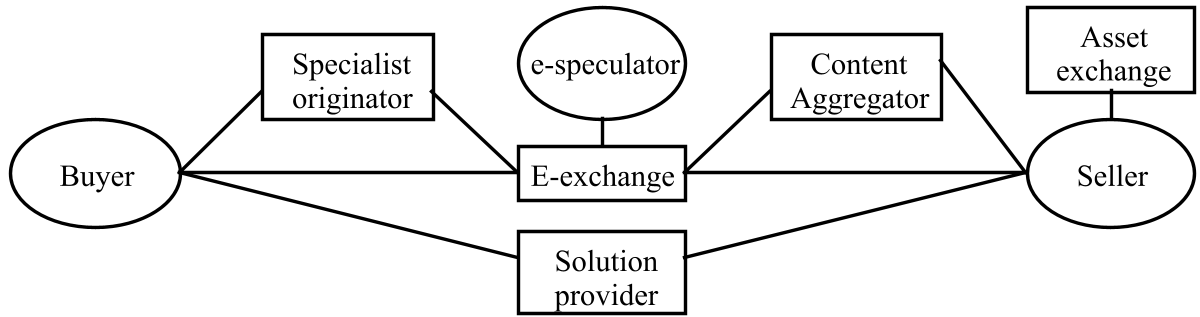
The paper scales from a "Basic System" (Buyers, Sellers, Exchanges) to a "Full System" designed for evolution.
- E-Speculators: Actors who take short-term positions to provide liquidity.
- Content Aggregators: Agents that package goods from multiple sellers into a single value proposition.
- Specialist Originators: Reverse aggregators that group buyer orders to leverage economies of scale.
By using reinforcement learning and performance knowledge, agents learn which plans work best under specific environmental conditions, allowing the market to "evolve" as agents discover more efficient ways to facilitate these complex, multi-actor interventions.
Critical Insight: The "Why" Behind the Method
Why go through the complexity of multiagent systems? Because e-business is "Industry Process Reengineering" on a massive scale. The inductve bias here is that markets are not just spreadsheets; they are networks of autonomous, negotiating components.
The paper's genius lies in the "Actor's Assistant." Instead of relying only on internal market data, it mines the Internet for "individual signals." This mimics the real-world "hunch"—for example, predicting a commodity price hike based on foreign political news—and gives software agents the same "alertness" to opportunity that human entrepreneurs possess.
Conclusion & Future Outlook
John Debenham’s work provides a blueprint for an e-market that is a living organism rather than a static database.
- Takeaway: Effective e-markets require robust process management and agents capable of "emergent" reasoning.
- Limitations: The paper acknowledges the difficulty in establishing a common language (ontology) for communicating "expertise" between agents.
- Legacy: This framework foreshadowed the current shift toward "Agentic Workflows" in AI, where the goal isn't just to execute a command, but to autonomously navigate complex, unreliable environments to find optimal value.