
Harnessing the Network: How Social Ties Transform into Entrepreneurial Mastery
Research on the Relationship Between Entrepreneurship Learning and Entrepreneurship Ability Based on Social Network
This paper investigates the interplay between Social Networks, Entrepreneurial Learning, and Entrepreneurial Ability. Using Structural Equation Modeling (SEM) on a dataset of 512 entrepreneurs, it demonstrates that social networks serve as a critical learning platform where formal and informal ties significantly boost entrepreneurial capacity through imitation, exchange, and guidance learning.
TL;DR
Is entrepreneurial success a result of "born talent" or "hustled experience"? This paper argues it’s a learned capacity mediated by your social circle. By analyzing 512 entrepreneurs via Structural Equation Modeling, the study reveals that Social Networks aren't just for resources—they are the primary "classroom" for Entrepreneurial Learning, with formal professional networks providing the highest impact through structured guidance.
Background: Beyond the "Born Entrepreneur" Myth
In the traditional view, entrepreneurial ability was often treated as a static trait or a byproduct of decades of industry experience. However, the reality of "serial beginners" succeeding in new fields contradicts this. The researchers here position entrepreneurial ability as a dynamic, accessible asset that can be developed. The missing link? The mechanism of social-mediated learning.
The Problem: The "Black Box" of Networking
Most practitioners know that "networking is important," but the academic world has struggled to explain the how.
- Prior Work Limitations: Earlier studies focused too much on a person's individual history.
- The Insight: The authors suggest that social networks provide "low-cost learning opportunities." By categorizing networks into Formal (suppliers, government, associations) and Informal (family, friends, colleagues), they pinpoint exactly where different types of knowledge flow from.
Methodology: The Architecture of Learning
The paper breaks down the learning process into three distinct channels:
- Imitation Learning: Observing "models" within the network.
- Exchange Learning: Mutual communication and skill sharing.
- Guidance Learning: Targeted mentorship and formal advice.
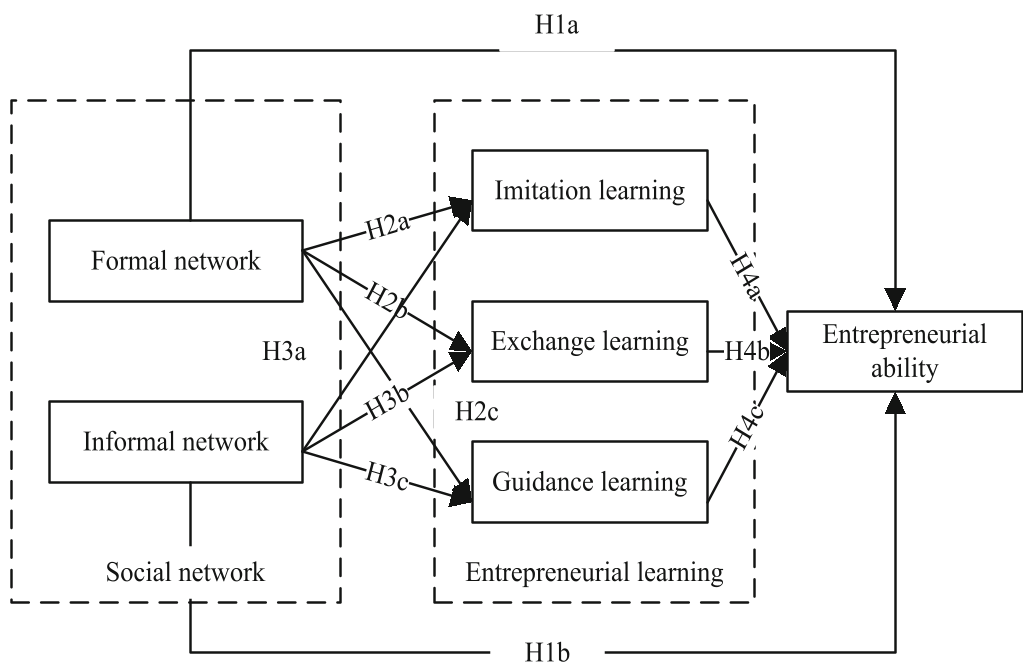 Figure 1: The theoretical framework linking Network types to Learning modes and final Ability.
Key Results: Guidance is King
The data suggests that not all networks are created equal.
- The Power of Formal Networks: Formal networks are the heavy hitters. They have a massive impact on Guidance Learning (Path Coeff: 0.809). This suggests that industry associations and professional partners provide higher-quality, actionable knowledge compared to casual social circles.
- The "Trust Paradox" of Informal Networks: While informal networks (friends/family) foster high trust and Exchange Learning, they struggled to provide effective "Imitation" or "Guidance" (the coefficients were actually negative or non-significant). Why? Because friends often share similar backgrounds, lacking the "heterogeneous information" needed for true growth.
- Impact on Ability: Guidance learning was the strongest predictor of success (Path Coeff: 0.652).
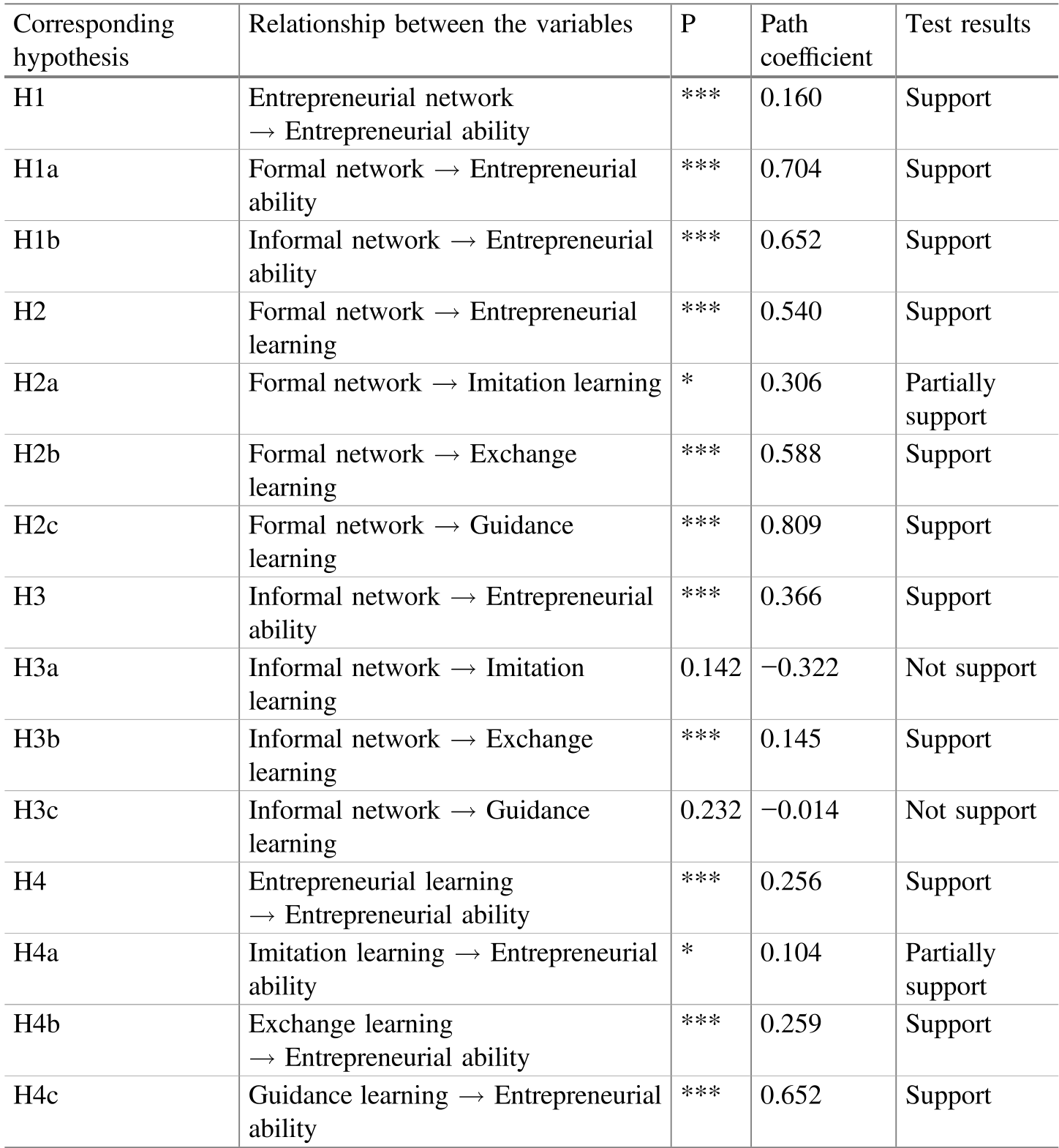 Table: Statistical validation of the learning paths. Note the dominance of Guidance Learning (H4c).
Critical Insight & Practical Takeaway
The paper’s most striking find is that imitation (modeling others) is the weakest way to build ability (only 0.104 impact).
For Entrepreneurs:
Don't just watch what others do (Imitation); talk to them (Exchange), and more importantly, find a structured way to get feedback (Guidance). Your family and friends are great for emotional support, but your "Formal Network" (suppliers, competitors, and trade groups) is where the real skill-building happens.
For Researchers:
This work confirms the Inductive Bias that entrepreneurial capacity is a socialized skill. Future research should look into "Negative Guidance"—how incorrect advice from a social network might actually degrade entrepreneurial ability.
Conclusion
Entrepreneurial mastery is a journey of active internalization. By strategically leveraging formal networks for guidance and informal networks for emotional exchange, entrepreneurs can "hack" their way to higher competency levels, regardless of their starting experience.