
Entropy-Based Graph Clustering: Minimizing Uncertainty to Find Communities
Entropy-Based Graph Clustering: Application to Biological and Social Networks
This paper introduces an Entropy-Based Graph Clustering algorithm designed to identify functional modules and communities in large-scale biological and social networks. By minimizing a newly defined graph entropy metric, the method identifies locally optimal clusters through iterative seed growth and can be parallelized to handle massive datasets.
TL;DR
Researchers have developed a new graph clustering approach that treats community detection as an entropy minimization problem. By defining a "stable" state where a network is partitioned into isolated, high-quality modules, the algorithm uses a greedy seed-growth strategy to find local optima. It outperforms classics like MCL and CNM in both accuracy (f-score) and scalability for massive, sparse real-world networks.
Background: The Modularity Challenge
Real-world systems—from protein-protein interactions (PPI) to the MySpace social graph—are characterized by high modularity and scale-free distributions. However, as networks grow into millions of nodes, traditional global optimization methods become computationally expensive. The authors identify a key insight: communities are essentially regions where "information leakage" (outer links) is minimized relative to "internal communication" (inner links).
Methodology: The Physics of Information in Graphs
The core of this work lies in the definition of Vertex Entropy.
1. Defining Stability
For any given cluster, a vertex has a probability of its links being internal and of being external. Entropy is maximized when a node is "undecided"—connected equally to the inside and outside of a cluster. Therefore, a good cluster is one where most nodes have an entropy near zero because they are decisively part of that community.
2. The Seed-Growth Algorithm
Unlike partition-based methods that split the whole graph, this algorithm works locally:
- Step 1: Selection - Pick a seed (improved by focusing on high-degree hubs).
- Step 2: Shrinking - Remove members that increase total graph entropy.
- Step 3: Expansion - Add neighbors that decrease total graph entropy.
- Step 4: Overlap - Because seeds are processed independently, the algorithm naturally accounts for nodes belonging to multiple communities.
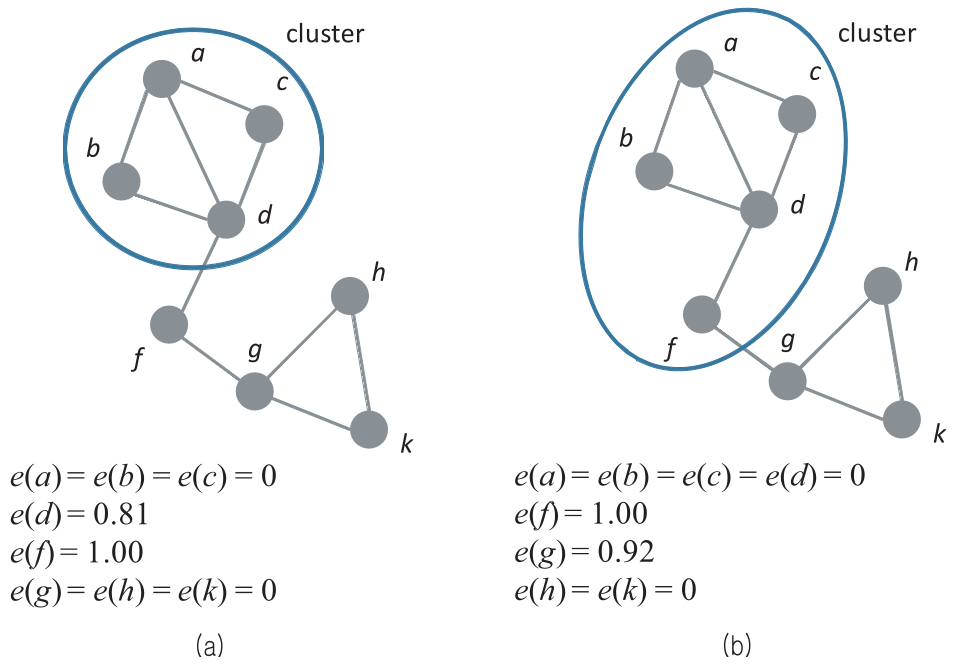 In the figure above, adding vertex 'f' increases entropy from 1.81 to 1.92, indicating that 'f' should remain outside the cluster to maintain structural stability.
Experiments & Results
The authors tested the framework on biological (Yeast) and massive social datasets (YouTube, AS links, MySpace).
Performance in Biological Networks
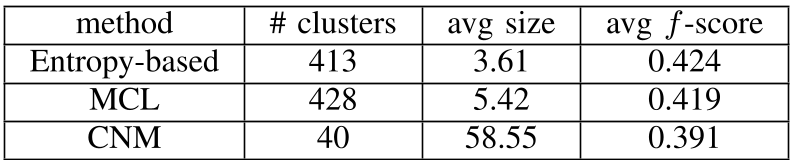
Using the f-score against MIPS ground truth, the Entropy-based approach reached a peak of 0.424. A critical finding was the Ablation Study on seed selection: using Degree-based seed selection (prioritizing hubs) consistently yielded the best balance between cluster size and accuracy.
Scalability via Parallelization
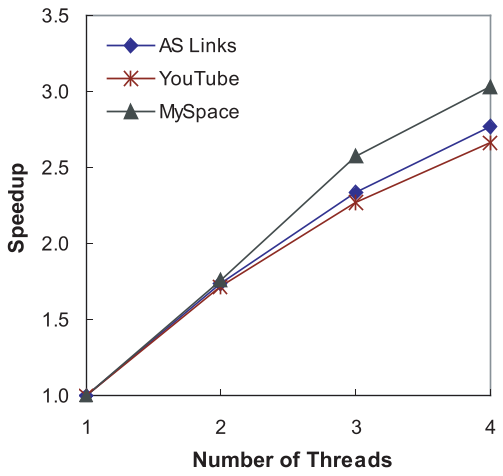
For social networks like YouTube ( nodes), the researchers implemented a multithreaded version. By isolating the seed selection into a "critical section" to avoid duplicate clusters, they achieved significant speedups.
- Efficiency Note: While the method is lightning-fast on sparse graphs (YouTube), it slows down on extremely dense graphs (MySpace) due to the overhead of calculating the entropy for a massive number of boundary candidates.
Deep Insight: Why It Works
The "magic" of this approach is its Inductive Bias toward hub-oriented structures. In scale-free networks, most information flow goes through a few nodes. By starting at these hubs and minimizing entropy, the algorithm effectively "captures" the community before it dissipates into the sparse periphery. It handles Overlapping Clusters more gracefully than MCL because it doesn't force a global partition; it allows nodes to remain in multiple "stable" local states.
Conclusion & Future Outlook
This paper proves that information theory provides a rigorous and efficient lens for community detection. While its performance on extremely dense graphs leaves room for optimization, its success on massive sparse datasets makes it a prime candidate for modern web-scale analysis. Future work could integrate edge weights or temporal dynamics into the entropy calculation to track how communities evolve over time.