
Entropy Production: A New Physics-Inspired Lens for Social Network Dynamics
Entropy Production in Stationary Social Networks
This paper introduces "Entropy Production" from statistical physics as a novel metric to characterize directed information flow in stationary social networks. By applying Bayesian inference to a small-world network model, the authors provide a robust estimator for measuring the directionality and balance of communication in systems like mailing lists.
TL;DR
When social networks stop growing, they enter a "stationary state," but their internal dynamics remain far from quiet. This paper adopts the concept of Entropy Production from statistical physics to measure whether communication is a balanced conversation or a directed one-way flow. Using Bayesian inference, the authors provide a mathematical framework to resolve the "zero-count" problem in sparse data, proving its utility on a 15-year archive of the R-mailing list.
Beyond Topology: The Need for Dynamical Metrics
As social platforms mature, they reach a plateau where the number of users remains relatively constant. At this stage, looking at the "growth" of the graph is no longer informative. Instead, we must look at the Probability Currents—the flow of messages between individuals.
The authors identify a fundamental distinction:
- Locally Balanced Dynamics: Every message from to is met with a reply. The system is in "equilibrium."
- Directed Flows: Messages move in cycles or one-way paths (e.g., ). This is a "nonequilibrium stationary state" (NESS).
Current metrics like "degree" or "clustering coefficients" describe the skeleton of the network but fail to capture the blood flow (directionality and balance) of the information exchange.
The Method: Physics Meets Bayesian Inference
1. Defining Link Entropy
The core insight is that each message sent from node to increases the system's entropy by: Where represents the underlying rate of communication. If , the entropy production is zero, signaling a perfectly balanced interaction.
2. The Bayesian Solution to the "Zero-Count" Problem
In real-world data, we only see counts (), not rates. If a user receives a message but never replies (), a naive calculation of would diverge to infinity.
The authors solve this by assuming the rates follow an Inverse Gamma Distribution (consistent with the power-law nature of small-world networks). By calculating the expectation value through a posterior distribution, they derive a stable estimator using modified Bessel functions.
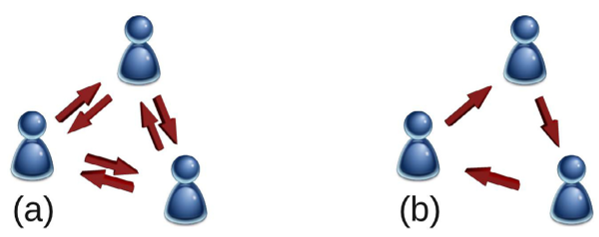 Figure 1: Conceptual difference between (a) random balanced communication and (b) directed clockwise flow.
Experimental Insights: The R-Mailing List
The authors tested their framework on 15 years of R-mailing list data.
Key Findings:
- Entropy vs. Message Volume: Entropy production is not a simple linear function of message count. The "Node Entropy Production per message" () reveals who is a "balancer" versus who is a "broadcaster."
- Centrality Correlation: There is a strong correlation between entropy production and Betweenness Centrality. Nodes that sit on the shortest paths of information flow are also the primary drivers of entropy (nonequilibrium) in the network.
- The "Broadcaster" Signature: Nodes with a high volume of outgoing messages tend to produce less entropy per message, suggesting a more efficient or systemic one-way dissemination of information.
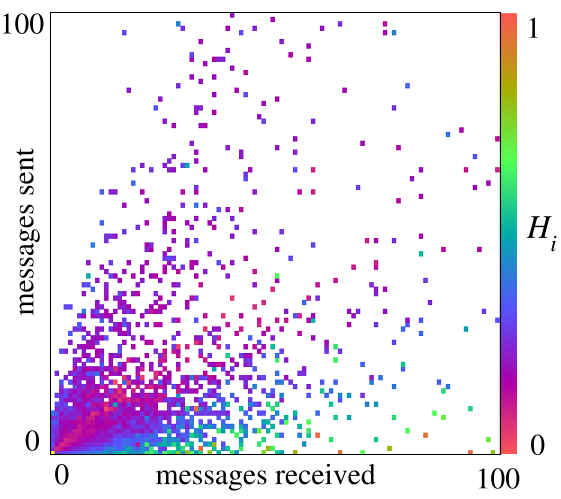 Figure 2: Heatmap showing entropy production relative to incoming vs. outgoing message counts. Note the minimal entropy along the diagonal where communication is balanced.
Critical Analysis & Future Outlook
Takeaway
This work translates a deep thermodynamic principle into a practical tool for data science. It allows us to move beyond "who is connected to whom" and start asking "how is the information unbalanced."
Limitations
- Independence Assumption: The model assumes messages are independent events (like a Geiger counter). In reality, social interactions are highly correlated (chains of replies), which might require a more complex Markovian model.
- Stationarity: While suitable for matured networks, it may not apply to viral spikes or rapidly evolving "breaking news" events on platforms like X (formerly Twitter).
Future Work
The authors suggest this could be applied to Anomaly Detection. A sudden surge in entropy production on a specific link might signal a bot attack or a breakdown in community coordination, providing a "early warning system" for network health.