
From Physics to Facebook: Characterizing Social Flows via Entropy Production
On the computation of entropy production in stationary social networks
This paper introduces "Entropy Production" as a novel metric for characterizing stationary social networks, drawing from statistical physics. It measures the directionality of communication flow to distinguish between balanced interactions and directed information currents, validated through Forest Fire models and the R mailing list archive.
TL;DR
Social networks eventually reach a stationary "matured" state where their size plateaus. However, the dynamics within that plateau can range from balanced echoes to unidirectional flows. This paper adapts the concept of Entropy Production from statistical physics to quantify this "directionality" of communication, providing a computationally efficient alternative to heavyweight metrics like Betweenness Centrality.
Background: The Hidden Pulse of Stationary Networks
Most social network research focuses on how networks grow. But what happens when they stop growing? In a statistically stationary state, the topology is fixed, but messages are still flying.
The authors identify a gap: current metrics like PageRank or Clustering Coefficients describe where a node is, but not the asymmetry of its interactions. A user who only sends messages is fundamentally different from one who only receives, even if their total activity (degree) is the same. Thus, they introduce the "physical" concept of irreversibility into social science.
Methodology: The Thermodynamics of a Message
In statistical physics, entropy production measures how far a system is from thermal equilibrium. A system in "detailed balance" (where every process is countered by its reverse) produces no entropy.
In a social network, if individual and reply to each other equally, the link is "balanced." If the flow is one-sided, it produces "social entropy."
The Core Formula
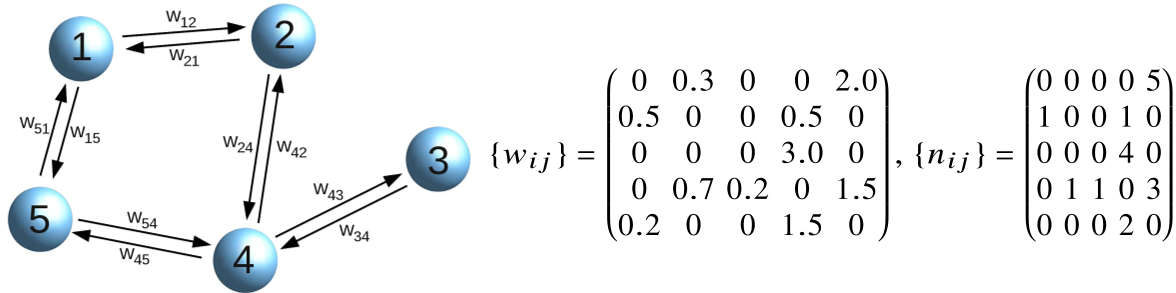
The entropy generated by a directed link is defined as: where is the message count and is the underlying probability rate.
The Bayesian Fix
A major technical contribution is the move from Naïve Estimators to Bayesian Inference.
- The Problem: If a user sends 10 messages and receives 0, the log-ratio diverges to infinity.
- The Solution: By using an Inverse Gamma prior (reflective of the power-law nature of social networks), the authors "regularize" the rates. Even with zero messages observed, the Bayesian posterior provides a small, non-zero rate estimate, keeping the metric stable and informative.
Experimental Insights
The authors tested their metric against the Forest Fire Model (which simulates realistic network densification) and the R Mailing List Archive (15 years of real data).
1. The Centrality Correlation
The most striking finding is the relationship between Entropy Production and Betweenness Centrality.
- The Insight: Nodes that act as "bridges" between communities or "hubs" for information flow generate high entropy.
- The Value: Betweenness Centrality is notoriously expensive to calculate for large graphs (). Entropy Production mimics its results with complexity—a massive win for real-time monitoring.
2. Real-World Case: The R Mailing List
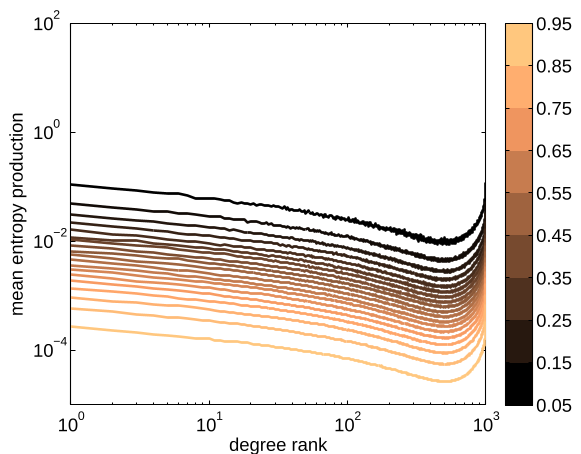
Analyzing 23,462 users, the authors found that entropy production varies over five orders of magnitude.
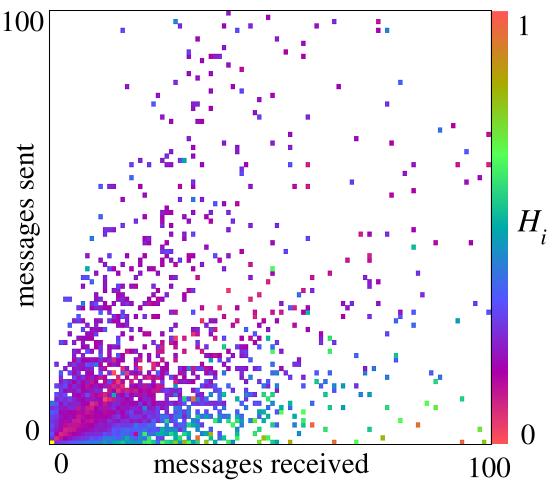
- Nodes that predominantly send or receive messages show distinct entropy profiles.
- The correlation with PageRank (0.94) and Betweenness (0.98) suggests that "heat" in the form of entropy production is a near-perfect proxy for "importance" in mailing list dynamics.
Critical Analysis & Future Outlook
While the bridge between physics and social dynamics is elegant, the paper assumes a stationary state. Real social networks are rarely perfectly stationary; they evolve in bursts. Furthermore, the model treats every message as an independent "click of a Geiger counter," ignoring the semantic context (an "OK" vs. a 1000-word tutorial).
Future Directions:
- Anomaly Detection: Can sudden spikes in entropy production signal a botnet attack or a coordinate "cancel culture" event?
- Semantic Entropy: Integrating NLP to weight entropy by the "information content" of the messages themselves.
Conclusion
Entropy production isn't just a physical curiosity. It is a robust, computationally lean metric that captures the "irreversibility" of human communication, identifying the true movers and shakers in a network without the computational burden of traditional graph theory.