
EARIL: Solving the "Static Model" Trap in Indoor RSSI Localization
Environmental-Adaptive RSSI-Based Indoor Localization
The paper introduces EARIL (Environmental-Adaptive RSSI-Based Indoor Localization), a novel framework for indoor object tracking. It utilizes real-time updates of signal propagation parameters via reference tags to achieve high-precision localization without the high cost of UWB or the static limitations of standard ZigBee chipsets.
TL;DR
Indoor localization has long been a trade-off between the high cost of Ultra-Wideband (UWB) and the low reliability of Received Signal Strength Index (RSSI). This paper introduces EARIL, a system that makes low-cost ZigBee-based tracking reliable by treating signal attenuation as a dynamic variable rather than a constant. By using reference nodes to "re-calibrate" the environment every 0.1 seconds, it beats commercial chipsets in both accuracy and speed.
The Problem: The Chaos of Indoor Radio
Why is GPS useless indoors? Beyond the lack of satellite visibility, indoor environments are chaotic. Radio signals bounce off metallic desks, penetrate drywall, and fade as people move.
The standard mathematical model for RSSI is simple: Where is the attenuation parameter. Traditional systems assume is a fixed number (usually between 2 and 4). The fatal flaw? changes constantly based on the environment. If you use a static in a dynamic room, your distance estimation fails immediately.
Methodology: The Power of Online Adaptation
The core insight of the Environmental-Adaptive RSSI-Based Indoor Localization (EARIL) is to stop guessing what is and start measuring it in real-time.
1. LFRN (Localization using Fixed Reference Nodes)
In this setup, reference nodes don't just listen to the target tag; they listen to each other. Since the distance between reference nodes is known and fixed, they can solve for the real-time attenuation parameter and the current transmission power .
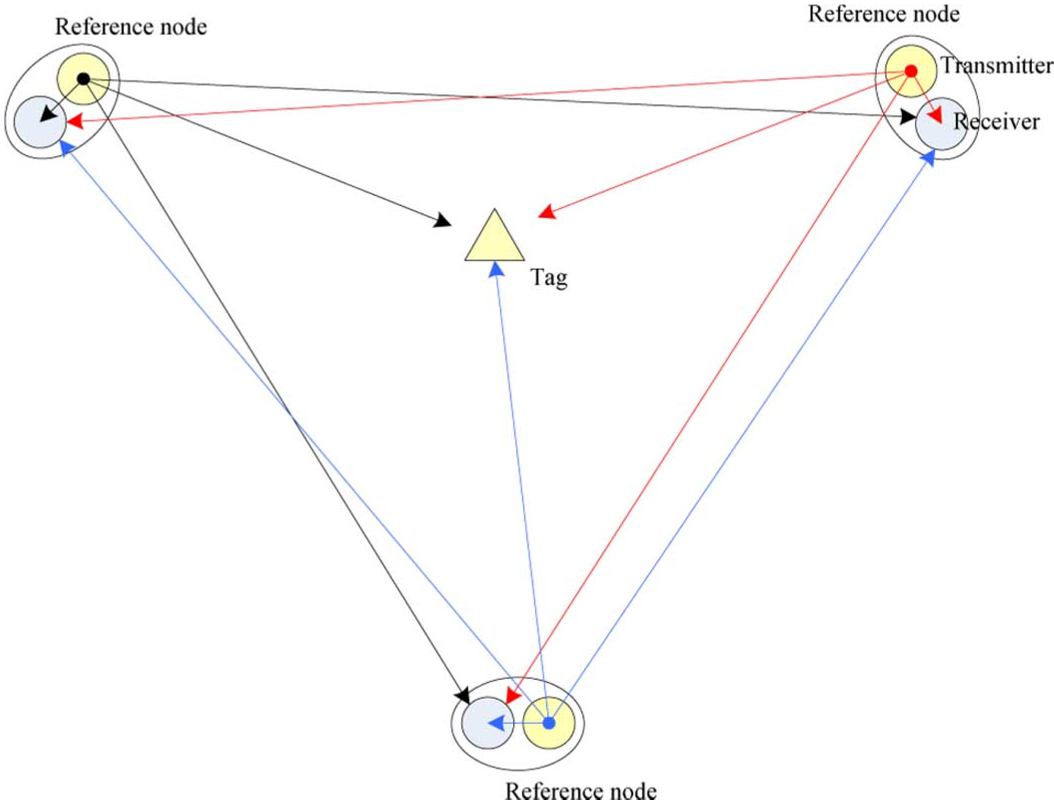
2. LMRN (Localization using Mobile Reference Nodes)
For robotics, the authors propose an even more efficient method. A mobile robot (with known coordinates from other sensors) acts as a moving reference. As it moves, it continuously samples the RSSI from fixed beacons, allowing the system to build a "live map" of signal decay for the entire room, which is then used to locate stationary tags or pedestrians.
Experimental Validation: Beating the Industry Standard
The authors compared EARIL against the Chipcon cc2431, a dominant commercial LBS (Location-Based Service) chipset.
- Accuracy: In tests inside an office and near walls, EARIL's LFRN method showed consistently lower error margins than the cc2431 as time progressed.
- Speed: While traditional ZigBee and UWB systems often have sampling latencies of several seconds, EARIL's LMRN variant achieved a sampling rate of 0.1s, making it viable for high-speed robot navigation.
 Table 1: LMRN shows significantly lower MSE (Mean Square Error) in almost all test scenarios compared to the commercial baseline.
Critical Insight: Hardware Simplicity vs. Software Intelligence
The genius of EARIL lies in its Hardware-Agnostic approach. It doesn't require expensive Time-of-Arrival (TOA) sensors or complex synchronization. By using a "closed-loop feedback correction" via extra reference tags, it shifts the burden of accuracy from the physical sensor to the mathematical model.
Limitations: While EARIL is robust against environmental shifts, it still relies on RSSI, which is inherently susceptible to massive metallic interference (which can cause signal "blackouts" that no model can fix). Future iterations would likely need to integrate IMU (Inertial Measurement Unit) data to bridge these gaps.
Conclusion
EARIL proves that for many "Ubiquitous Robotic Space" applications—like factory automation or pedestrian tracking—we don't need more expensive sensors; we just need smarter models that recognize the environment is never static.