
Bi-LSTM meets Climate Change: Deciphering Public Sentiment in Environmental Big Data
An analysis of environmental big data through the establishment of emotional classification system model based on machine learning: focus on multimedia contents for portal applications
2020-03-23
Summary
Problem
Method
Results
Takeaways
Abstract
The paper proposes a specialized emotional classification system for environmental big data, specifically targeting climate change discussions in portal news comments. It benchmarks traditional machine learning (SVM, Naive Bayes) against deep learning architectures (CNN, Bi-LSTM) using a custom-built Korean environmental lexicon. The Bi-LSTM model achieved SOTA performance for this specific domain.
## Executive Summary
**TL;DR**: This study addresses the growing need for governments to monitor public reactions to environmental issues like climate change. By constructing a custom Korean dataset of 11,440 news comments and applying a **Bi-LSTM** architecture, the researchers achieved a remarkable **95.05% accuracy** in sentiment classification, significantly outperforming traditional SVM and Naive Bayes methods.
**Background**: Positioned at the intersection of Environmental Science and NLP, this work transitions sentiment analysis from general "positive/negative" labels to a nuanced **7-emotion classification** (Rage, Terror, Sadness, etc.) specifically tailored for environmental policy feedback.
## The Core Challenge: Why General Models Fail
Environmental discourse is unique. A word like "precipitation" might be neutral in a weather report but "alarming" in a flood-prone region's comment section. Existing training datasets often lack **domain adaptation**, leading to poor performance when applied to climate change.
Furthermore, the authors argue that:
1. **Lexicon-based methods** fail to capture sarcasm and contextual shifts.
2. **Traditional ML (SVM/Naive Bayes)** often ignores word order, which is fatal for the morphologically rich Korean language.
## Methodology: Building a Domain-Specific Brain
The researchers didn't just pick a model; they built a pipeline.
### 1. The Environmental Lexicon
Using **Word2vec** and **Latent Dirichlet Allocation (LDA)**, they extracted keywords from the 2018 Korea Environment Institute (KEI) report and Naver News. This ensured the model understood the "language of climate change."
### 2. Model Architecture
They compared four distinct approaches:
* **Naive Bayes**: Used as a baseline.
* **SVM**: Tested with multiple kernels (Linear, RBF, Sigmoid, Polynomial).
* **CNN**: Utilized for extracting local features and n-gram patterns.
* **Bi-LSTM**: The flagship model designed to look at the sentence both forwards and backwards to grasp long-term dependencies.
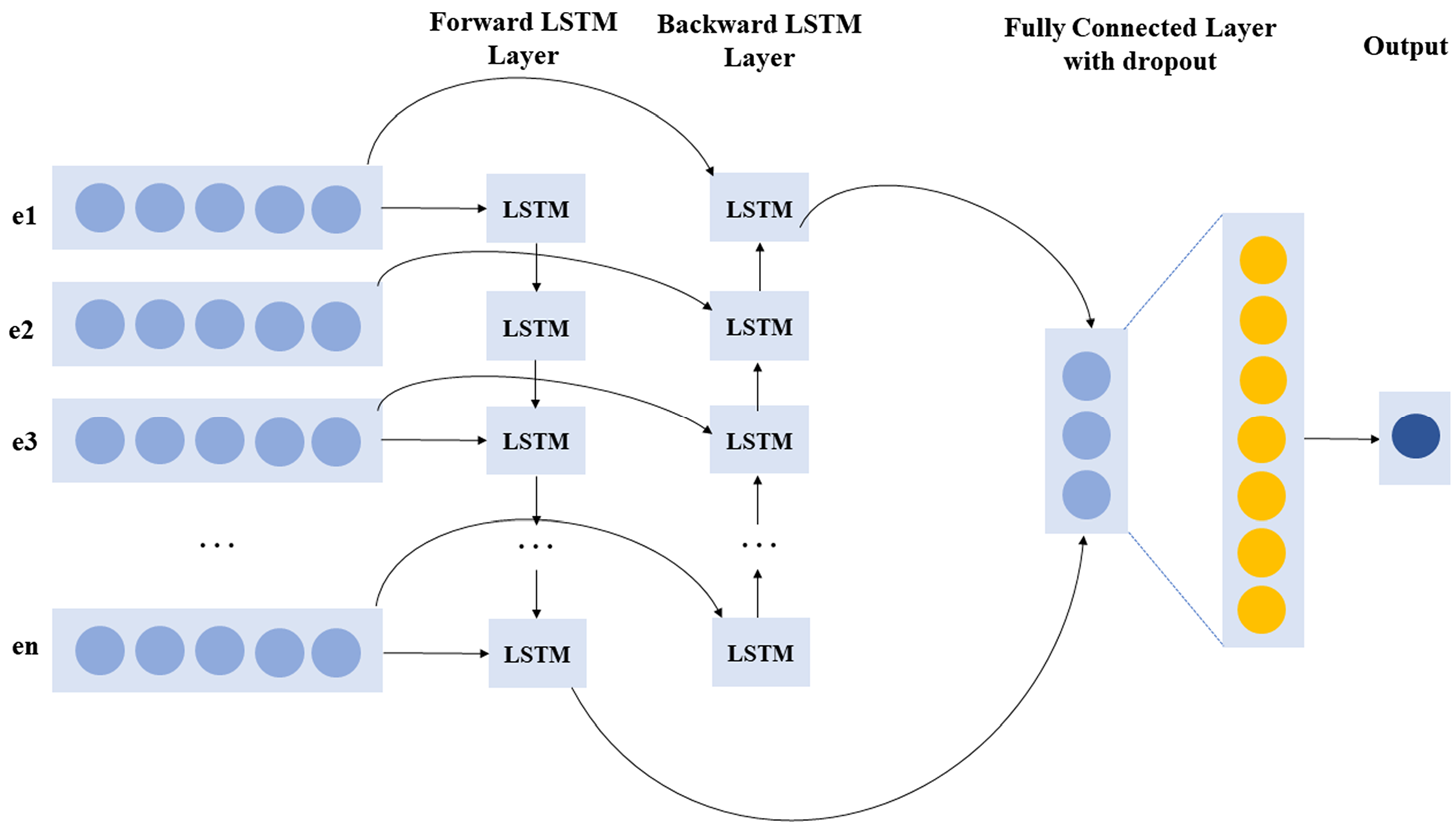
*Experimental Setup: The Bi-LSTM includes an embedding layer, bidirectional hidden layers, and a dropout strategy to prevent overfitting.*
## Empirical Results: Deep Learning Dominance
The results were clear: **Deep Learning is non-negotiable for environmental big data.**
| Model | 7-Sentiment Accuracy | 3-Sentiment Accuracy |
| :--- | :--- | :--- |
| Naive Bayes | 52.67% | 67.83% |
| SVM (Linear) | 80.06% | 89.35% |
| **Bi-LSTM** | **87.20%** | **95.05%** |
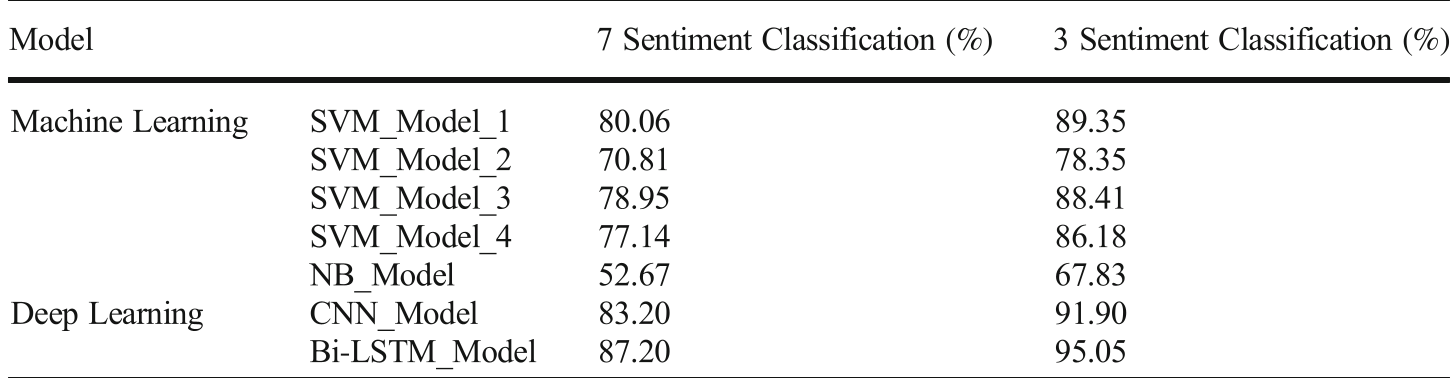
**Key Insight**: The Bi-LSTM's ability to maintain "memory" of previous words (solving the vanishing gradient problem) allowed it to identify complex emotions like "Expectation" or "Respect" within long, unstructured portal comments.
## Critical Analysis & Future Outlook
**Strengths**: The study provides a highly practical framework for government policy evaluation. By moving beyond binary classification to 7 emotional categories, it provides actionable data (e.g., distinguishing between "Terror" regarding a disaster and "Rage" regarding a policy).
**Limitations**: The authors acknowledge that **Bi-LSTM is computationally slower** than CNN. They suggest that **Ensemble models** (combining CNN efficiency with LSTM context) could be the next frontier to optimize both speed and accuracy.
**Conclusion**: This paper serves as a blueprint for specialized sentiment analysis. For researchers and product managers in the ESG (Environmental, Social, and Governance) space, it highlights that **data domain-alignment** is just as important as the choice of neural architecture.