
Beyond the Lab: How Stress Degrades Our Ability to Control Machines via Brain-Computer Interfaces
Influence of the Environmental Hostility Level in an HCI System
This paper investigates the impact of environmental hostility on user performance within a Human-Computer Interaction (HCI) system. The authors developed a binary control application using a portable EEG headset to play a table tennis game via eye-blink detection, achieving statistically significant evidence that hostile environments degrade HCI performance.
TL;DR
Researchers from the University of the Basque Country demonstrate that "hostile" environments—characterized by disturbing noise and negative feedback—significantly impair a user's ability to operate an EEG-based interface. Using an eye-blink-controlled table tennis game, the study proves that even simple HCI tasks become difficult when the user is under environmental pressure, suggesting that future assistive tech must account for the user's emotional and sensory context.
The "Sanitized Lab" Fallacy
Most Human-Computer Interaction (HCI) breakthroughs are born in quiet, controlled laboratories. However, the target users for EEG-based systems—such as the elderly or those with spinal cord injuries—often operate in the real world: a place filled with clattering dishes, traffic noise, and the psychological pressure of daily life. The core motivation of this study is to move beyond "does it work?" to "does it work when the user is stressed?"
Methodology: Gaming with Your Eyelids
The researchers built a custom Java platform and paired it with a Neurosky Mindwave Mobile headset.
1. The Interaction Signal
While many EEG applications try to filter out "muscle noise," this project embraces it. Eye blinks create massive spikes in raw EEG data. By categorizing these spikes into three intensity ranges (Involuntary, Voluntary, and Highly Forced), the system translates a physical blink into a digital command to change the direction of a paddle.
2. Experimental Design
The experiment was a 7-stage gauntlet:
- Calibration: Defining the baseline for a "voluntary" blink.
- Relaxing Rounds: Playing with soothing music.
- Hostile Rounds: Playing while subjected to the sound of breaking glass, car horns, and researchers providing negative verbal feedback (e.g., "You aren't doing well enough").
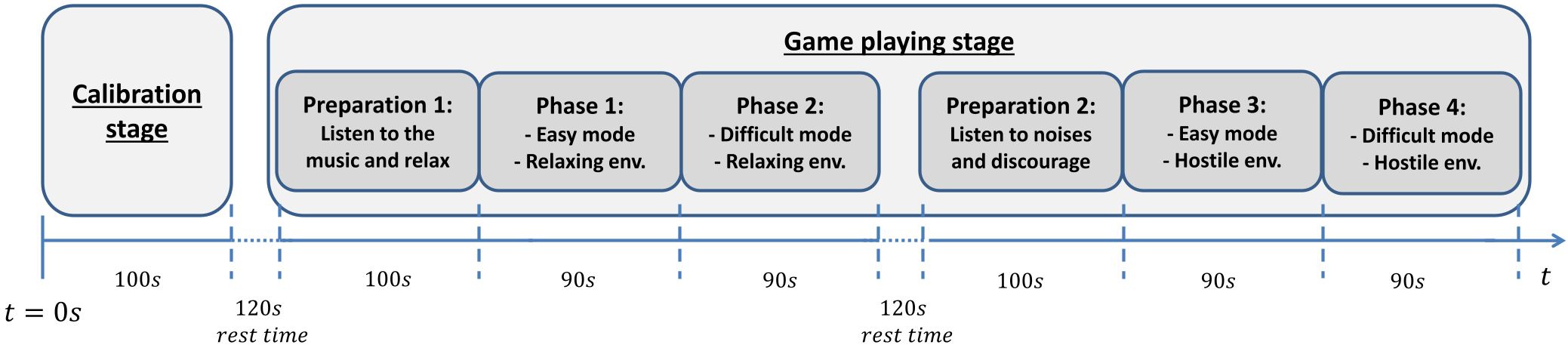 Figure: The structured sequence of the experiment from calibration to hostile phases.
Key Results: Performance Under Fire
The results were clear: environment matters. When the environment shifted from relaxing to hostile, the number of "missed balls" in the game increased across almost all ten participants.
- Easy Mode: Significant performance drop (p=0.0020).
- Difficult Mode: Even sharper drop in success (p=0.0078).
Interestingly, the study tracked the eSense Index (a proprietary Neurosky metric for attention). The data showed that attention peaks at "Goldilocks" difficulty levels—if the game was too easy (Phase 1) or too frustratingly hard (Phase 4), the user's focus wavered.
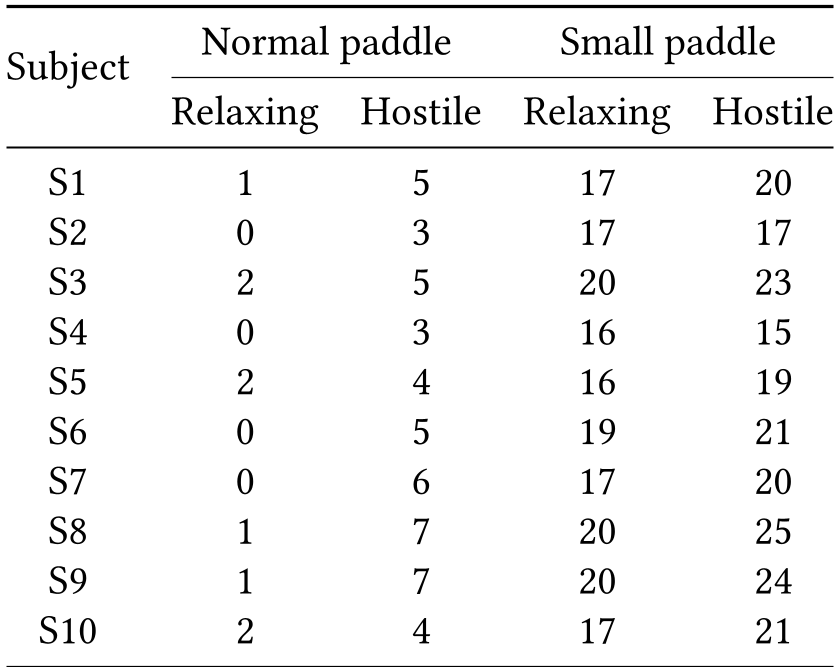 Table 3: Comparative data showing increased failures (missed balls) under hostile conditions for both normal and small paddle sizes.
Academic Insight: The Psychology of the Interface
This paper highlights an often-overlooked Inductive Bias in HCI design: the assumption that the user is a rational, calm actor. The researchers prove that "Environmental Hostility" acts as a cognitive tax. In a hostile setting, the brain's "bandwidth" is partially consumed by processing unpleasant stimuli, leaving fewer cognitive resources for the binary task of controlling the paddle.
Critical Analysis & Conclusion
Takeaway
The success of an HCI system depends 50% on the algorithm and 50% on the user's environment. Systems designed for home care or rehabilitation must be tested in "stress-heavy" scenarios to ensure they remain functional when the stakes are high.
Limitations
The study used a relatively small sample size (10 subjects) and a single-channel headset. While this maximizes portability (a major plus for real-world use), it limits the complexity of the signals that can be captured compared to multi-channel clinical EEG.
Future Work
The next frontier is "Environment-Aware" HCI—systems that can detect when a user is stressed (perhaps via the same EEG markers) and automatically simplify the interface or increase sensitivity to compensate for the drop in user performance.