
The Protocol as a Battlefield: Defending Vulnerable Systems through Attack Interference
An environmental paradigm for defending security protocols
This paper introduces an "Environmental Paradigm" for security protocol analysis, shifting from the traditional single-attacker model to a multi-agent, non-collaborative setting. It proposes using "guardians"—benign agents that mimic attacker behavior—to interfere with malicious exploits, effectively creating a defense mechanism via intentional attack interference.
TL;DR
What if the best way to defend a vulnerable security protocol isn't a complex patch, but a "benign" attack? This paper argues that in a world of multiple, non-collaborating attackers, their moves often interfere. By introducing Guardians—agents that intentionally disrupt malicious attack procedures—we can protect flawed protocols that are too critical to be taken offline immediately.
Background Positioning
In classical Security Protocol Analysis (SPA), we typically assume the Dolev-Yao (DY) model: a single, all-powerful attacker. While mathematically elegant, this doesn't capture the messy reality of the "network environment." This work moves SPA from a static "existence proof" of vulnerabilities toward a dynamic, agent-based "ecology" of security, recruiting tools from AI and robotics to model protocols as interactive environments.
1. The Core Insight: Why Non-Collaboration Matters
Most research assumes multiple attackers will collaborate to be more powerful. However, the authors prove that non-collaborating attackers actually weaken each other.
- The Interference Phenomenon: If two attackers try to exploit the same protocol run, their messages may clash.
- The Defensive Shift: If an attack's success can be disrupted by another agent's activity, we can build a Guardian to do this intentionally.
Instead of proving a protocol is "unbreakable," the authors ask: How can we make a known-vulnerable protocol survive in the wild long enough for us to fix it?
2. Methodology: Modeling Protocols as Environments
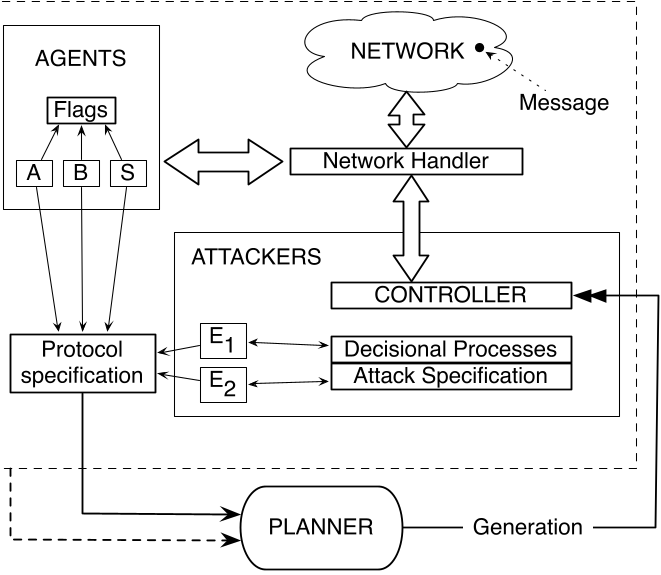
To handle the complexity of multiple agents, the paper introduces a high-level architecture centered on a Network Handler (NetHandler).
The Architecture
Unlike standard models where the network is just an abstraction, this paradigm treats the network as an organizational center.
- Concurrency: Multiple distributed threads representing different agents.
- Visibility Control: A
canSee()function that defines which attacker sees what, allowing for "information denial" between competitors. - Agent Controllers: Instead of hard-coded roles, agents use Finite State Machines (FSMs) to decide their moves contextually.
3. Case Study: Breaking (and Saving) SRA3P
The authors use the Shamir-Rivest-Adleman Three-Pass (SRA3P) protocol as a testbed. SRA3P is vulnerable to an "oracle attack" where an initiator is tricked into decrypting its own message.
Competitive Attack Variants
- Strong Attack: When an attacker knows their competitor, they send "fake" secret data directly to mislead them.
- Subtle Attack: When the competitor is unknown, the attacker injects fake messages under a false identity to pollute the competitor's knowledge.
The Defensive Logic
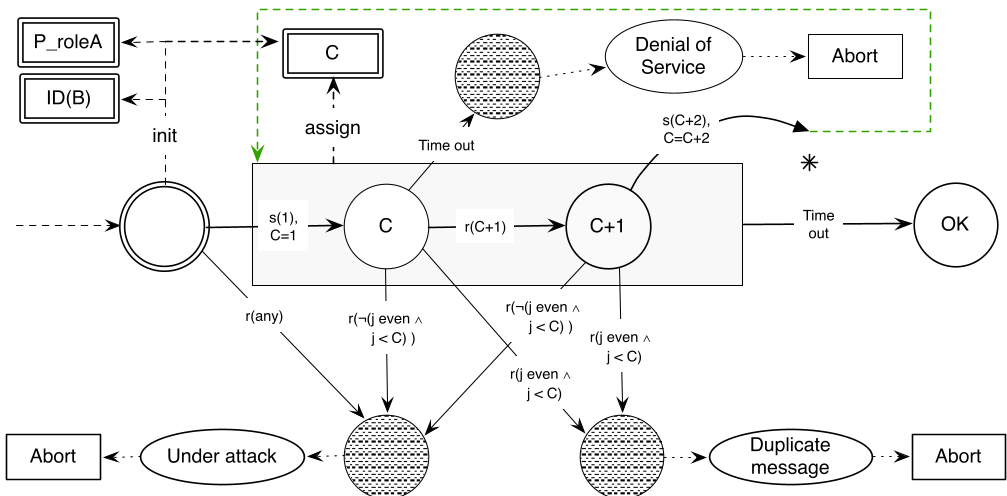
The Guardian exploits these behaviors. For example, if an honest agent (A) receives two responses to a single request (one from a malicious attacker, one from a Guardian), it sees a protocol violation. This duplicate-response flag tells the honest agent: "Stop! You are under attack."
4. The Future: SLAM and Automated Synthesis
The most provocative part of this paper is the proposal for systematic defense construction.
How do we build the perfect Guardian?
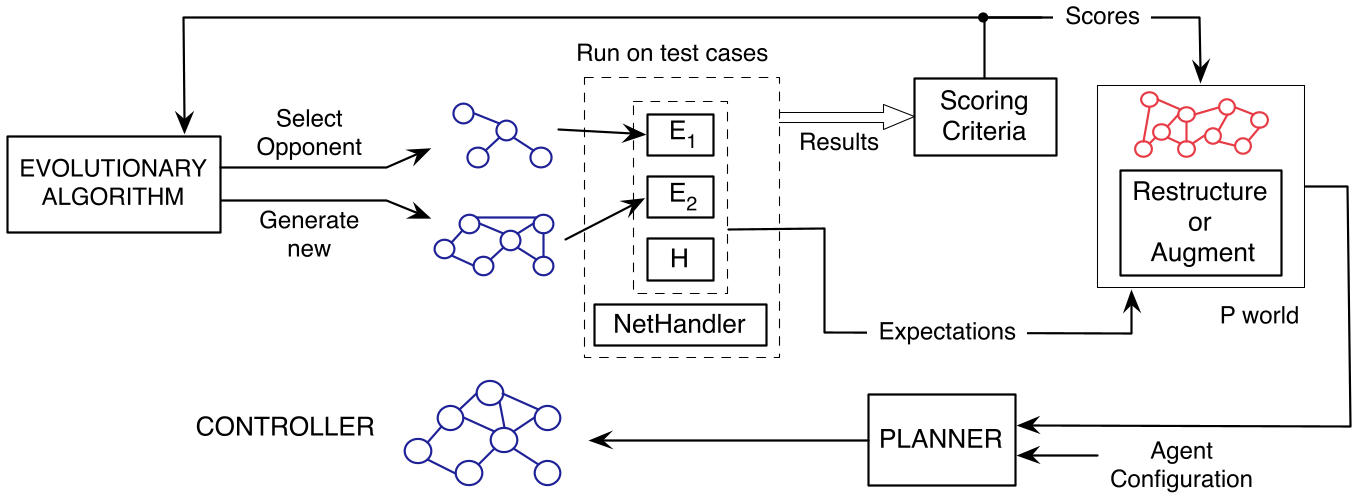
- P-Graph Construction: Map out all possible interaction states under a protocol.
- Evolutionary Search: Use algorithms to discover stable "worldviews" of the protocol.
- Planning: Use AI planning (similar to SLAM in robotics) to find a path through the P-Graph that reaches a "Guardian Success" state—where the malicious attacker fails and the honest agent is alerted.
5. Critical Analysis & Conclusion
Takeaway
This environmental paradigm is a "security transposition" of current trends in robotics: focusing on the relationship between behavior, goals, and environment. It offers a pragmatic tool for securing Industrial Control Systems (ICS) or SCADA systems where "just upgrade the protocol" is not a realistic option.
Limitations
- Overhead: Running a centralized Network Handler and active Guardians adds latency.
- Complexity: Determining the "P-Graph" for complex modern protocols (like TLS 1.3) would be a massive computational challenge.
- The "Armour Race": Malicious attackers could evolve to recognize Guardian activity and adapt their strategies.
Final Thoughts
By shifting from "proving security" to "managing environment," this paper provides a robust framework for dealing with the reality of persistent vulnerabilities. The Guardian isn't a cure, but it is a vital life-support system for the aging protocols that run our modern world.