
Audio Textures: Bridging Computer Vision and Sound Classification with LBP
17574_Environmental Sound Classification Using Local Binary Pattern and Audio Features Collaboration.
This paper introduces a novel framework for Environmental Sound Classification (ESC) by adapting Local Binary Pattern (LBP), a classical image texture descriptor, for 1D audio signals and 2D spectrograms. The proposed collaborative approach combines generalized LBP-1D/LPQ-1D with traditional audio features like MFCC and GFCC, achieving state-of-the-art results for handcrafted methods on the ESC-10 (88.5%) and ESC-50 (64.6%) datasets.
TL;DR
Current Environmental Sound Classification (ESC) is dominated by heavy Convolutional Neural Networks (CNNs). This paper revisits "handcrafted" features with a twist: it adapts Local Binary Patterns (LBP)—a powerhouse in image texture recognition—for audio. By treating sound spectrograms as textures and combining them with 1D signal patterns, the authors achieve CNN-level accuracy (88.5% on ESC-10) with only a fraction of the computational cost, making it ideal for edge AI.
The Problem: Accuracy vs. Efficiency
Identifying sounds like a dog barking or a baby crying is difficult because environmental sounds lack the rigid structure of speech or music. While CNNs are the current SOTA, they have two major "hidden costs":
- Data Hunger: They require massive datasets or extensive data augmentation to avoid overfitting.
- Resource Intensity: Training and even inference on low-end hardware (like IoT devices) is often prohibitively slow.
The authors ask: Can we achieve the pattern-recognition power of a CNN using the mathematical efficiency of classical texture descriptors?
The Methodology: Decoding Sound as Texture
The core innovation lies in Feature Collaboration. Instead of relying on a single descriptor, the model looks at the signal from three distinct perspectives:
1. 2D Spectrogram Texture (LBP, VAR, ELBP)
The paper treats the spectrogram not just as a graph, but as a digital image. It applies:
- LBP (Local Binary Pattern): Captures local micro-textures by comparing a pixel's intensity to its neighbors.
- VAR (Variance): Captures the contrast or "loudness" variation that LBP ignores.
- ELBP (Extended LBP): Adds radial and intensity differences for extra robustness.
2. 1D Temporal Patterns (LBP-1D, LPQ-1D)
The authors generalized LBP for 1D signals. While 2D LBP looks at a circle of pixels, 1D LBP looks at neighbors in time (left and right). This captures "growth," "decay," "minima," and "maxima" patterns directly in the time-domain signal.
3. Classic Audio Descriptors
To ensure no information is lost, they combine these new features with "Industry Standards" like MFCC (human hearing simulation) and GFCC (impulsive sound detection).
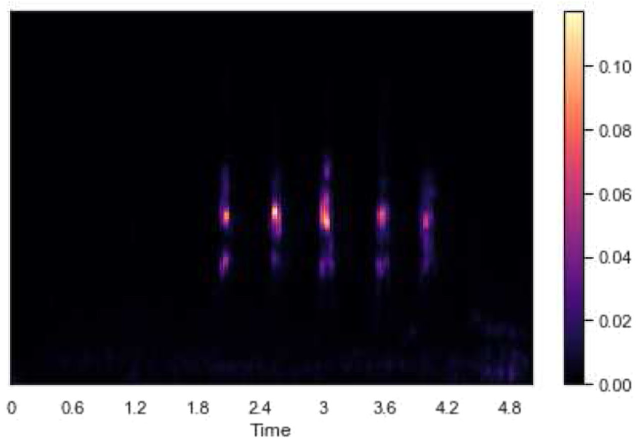 Figure: Visual representation of various features including Spectrogram, LBP, and traditional audio descriptors.
Experiments: How Efficient is it?
The researchers tested their method against the ESC-50 dataset (2,000 sounds, 50 classes).
Key Findings:
- Superiority of LBP: On its own, the LBP feature outperformed MFCC in almost every test.
- Collaboration is Key: Mixing image features with audio features broke the 60% accuracy barrier on ESC-50, proving that "looking" at sound as an image provides info that "hearing" sound as a wave does not.
- Computational Speed: Training an 18-layer CNN on a low-end GPU (NVIDIA 930MX) took 26.6 hours. The LBP-based SVM model took only 20 seconds.
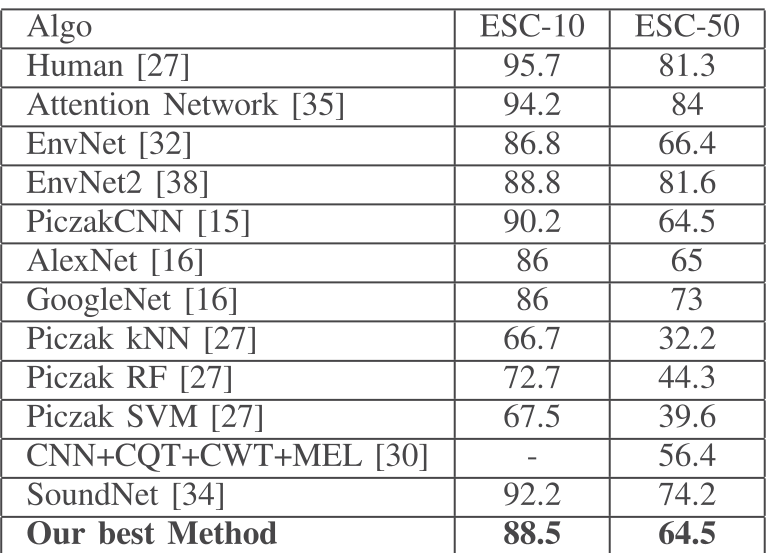 Table: Comparison shows the LBP method (88.5%) rivals deep learning models like AlexNet and PiczakCNN.
Critical Insights & Takeaways
This paper offers a refreshing perspective in an era of "Deep Learning First."
- Inductive Bias Matters: LBP essentially "bakes in" the concept of local invariance, which CNNs have to learn through thousands of examples. This is why LBP excels when data is scarce.
- Domain Adaptation Success: The transition from 2D image processing to 1D signal processing (LBP-1D) is mathematically sound and computationally trivial, yet highly effective.
- Limitations: While LBP is faster, it still requires "handcrafting." It may not scale to millions of classes as easily as a self-supervised transformer, but for specific tasks like "Road Surveillance" or "Home Automation," it is the superior engineering choice.
Conclusion
The study proves that the "Texture" of sound is a powerful feature. For developers working with NVIDIA Jetson Nano or other low-power AI systems, this collaborative LBP approach provides a path to high-performance sound recognition without the need for high-end GPUs or massive datasets.
Senior Editor's Note: This work perfectly illustrates the value of cross-disciplinary research. By importing "old" tools from computer vision into audio, the authors found a shortcut to efficiency that the "deep learning only" crowd often misses.