
IPI Algorithm: Fusing Nonlinear Dynamics and SVMR for Robust Environmental Forecasting
Environmental Time Series Prediction with Missing Data by Machine Learning and Dynamics Recostruction
The paper introduces the Iterated Prediction and Imputation (IPI) algorithm for environmental time series forecasting in the presence of missing data. It combines Nonlinear Dynamics Reconstruction (Grassberger-Procaccia algorithm) for model order estimation with Support Vector Machine Regression (SVMR) for skeleton estimation, achieving a 0.45% average percentage error on Ozone concentration prediction.
TL;DR
Predicting environmental variables like Ozone levels is often hindered by "holes" in the data. This paper presents the Iterated Prediction and Imputation (IPI) algorithm. By combining the physical intuition of Dynamics Reconstruction (how many past states matter?) with the predictive power of Support Vector Machine Regression (SVMR), the researchers achieved a remarkable 0.45% prediction error even with significant missing data.
Problem & Motivation: The "Gap" in Environmental Data
In climate science, time series are rarely perfect. Sensors fail, batteries die, and maintenance happens. Standard practices usually follow two flawed paths:
- Deletion: Removing time steps with missing data. In a time series, this is fatal because it breaks the temporal "thread" or dependency.
- Simple Imputation: Filling gaps with means or linear interpolation, which ignores the complex, nonlinear physics governing the system.
The authors' insight is that an environmental time series is not just random noise; it is generated by an underlying dynamical system. If we can reconstruct that system's "skeleton," we can fill the gaps and predict the future simultaneously.
Methodology: Bridging Physics and Machine Learning
The IPI algorithm operates in an iterative loop, reminiscent of the Expectation-Maximization (EM) algorithm.
1. Model Order Estimation (The Physics)
How many past hours of Ozone data do we need to predict the next hour? This is the Model Order. Using Takens Embedding Theorem, the authors map the time series into a multi-dimensional space. They use the Grassberger-Procaccia algorithm to find the Correlation Dimension ().
- Innovation: To automate the slope detection in the log-log plot (usually done manually), they use a Hough Transform, a computer vision technique, to find the most likely linear fit for the dimension calculation.
2. Skeleton Estimation (The ML)
Once the order is known, Support Vector Machine Regression (SVMR) acts as the "skeleton" (). SVMR is chosen for its robustness against overfitting, thanks to its -insensitive loss function and regularization constant ().
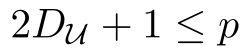 Above: The Takens Embedding inequality used to determine the embedding dimension.
3. The IPI Iterative Loop
- Initialize: Fill gaps with a rough estimate.
- Estimate Order: Calculate via Dynamics Reconstruction.
- Train SVMR: Learn the pattern.
- Impute: Use the SVMR to provide better estimates for the missing values.
- Repeat: Continue until the test error stops decreasing.
Experimental Results
The researchers tested this on the M356 dataset (Hourly Ozone concentrations in Europe). Despite 10% of the training data being missing, the model achieved nearly perfect alignment with the ground truth.
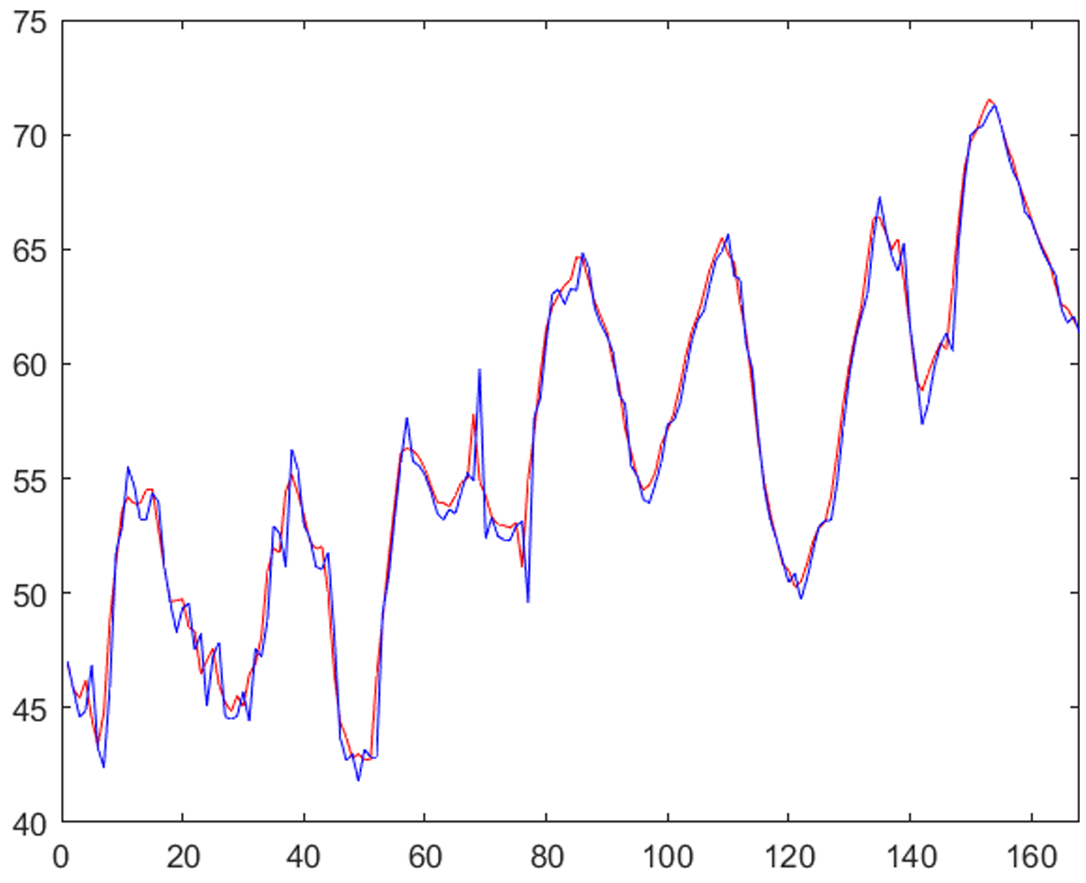 The model (dashed lines) closely tracks the actual Ozone fluctuations (solid lines) over a full week.
Quantitative highlights:
- Average Absolute Error: ~0.375 .
- Average Percentage Error: 0.45%.
- Determinism Check: By randomly permuting the data, the Correlation Dimension jumped from 3.60 to 24.5, proving that the algorithm successfully captured a low-dimensional, deterministic signal rather than just modeling noise.
Critical Insight & Future Outlook
The IPI algorithm's strength lies in its Inductive Bias. By forcing the machine learning model to respect the embedding dimensions suggested by nonlinear dynamics, it avoids the "garbage in, garbage out" trap of standard imputation.
Limitations: The authors note that the algorithm does not strictly guarantee a global minimum, and SVMR could potentially be replaced by more modern probabilistic models like Gaussian Processes to provide uncertainty estimates for the missing data.
The Takeaway? For critical environmental monitoring, don't just "fill the gaps"—reconstruct the dynamics.