
Beyond Global Flooding: The Invariance of Delay in Social-Aware Mobile Networks
Epidemic forwarding in mobile social networks
This paper presents a social-aware epidemic forwarding model for mobile social networks, utilizing mean-field equations to derive expected end-to-end unicast message delays. By incorporating scale-free social graph characteristics and message expiration (timeout) mechanisms, the study provides a robust framework for assessing information dissemination efficiency in human-centric opportunistic networks.
TL;DR
This research investigates how social constraints—willingness to share only with friends—impact message forwarding in mobile environments. Using mean-field equations and scale-free graph theory, the authors demonstrate that while social awareness increases overall delay, it makes the system surprisingly resilient to increases in network size.
Motivation: The Social Filter
Standard epidemic models assume a "hit-and-spread" approach: if two nodes meet, the message transfers. In reality, human interaction is governed by Social Awareness. You might share a photo with a colleague you meet in the hallway, but not with a stranger on the same bus.
When we overlay a social graph (who knows whom) onto a mobility model (who meets whom), the "complete graph" of potential transfers collapses into a Scale-Free Topology. This paper seeks to answer: How does this structural limitation change the speed of information, and what happens when messages have a "shelf-life" (timeout)?
Methodology: Mean-Field Modeling in Scale-Free Graphs
The authors use a power-law degree distribution to represent social ties. They categorize nodes by their degree and track the transition from Ignorants (those without the message) to Spreaders.
The Core Equation
The rate of decrement for ignorants of degree is modeled as: Where is the probability that a friend of a given node is already a spreader.
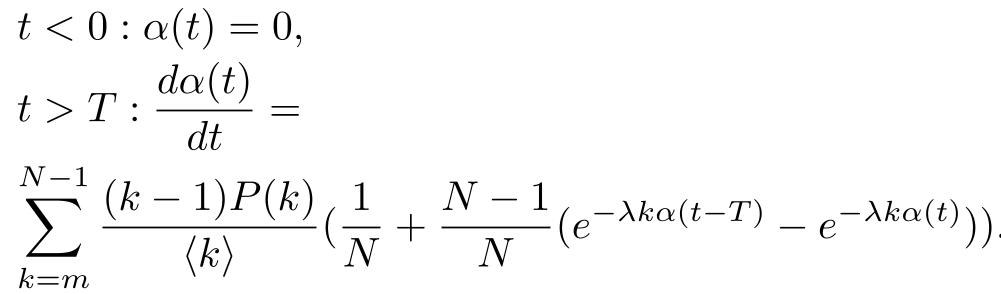 The Delay Differential Equation (DDE) above (Eq 10) describes the system state when message expiration is introduced.
Key Insights and Experimental Results
1. The Stability Paradox
In traditional networks, adding more nodes usually changes the delivery delay (often increasing it logarithmically). However, in social-aware networks, the Expected Delivery Delay remains almost constant regardless of network size .
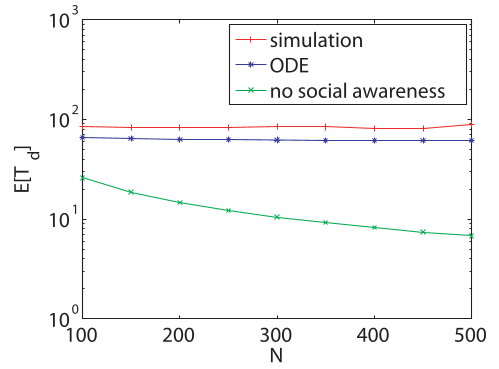 Figure 1: Comparison showing the stability of social-aware delay vs. the scaling of social-blind epidemic forwarding.
Why? Social awareness limits a node's "vision" to its social circle. As the network grows, the number of friends grows very slowly. Message dissemination becomes a local dynamic that is largely indifferent to the massive boost in total system scale.
2. The Impact of Network Skewness ()
The research confirms that the "shape" of your social network matters more than its size.
- Skewness (): Higher values (more people with very few friends) lead to significantly higher delays.
- Minimum Degree (): Increasing the baseline number of friends drastically speeds up delivery.
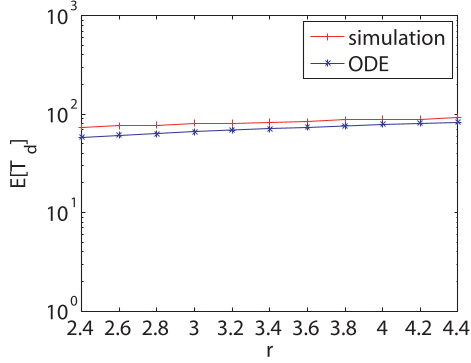 Figure 4: The sharp increase in delay as the social relationship distribution becomes more skewed (higher γ).
3. The Validity Trade-off
Relay nodes cannot store messages forever. By introducing a timeout , the authors found a "sweet spot." If is set slightly above the expected delay of an unlimited-validity system, the delivery ratio stays near 100% while freeing up storage energy much sooner.
Critical Analysis & Conclusion
This work provides a crucial theoretical bridge between Social Network Analysis (SNA) and Mobile Ad Hoc Networks (MANETs).
Takeaway: The most efficient dissemination protocols are those that exploit high-degree "social hubs" and recognize that in human-centric networks, the global population size is less important than the local community structure.
Limitations: The model assumes an exponential distribution for inter-contact times to maintain mathematical tractability. While the authors defend this using some real-world traces, human mobility often follows power-law distributions ("heavy tails"), which might introduce longer-than-predicted delays in extremely sparse environments.
Future Outlook: Applying these mean-field insights to Fragmented Networks where social groups are physically isolated could lead to better "Store-Carry-Forward" strategies in disaster recovery or rural connectivity scenarios.