
EpiSimdemics: Scaling Pandemic Simulations to 100 Million Agents via Biological Intuition
EpiSimdemics: an efficient algorithm for simulating the spread of infectious disease over large realistic social networks
EpiSimdemics is a scalable parallel algorithm designed to simulate infectious disease spread across massive, realistic social contact networks using individual-based models. It utilizes a semantics-aware approach to achieve linear scaling on HPC systems, enabling simulations for populations of up to 100 million individuals.
TL;DR
Simulating how a virus spreads through a city is hard; doing it for a whole nation is an HPC nightmare. EpiSimdemics breaks this barrier. By exploiting the biological fact that viruses have a "latent period," researchers from Virginia Tech developed a parallel algorithm that decouples agent interactions, allowing for linear scaling across hundreds of processors and reaching the milestone of 100 million simulated individuals.
Background: The Limits of "Mean Field" Thinking
Most classic epidemiology relies on differential equations—treating people like particles in a gas that mix uniformly. But humans don't "mix uniformly." We go to specific schools, work in specific offices, and ride specific buses. This is a Social Contact Network.
Individual-based models (IBMs) are the gold standard for accuracy because they simulate every person (agent) and every interaction. However, when you scale an IBM to 100 million people, the "Discrete Event Simulation" (DES) approach usually chokes on synchronization. If Person A moves from Location 1 to Location 2, the simulation usually waits to update everything in order. This serial bottleneck kills performance on supercomputers.
The "Latent Period" Insight: Why We Can Parallelize
The core methodology of EpiSimdemics rests on a brilliant observation of disease semantics:
There is a minimum latent period () between the moment an individual is infected and the moment they become infectious to others.
If we divide our simulation time into "phases" () that are shorter than , we can make a radical move: We can simulate all locations in parallel during that phase without worrying about immediate feedback loops.
If you get infected at 10:00 AM at a coffee shop, you cannot infect someone else at 2:00 PM at the office (because the virus hasn't replicated enough yet). Therefore, what happens at the coffee shop and the office within the same 24-hour window can be computed independently and "merged" at the end of the day.
Methodology: PTTS and Bipartite Graphs
The system represents the world as a labeled bipartite graph , where are people and are locations.
- Within-Host Model: Uses Probabilistic Timed Transition Systems (PTTS). This is a Finite State Machine where transitions aren't just probabilistic, but also depend on "dwell time" (how long you stay sick).
- Between-Host Model: A transmission function calculates infection probability based on duration of exposure and the "infectivity" of others present.
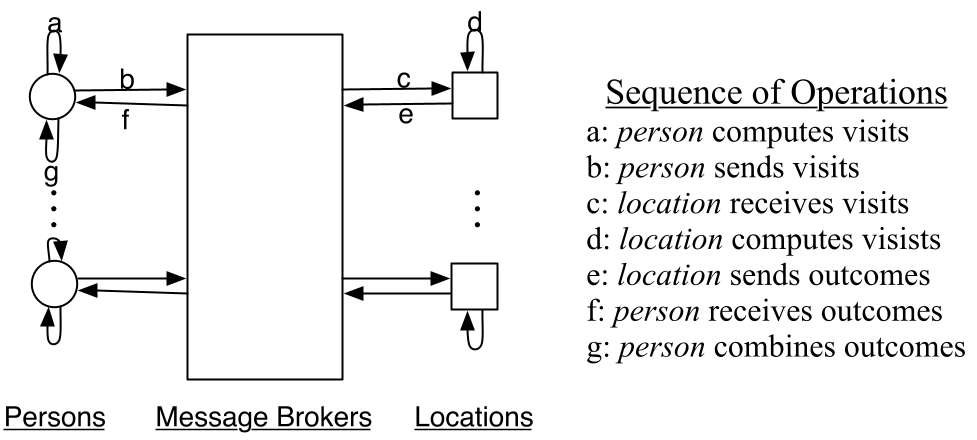 Fig 1: The computational structure showing the decoupling of Person Managers and Location Managers.
Experiments: Breaking the 100 Million Barrier
The authors tested EpiSimdemics on massive datasets, including the states of Alabama and California.
Strong Scaling
On the California network (33 million people), the algorithm showed nearly perfect linear speedup. As more processors (PEs) were added, the execution time dropped proportionally, proving that the overhead of communication was successfully minimized.
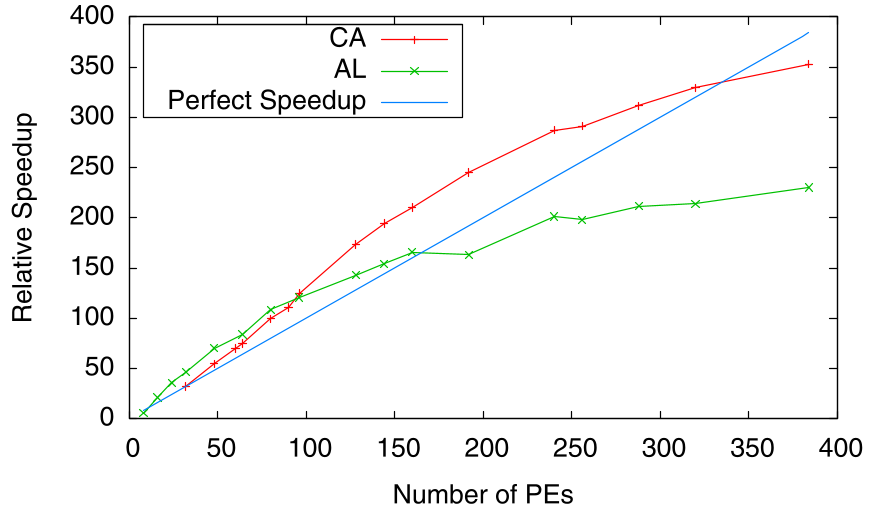 Fig 2: Speedup results showing linear scaling for both small and large state networks.
Weak Scaling (Large-Scale Capability)
In a massive test simulating nearly 100 million people (combined data from NY, CA, FL, IL, MI, NJ), the system maintained efficiency. Even with a 50x increase in population size, the total runtime only increased by a factor of 2.5, thanks to the massive parallelism afforded by the constraint.
Deep Insight: Beyond Just Viruses
EpiSimdemics isn't just for the flu. Because the underlying math is a Networked Discrete Dynamical System (NDDS), it can be used for any "reaction-diffusion" process on a social graph. This includes:
- Diffusion of Norms: How social behaviors or "fads" spread.
- Information Warfare: How misinformation propagates through contact.
- Economic Impacts: Evaluating how closing schools (NPIs) affects the workforce and local economy.
Conclusion
The genius of EpiSimdemics is not just in "throwing more hardware" at the problem. It is in the mathematical abstraction of biological reality. By realizing that disease spread has a "built-in" delay, the researchers unlocked a way to turn a serial, dependent nightmare into a parallel, independent dream. This work remains a cornerstone for how modern governments plan for real-world pandemics.