
Epistemology in the Digital Age: Why We Verify (or Ignore) Fake News on Social Media
Epistemology in the Era of Fake News: An Exploration of Information Verification Behaviors among Social Networking Site Users
This study investigates news verification behaviors on social networking sites (SNSs) in the context of fake news. Leveraging the Epistemology of Testimony and trust theories, the authors proposed a research model and validated it through a survey of 514 active SNS users, achieving SOTA theoretical clarity on how network characteristics and user intentions drive or inhibit information validation.
TL;DR
In an era where "a lie travels halfway around the world while the truth is putting on its shoes," understanding the psychology of the user is more critical than any algorithm. This study explores the drivers of Information Verification Behavior. It reveals that our social network structure—how diverse our friends are and how much we trust them—directly dictates whether we fact-check a story or blindly hit "Share."
The "Why" Behind the Behavior: Epistemic Responsibility
Most research on fake news focuses on the content (is it a deepfake?) or the platform (is the algorithm biased?). This paper pivots to the user's epistemology—the theory of how we know what we know.
The authors argue that when we see a post, we perform a "Social Operation of the Mind." We assess the Authority of the person sharing it and decided whether to seek Independent Corroboration. The pain point is that modern SNS designs often mask these authority cues, wrapping fake stories in the "cloak" of legitimate media, making the user the final gatekeeper of truth.
Methodology: Mapping the Social Mind
The researchers developed a comprehensive research model based on two primary pillars:
- Perceptions of News Sharers: Dealing with Social Tie Variety (how diverse is your circle?) and Cognitive Homogeneity (is it an echo chamber?).
- Perceptions of News Authors: Dealing with Media Credibility and Fake News Awareness.
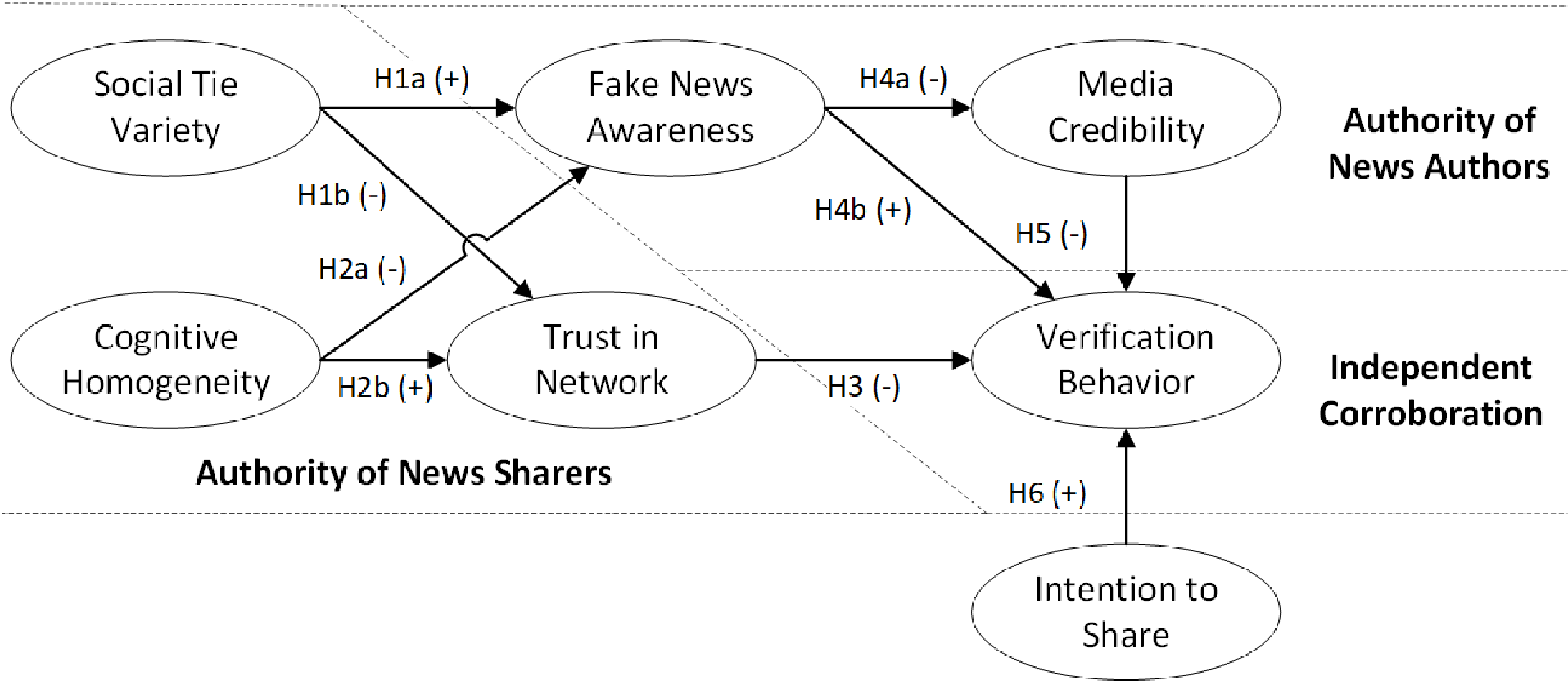
The study utilized a survey of over 500 SNS users, primarily millennials, to test how these factors interact to produce News Verification Behavior (Ver).
The Paradox of Trust: Why Trusted Circles Fact-Check More
The research yielded two counter-intuitive "shocks" to traditional trust theory:
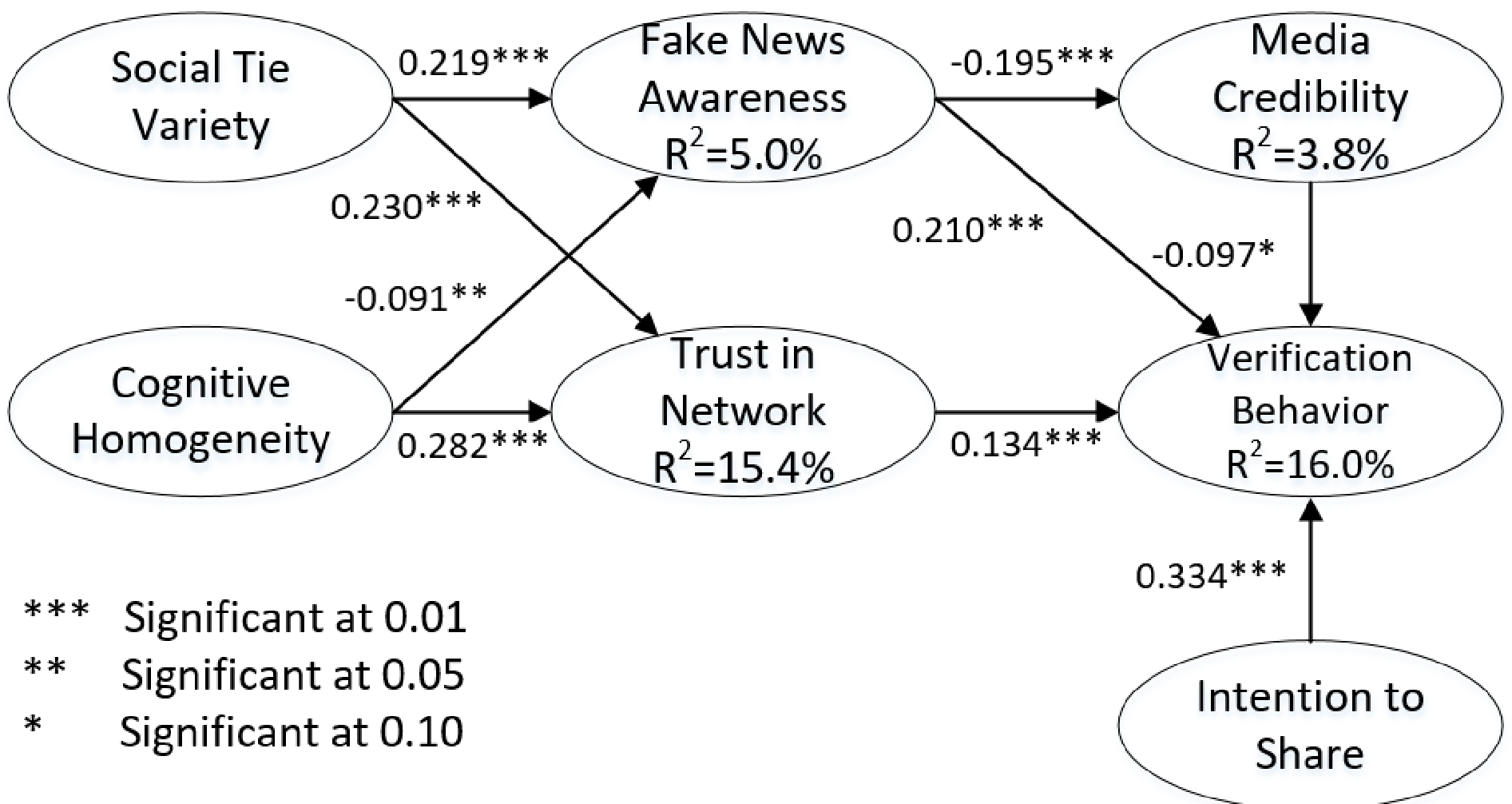
- The Diverse Trust Boost: Usually, we think diverse networks are harder to trust. However, the study found that Social Tie Variety actually increased trust in the network. The authors suggest that in a diverse network, users attribute negative behaviors to external factors rather than individual malice, preserving a higher "baseline" of trust.
- Trust Drives Verification: Theoretically, if you trust someone, you should "relax controls" and fact-check less. The results showed the opposite. Users in high-trust networks verified information more frequently.
The Insight: In a meaningful relationship, the "cost" of sharing a lie is higher. Users verify because they value their reputation among people they trust.
SOTA Comparison & Key Findings
Compared to prior work that viewed verification as a chore for the skeptical, this paper shows it is a proactive management of social identity.
- Intention to Share (β = 0.22): If you plan to post it, you're more likely to check it.
- Fake News Awareness (β = 0.17): Simply being "awake" to the existence of disinformation is a massive catalyst for verification.
- Media Skepticism: Paradoxically, lower media credibility (PMC) leads to higher verification, as users stop trusting the "source" and turn to the "crowd" or alternate searches.
Critical Insight & Future Outlook
The core takeaway is clear: Identity management is the engine of truth.
Limitations: The study relies on a student-heavy sample. In a broader demographic, "Confirmation Bias" might play a much harsher role, potentially overriding the reputation-saving instinct found here.
Future Work: The authors suggest that SNS designers shouldn't just ban bots; they should design for "Ideational Convergence." By creating tools that encourage deeper, more meaningful social ties rather than superficial "conveyance," platforms can naturally incentivize users to become their own fact-checkers.
Conclusion
Fake news isn't just a technical glitch; it's an epistemic crisis. By framing verification as a social behavior rather than just a cognitive task, this research provides a roadmap for building more resilient digital communities.