
CCA-OC: Solving the "Noisy Signal" Puzzle in Emotion Recognition via Channel Coding
Error-correcting output codes for multi-label emotion classification
This paper introduces a robust multi-label emotion classification framework based on Error-Correcting Output Codes (ECOC) using Canonical Correlation Analysis (CCA). By treating emotion recognition as a communication problem over a noisy channel, it utilizes redundant codewords to correct signal noise in EEG and physiological data, achieving superior performance on the DEAP dataset.
TL;DR
Emotion recognition from EEG and physiological signals is notoriously difficult due to signal noise. This paper re-imagines the problem: instead of just classifying signals, it treats emotion labels as a "message" being sent through a "noisy channel" (the human body and sensors). By applying Error-Correcting Output Codes (ECOC) via Canonical Correlation Analysis (CCA), the authors create a redundant "safety net" for labels that allows the system to recover the true emotional state even when the input data is corrupted.
The Motivation: Why Traditional Classifiers Fail
The central nerve system signals are the "gold standard" for emotion because they cannot be faked. However, they are messy. Baseline drifts and measurement errors often bury the emotional "signature" in noise.
Most traditional methods (SVM, LDA) suffer because:
- They assume a clean mapping from features to labels.
- They often ignore the correlation between different emotional dimensions (e.g., how "Arousal" might relate to "Valence").
The authors' key insight: If we treat recognition as reliable communication, we can use redundant information to "correct" the errors caused by noise.
Methodology: The CCA-OC Framework
The core of the method is the Multi-label Output Coding using Canonical Correlation Analysis (CCA-OC). The process is split into two phases:
1. Encoding (Building the Safety Net)
Instead of just training a model to predict the label vector , the authors use CCA to find the maximum correlation between features (EEG/Bio-signals) and labels . This generates canonical output variates.
- The Codeword : The final target isn't just the label; it's a codeword , where is the redundant information.
2. Decoding (Recovering the Truth)
When a new signal arrives, the system predicts the codeword. Because the codeword has redundancy, if the classifier for a single label makes a mistake due to noise, the regression models predicting the canonical variates can "outvote" the error.
 Figure 1: The ECOC framework applied to physiological emotion recognition.
The decoding is formulated as a minimization problem that balances the binary classification probability and the Gaussian distribution of the canonical variates.
Experiments & SOTA Comparison
The researchers tested this on the DEAP dataset (EEG + 6 peripheral signals). They evaluated two scenarios: User-Dependent (personalized) and User-Independent (generalized).
Key Results
- Performance Leap: In User-Independent tests, CCA-OC achieved an average F1-score of 0.76, crushing the previous MT-MKL baseline of 0.58.
- Robustness: Even with fewer training samples, the "redunancy" provided by the CCA variates kept the accuracy stable.
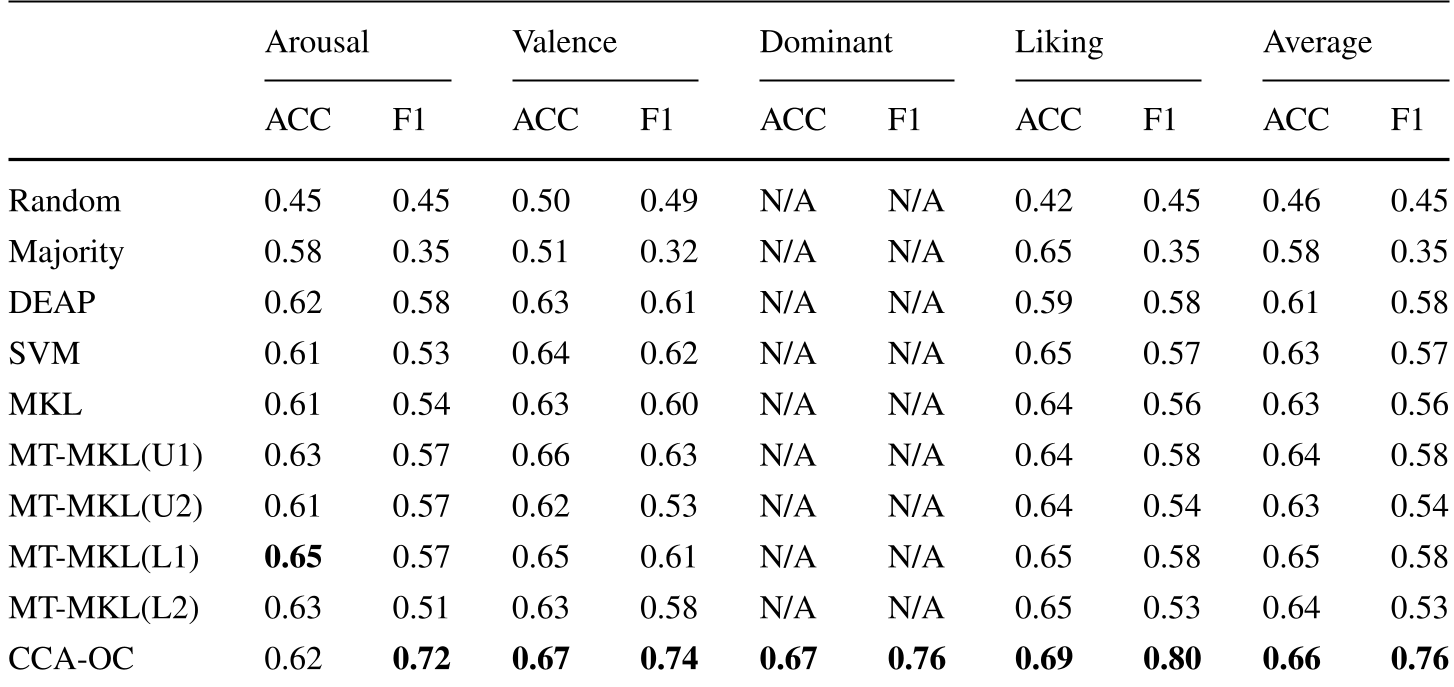 Table: Comparison of CCA-OC vs Baselines. Note the significant 18% improvement in average F1-score.
The "Aha!" Moment
The authors performed an ablation study (encoded in Table 7) comparing the "Classifier-only" vs "Two models" (Combined) approach. The results proved that original labels and redundant canonical information are complementary. Using both is what allows the system to "self-correct."
Critical Analysis & Conclusion
The beauty of this work lies in its cross-disciplinary approach. It moves away from the "black box" machine learning mentality and adopts a "reliable communication" perspective from information theory.
Limitations:
- The study used PCA to reduce features to 50 dimensions before CCA; a deep learning-based feature extractor might preserve more nuances.
- The current decoding relies on a balancing parameter , which requires tuning.
Final Takeaway: This paper proves that in noisy domains like affective computing, the relationship between labels is as important as the relationship between features and labels. By encoding this relationship, we create systems that don't just "guess"—they "correct."