
Why a Little Chaos Helps Us Cooperate: The Paradox of Noise in Evolutionary Games
Errors can increase cooperation in finite populations
This paper investigates how noise (implementation and perception errors) influences cooperation in an evolutionary Prisoner's Dilemma involving finite populations. Using finite automata to represent strategies and incorporating complexity costs, the author demonstrates that low levels of noise can paradoxically stabilize cooperation by making the Win-Stay Lose-Shift (WSLS) strategy evolutionarily robust.
TL;DR
In a world of perfect information, cooperation is surprisingly fragile. New research shows that "noise"—the small errors we make in implementing or perceiving actions—is actually the glue that keeps cooperation stable. By penalizing "naive" cooperators and rewarding sophisticated error-correcting strategies like Win-Stay Lose-Shift (WSLS), a small amount of uncertainty prevents the total collapse of social efficiency.
The Fragility of Perfection
In theoretical biology and economics, the Prisoner's Dilemma is the standard model for social conflict. We know that strategies like Tit-for-Tat (TFT) can sustain cooperation. However, in a "perfect" (noise-free) environment, TFT is vulnerable.
Why? Because of Random Drift. In a population of TFT players, an "Always Cooperate" (AllC) mutant performs exactly the same. Since AllC is simpler (less complex), it can drift into the population. But once the population is full of "naive" AllC players, "Always Defect" (AllD) monsters can invade and wipe everyone out. This creates a never-ending cycle of cooperation and collapse.
The Methodology: Automata and Evolution
The researcher, Huanren Zhang, modeled strategies using Finite Automata—mathematical machines that decide the next move based on the current state and the opponent's last action.
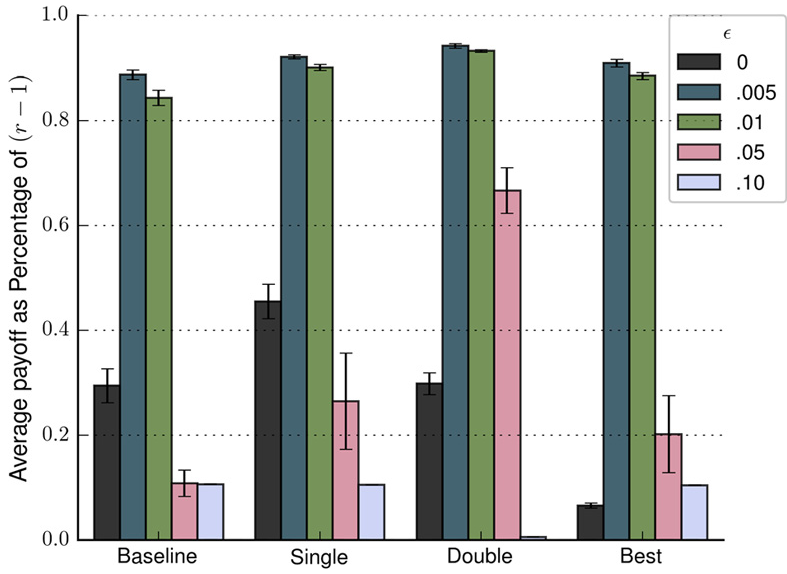 Figure: The 7-bit coding of strategies, showing how states and transitions are represented as genotypes.
The study utilized two main tools:
- Moran Process (Theory): A mathematical model where we track the probability of the population transitioning between homogeneous states (All-TFT, All-WSLS, etc.).
- Computational Simulations: Running 50,000 generations of evolution with mutations to see which phenotypes survive the "Darwinian" struggle.
The Core Insight: Noise as a Filter
The introduction of noise ()—the probability that you accidentally defect when you meant to cooperate—changes everything.
In a noisy world, TFT performs poorly because it gets into "vendetta loops" (you hit me by mistake, I hit you back, you hit me back...). This opens the stage for Win-Stay Lose-Shift (WSLS).
- WSLS Logic: If the last round was "good" for me (C-C or D-D? No, specifically based on payoffs), I stay with my move. If it was "bad," I shift.
- The Benefit: WSLS can correct errors. If a mistake happens, it can "reset" the cooperation. More importantly, WSLS exploits "Always Cooperate" players, preventing them from drifting in and weakening the population defenses against defectors.
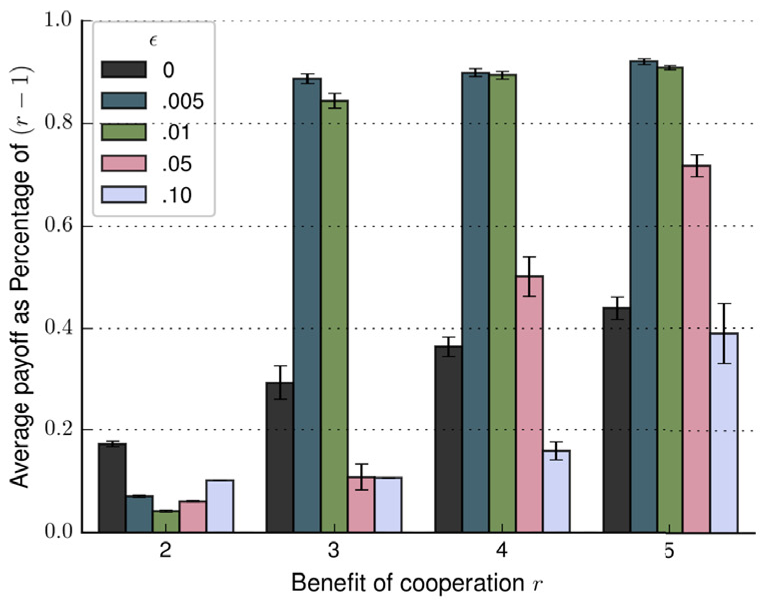 Figure: Average payoff as a function of noise. Note how cooperation (r=3, 4, 5) peaks at low noise levels rather than zero noise.
Key Results
- The "Goldilocks" Zone: Noise is beneficial only when it's low (around 0.5% to 1%) and the benefit of cooperation (r) is high (). Too much noise () destroys everything because players can no longer distinguish between a "mistake" and a "traitor."
- WSLS vs. The World: In noisy environments, WSLS becomes the dominant modal strategy. It acts as an Evolutionarily Stable Strategy (ESS) that protects the population from both naive cooperators and opportunistic defectors.
- TFT's Role: While WSLS keeps the peace, Tit-for-Tat is still the "pioneer." It is usually the strategy that first breaks the reign of "Always Defect" populations, allowing WSLS to then take over and stabilize the system.
Deep Insight: Complexity vs. Survival
The paper adds a layer of realism by imposing Complexity Costs. Simple strategies (1 state) are cheaper to maintain than complex ones (2+ states). In a noise-free world, this cost favors "Always Cooperate," which leads to the eventual invasion by defectors. Noise forces the population to "pay the price" for more complex, 2-state machines like WSLS because the payoff from stable cooperation outweighs the cost of the extra logic bits.
Conclusion & Future Outlook
This work challenges our intuition that "better" information always leads to "better" outcomes. In social systems, a certain level of ambiguity and error is vital. It forces agents to develop forgiveness and discernment, traits that are unnecessary in a perfect world but essential for survival in a real one.
For AI researchers, this suggests that when training multi-agent systems (MAS), injecting a controlled amount of noise into the observation space might actually result in more robust and cooperative agent behaviors than training in a clean, high-fidelity simulation.
Takeaway: In the game of life, perfection is a weakness. The ability to handle errors is what makes a society stable.