
ESD: Optimizing the Energy-Delay Trade-off in Mobile Social Networks
ESD: An Energy Saving Data Delivery Scheme in Mobile Social Networks
The paper proposes ESD (Energy Saving Data Delivery), a scheme designed for Mobile Social Networks (MSNs) that optimizes data delivery using a hotspot-based store-carry-forward mechanism. It leverages a Semi-Markov mobility model to predict destination user locations and transforms the routing task into a Delay-Constrained Least Cost (DCLC) Multicast Problem to minimize energy while maintaining QoS.
TL;DR
The ESD (Energy Saving Data Delivery) scheme addresses the inefficiency of data delivery in Mobile Social Networks (MSNs). By combining a Semi-Markov mobility model for location prediction with a multicast routing approach (solving the DCLC problem), it achieves high delivery ratios and low latency without the typical energy "explosion" associated with multi-copy protocols.
Background & Motivation: The Energy-Delay Dilemma
In Mobile Social Networks, connectivity is intermittent. Most protocols use the store-carry-forward mechanism. However, they usually fall into two extremes:
- Single-copy (e.g., CAOR): Saves energy but suffers from high delay because it misses opportunities to encounter the user at multiple locations.
- Multi-copy Flooding (e.g., Epidemic/Homing Spread): Minimizes delay but drains device batteries by creating redundant copies across the network.
The authors of ESD noticed a critical gap: Human mobility is predictable but time-varying. By quantifying where a user is likely to be at a specific time, we can send exactly the right number of copies to the right "hotspots."
Methodology: Predictive Multicasting
The ESD scheme is structured into three sophisticated phases:
1. The Predict Phase (Finding the "Optimal Set")
Instead of sending data to all hotspots, the source user calculates the optimal destination hotspot set (). Using a Semi-Markov model, it estimates the probability that a destination user will appear in a specific hotspot at time . The goal is to find the smallest set of hotspots that guarantees a delivery probability threshold ().
2. The Routing Phase (Solving M-DCLC)
Once hotspots are selected, how do we get the data there? Sending separate copies to each hotspot is wasteful if paths overlap. ESD treats this as a Multicast Delay-Constrained Least Cost (M-DCLC) problem.
- Logic: Find a Steiner Tree that connects the source to all target hotspots while staying within the time limit.
- Algorithm: They utilize the BSMA (Bounded Shortest Path Multicast Algorithm) to find the most energy-efficient tree.
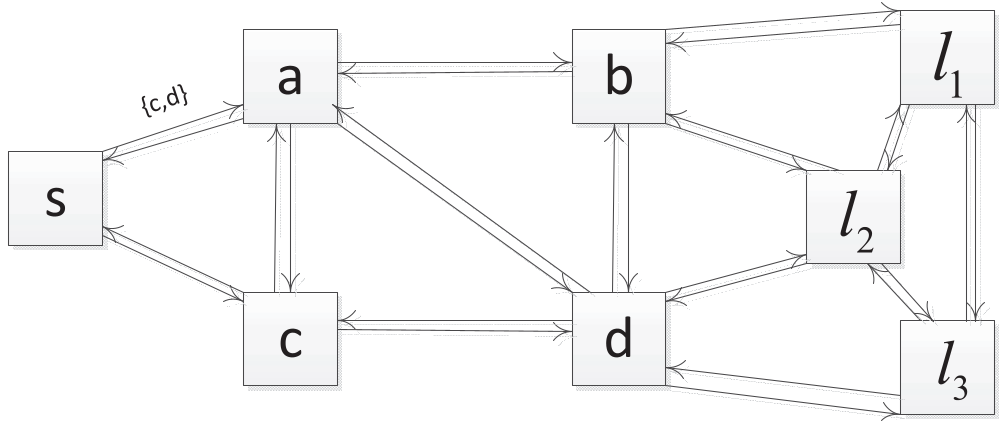 Fig 1. The Network Model where edges represent expected transit times and costs between hotspots.
3. The Retransmit Phase
If the destination isn't met by the deadline, the data is retransmitted from the hotspot throwboxes rather than the source, drastically reducing the "stretched" energy cost of the entire path.
Experimental Validation
The authors compared ESD against CAOR (Single-copy) and Homing Spread (Multi-copy to all hotspots).
Key Findings:
- Energy Efficiency: ESD's energy cost is nearly as low as the single-copy CAOR because the multicast tree eliminates redundant link transmissions.
- Latency: ESD significantly outperforms CAOR, approaching the "ideal" delay of the Epidemic/Homing Spread models.
- Social Tie Impact: As "Community Similarity" increases (users share more common habits/locations), ESD becomes even more efficient, as the predictive model becomes more accurate.
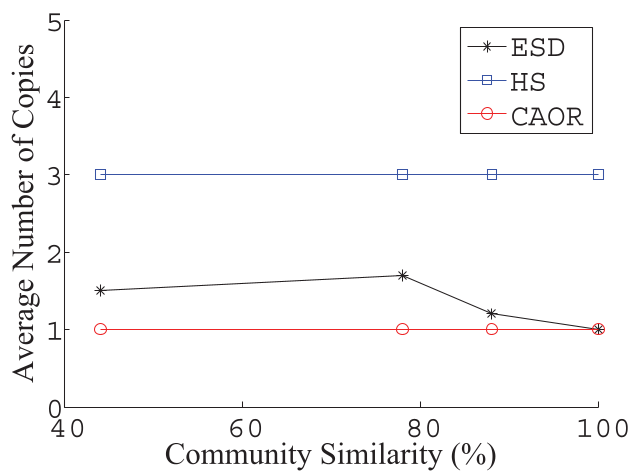 Fig 2. Comparative results showing ESD maintaining low energy cost (a) while delivering significantly lower delay (c) than CAOR.
Critical Insight & Conclusion
The genius of ESD lies in the mathematical formalization of "opportunity." By using Z-transforms to solve the first-passage time in a Semi-Markov process, the authors move MSN routing from "best-effort" heuristics to a rigorous optimization problem.
Limitations: The model assumes users have some knowledge of others' transition matrices (for delivery prediction), which may raise privacy concerns in real-world deployments. Future work would likely need to incorporate "privacy-preserving" trajectory prediction.
Final Takeaway: ESD proves that multi-copy routing doesn't have to be expensive. If you know when and where to branch your data, you can achieve SOTA performance with a fraction of the power.