
E-SmallTalker: Breaking the Ice with Connectionless Bluetooth Discovery
E-SmallTalker: A Distributed Mobile System for Social Networking in Physical Proximity
E-SmallTalker is a distributed mobile social networking system designed to facilitate face-to-face interactions by automatically discovering common interests between strangers in physical proximity. It utilizes a novel Iterative Bloom Filter (IBF) protocol over the Bluetooth Service Discovery Protocol (SDP) to exchange data without requiring intrusive device pairing or internet connectivity.
TL;DR
E-SmallTalker is a pioneer distributed system that helps strangers initiate "small talk" by discovering shared interests via their mobile phones. It bypasses the awkwardness of Bluetooth pairing and the privacy risks of central servers by using a clever Iterative Bloom Filter (IBF) protocol embedded directly within the Bluetooth Service Discovery Protocol (SDP).
The Social Gap and Technical Hurdles
Face-to-face interaction is often hindered by the "social gap"—the hesitation to talk to strangers. While mobile phones could bridge this gap by identifying commonalities (mutual friends, shared hobbies), existing solutions fell into two traps:
- Centralization: Requiring GPS and persistent internet, which compromises privacy and costs data.
- Intrusiveness: Bluetooth traditionally requires "pairing," involving passcodes and manual confirmation—highly awkward for two people standing next to each other at a bus stop.
Methodology: High-Efficiency Probabilistic Exchange
The core innovation lies in the Iterative Bloom Filter (IBF). A standard Bloom filter is a bit-vector used to test set membership. However, if the set of interests is large and the bit-vector is small (limited by Bluetooth protocol constraints), the error rate (false positives) sky-rockets.
1. Hijacking the SDP
Instead of connecting, E-SmallTalker hijacks the Service Discovery Protocol (SDP). Typically used to tell a phone that "I have a printer service," the authors stuffed Bloom filters into the Attribute Value fields. This allows phones to "read" each other's data without ever asking for permission to pair.
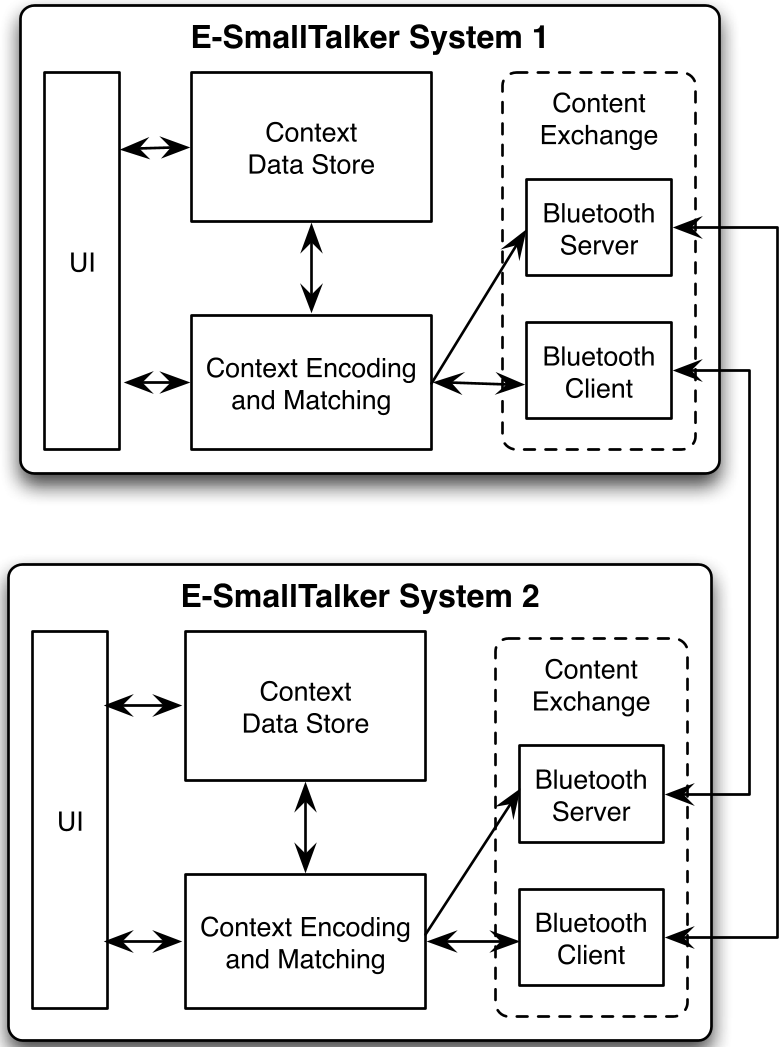
2. The Iterative Refinement
To fight the 128-byte limit of SDP attributes, the system uses multiple rounds:
- Round 1: Exchange a coarse Bloom filter (e.g., 5% false positive rate).
- Round 2: Only the items that "hit" in Round 1 are re-encoded into a second, much tighter filter. This "zoom-in" approach allows the system to achieve surgical precision (0.001% error) while using 75% less space than a standard one-shot filter.
Experimental Performance
The authors tested E-SmallTalker using legacy Nokia and Sony Ericsson devices.
- Discovery Speed: The average discovery time was 20.04 seconds. While perhaps slow for a drive-by, it is perfectly suited for waiting rooms, airports, or conferences.
- Reliability: The system maintained a 90% success rate up to the 10-meter Bluetooth limit.
- Energy Impact: Running the system continuously reduced battery life from 32 hours to 29 hours—a marginal 10% overhead for staying socially "discoverable."

Critical Insight & Future Outlook
E-SmallTalker’s brilliance is its opportunistic use of metadata channels. By treating a discovery protocol as a data transport layer, it solves the "pairing paradox."
Limitations: The primary bottleneck remains the underlying Bluetooth hardware; because devices cannot always "hear" while "shouting" (inquiry collisions), discovery time increases as the crowd gets denser. This suggests that while E-SmallTalker is great for a quiet cafe, it might struggle in a packed stadium without further collision-avoidance logic.
In the era of modern smartphones, these concepts live on in technologies like Apple's AirDrop and NameDrop, which use a similar hybrid of BLE advertising and secure local exchange—validating the authors' early vision of decentralized social proximity.
Takeaway
Meaningful social interaction doesn't require a central "Big Brother" server; it just requires smart, low-power probabilistic data structures that respect user boundaries.