
ESRS: Balancing the Tug-of-War Between Efficiency and Security in Mobile Social Networks
ESRS: An Efficient and Secure Relay Selection Algorithm for Mobile Social Networks
The paper introduces ESRS (Efficient and Secure Relay Selection), a novel relay selection algorithm for Mobile Social Networks (MSNs) modeled as a network formation game. It aims to balance transmission latency and information leakage probability, achieving an optimal trade-off between communication efficiency and security.
TL;DR
In the decentralized world of Mobile Social Networks (MSNs), choosing the right "middleman" (relay) is a choice between speed and secrecy. ESRS (Efficient and Secure Relay Selection) solves this by treating the network as a competitive game. By mathematically balancing the benefit of a fast encounter with the risk of an information leak, it achieves a "Pairwise Stable" network where no user has an incentive to defect, resulting in faster, safer data delivery.
Background: The Social Dilemma of MSNs
Mobile Social Networks rely on opportunistic encounters—people passing each other in the street—to move data. While previous research has mastered "efficiency" (using social metrics like encounter frequency), they often ignore a scary reality: Information Leakage. Even with encryption, the mere act of a non-intended user handling your data increases the attack surface.
The core challenge is a classic trade-off:
- Social-only routing is fast but leaks data like a sieve.
- Security-only routing is safe but painfully slow (high latency).
The Insight: Relay Selection as a Game
The authors propose that relay selection shouldn't be a top-down command but a Network Formation Game. In this model, every node (source, relay, and destination) is a "player" with a payoff function. A relay only joins the path if it gets a "wage" that covers its link maintenance costs, and a source only picks a relay if the social benefit (meeting the destination soon) outweighs the risk (the relay's overhearing probability).
Methodology: The Logic of the ESRS Algorithm
The ESRS algorithm operates in rounds (max hops). In each round:
- The Source () calculates the payoff for potential relays based on the probability of reaching the destination () minus the leakage risk ().
- The Relays decide whether to accept the task based on a wage budget ().
 The Payoff Function: Balancing direct transmission benefits against leakage costs.
Ensuring Stability
A critical contribution of this paper is the proof of Pairwise Stability. In simple terms, this means that once the ESRS algorithm forms a path, no two users can change their connection to get a better deal for both. This prevents the network from constantly "re-shuffling" and ensures reliable routing.
Experimental Results: The Best of Both Worlds
The authors tested ESRS against three baselines: Rand (Random), Relation (Social-heavy), and Leakage (Security-heavy).
1. Synthetic Trace Analysis
Using a Power Law distribution to model human behavior, the results showed that ESRS comfortably sits in the "sweet spot." It avoids the massive latency found in Leakage-only methods and the high risk found in Relation-only methods.
2. Real-World Trace Analysis
Using data from the University of St Andrews, the study found that as the environmental threat level changes (modeled by the exponent ), ESRS adapts. When nodes are generally trustworthy, it behaves more like a social-efficiency algorithm. When nodes are risky, it tightens the selection criteria.
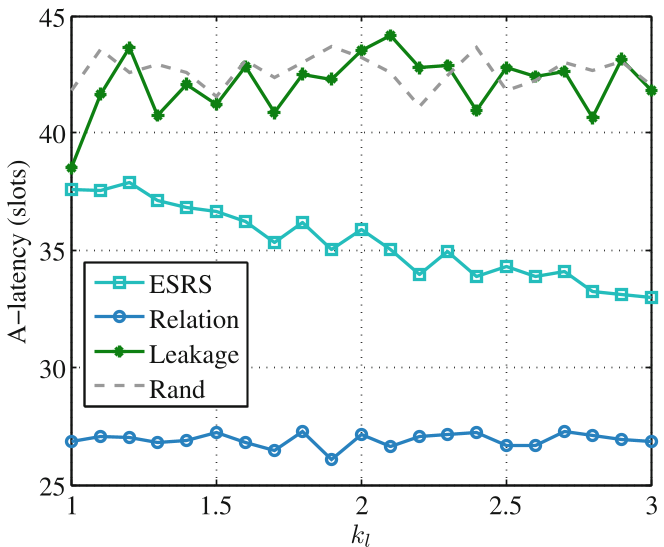 Comparison of Average Latency (A-Latency) and Average Maximum Leakage Probability (A-MLP).
Critical Insight & Conclusion
The brilliance of ESRS lies in its Inductive Bias toward stability through Game Theory. By quantifying "security" as a cost in a payoff function, the authors move away from binary security (on/off) to a probabilistic model that reflects real-world risk.
Limitations: The model currently assumes a fixed "wage" budget and doesn't fully account for multi-node collusion where groups of malicious nodes coordinate to intercept data.
Future Outlook: Integrating this game-theoretic framework with Incentive Mechanisms (like blockchain-based tokens) could provide the "wages" needed to drive relay participation in real-world deployment.