
Estimating Social Network Properties: The Power of the Random Walk
Estimating Clustering Coefficients and Size of Social Networks via Random Walk
The paper proposes novel random walk-based algorithms to estimate the global/average clustering coefficients and total network size of massive online social networks. By leveraging only the public adjacency list interface and counting "neighbor collisions," the method achieves high accuracy with a small fraction of nodes (as low as 1%), significantly outperforming existing ego-network sampling techniques.
TL;DR
Analyzing "The Billion-User Scale" is the grand challenge of modern graph theory. This paper introduces a highly efficient suite of algorithms to estimate Clustering Coefficients and Network Size using simple Random Walks. By shifting from broad "Ego-network" queries to clever "Neighbor Collision" statistics, the authors achieve SOTA accuracy while sampling only a tiny fraction of the graph.
Problem & Motivation: The "Public Interface" Bottleneck
If you want to analyze Facebook's structure, you can't download the graph. You are restricted to their public API: you can see a user and their list of friends .
Previous methods typically used Ego-network augmentation. This meant for every sampled user, you had to fetch the friend lists of all their friends to check for triangles. For a user with 5,000 friends, this is 5,000 API calls for just one sample point! The authors realized this was a massive waste of bandwidth. They asked: Can we estimate global transitivity by looking only at the nodes we naturally visit during a walk?
Methodology: Beyond Ego-Networks
The core innovation lies in the mathematical weighting of a random walk sequence .
1. Clustering via Connectivity Testing
Instead of checking the entire neighborhood, the algorithm tests if and are connected.
- The Intuition: In a random walk, the probability of visiting a triangle is proportional to the local clustering. By appropriately weighting the transition probabilities at each step, they create an unbiased estimator for both Local and Global coefficients.
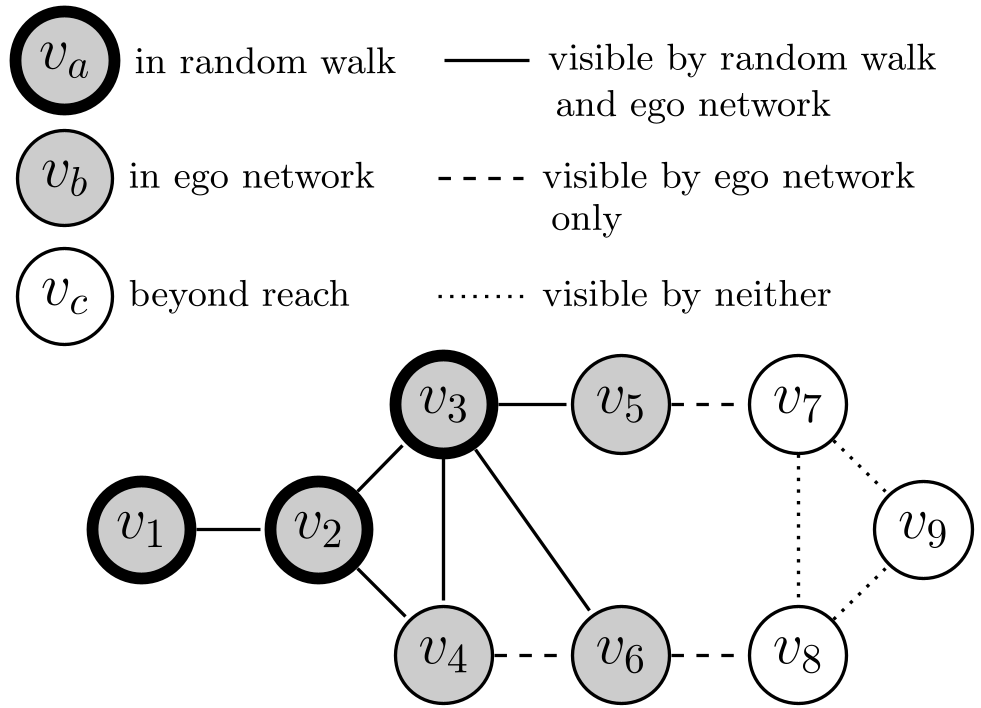 Figure 1: Traditional Ego-networks (right) require exponentially more queries than the simplified Random Walk (left).
2. Network Size via Neighbor Collision
Traditional size estimation relies on the "Birthday Paradox"—how often do we hit the exact same node twice? This paper proposes Neighbor Collision: counting how often two sampled nodes share a common neighbor.
- Why it works: Neighbor collisions occur much more frequently than identical node collisions. This creates a stronger signal with fewer samples, significantly reducing the variance of the size estimate .
Experiments & Results
The authors validated their approach on massive real-world datasets like Orkut (3M nodes) and LiveJournal (4.8M nodes).
- Clustering Accuracy: On the Orkut dataset, using just 1% of the nodes, the Random Walk method's confidence intervals were 4 times tighter than previous Metropolis-Hastings methods for average clustering.
- Size Estimation: The neighbor collision method outperformed standard node collision by up to 42.5% in precision on the DBLP dataset.
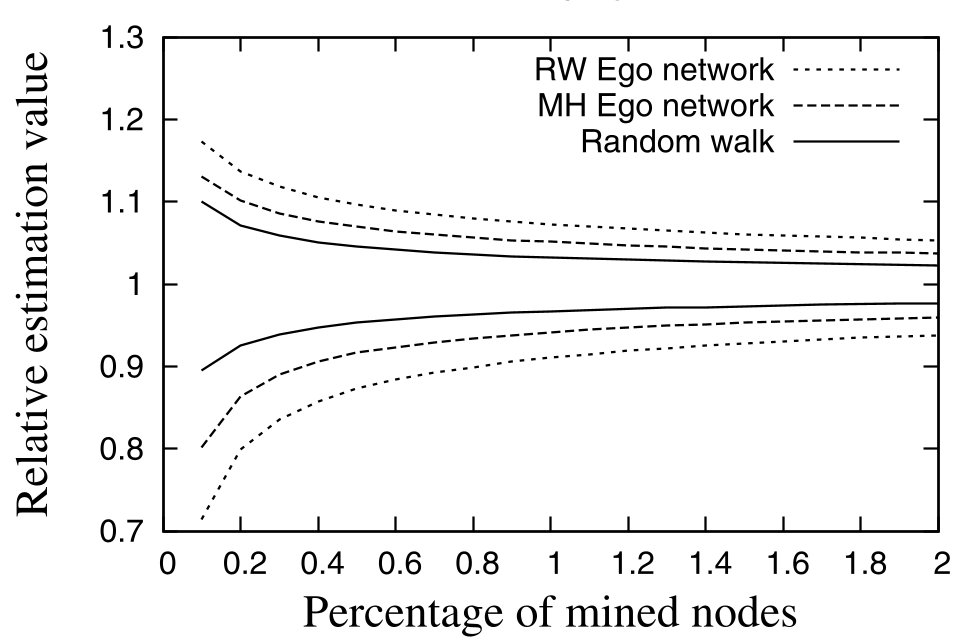 Figure 2: The convergence of the Random Walk estimator (red) is significantly more stable and accurate than Ego-network based methods (blue/green).
Critical Analysis & Conclusion
Takeaway
This work demonstrates that "more data" (fetching the whole neighborhood) isn't always "better data." By focusing on the stationary distribution of the random walk and using neighbor collisions, we can infer global properties of a billion-node system from a few thousand local steps.
Limitations
- Mixing Time: The efficiency is highly dependent on the graph's "Mixing Time" (how fast a walk becomes "random"). While social networks mix quickly (small-world property), "bottlenecked" or highly modular graphs might require much longer walks.
- Directed Graphs: The current theorems are optimized for undirected friendship networks. Extending this to directed follower-based networks (like X/Twitter) would require accounting for the lack of symmetry in transition matrices.
This paper remains a cornerstone for anyone building "External Access" crawlers or attempting to verify the true user count of private platforms without full database access.