
Estimating the "Quiet" Neighbors: A Micro-Level Approach to Social Influence
Estimating the Degrees of Neighboring Nodes in Online Social Networks
The paper introduces a node-centric (micro-level) algorithm designed for individual agents in online social networks (OSNs) to estimate the degrees of their immediate neighbors. By integrating Bernoulli trials, Beta distributions, and Power-law constraints, the method achieves 92% estimation accuracy on a Facebook dataset of over 60,000 nodes without requiring global topology access.
TL;DR
How do you know how influential your friends are if you can't see their entire friend list? This paper proposes a distributed, agent-centric algorithm that allows a single node to estimate its neighbors' degrees (number of connections) simply by watching their interactions. By using a clever mix of Beta-binomial distributions and Power-law physics, the authors achieve over 92% accuracy on real Facebook data—even when most "friends" are silent lurkers.
Background: Macro vs. Micro Perspectives
In the study of Online Social Networks (OSNs), we usually take a "God's eye view," analyzing the entire graph at once. This is Macro-level analysis. However, real-world nodes (like you on Facebook or a sensor in a forest) don't have the luxury of seeing the whole map.
The authors pivot to a Micro-level approach:
- Privacy: You don't know your friend's friend list.
- Scalability: Networks are too big to crawl entirely.
- Dynamics: Connections change faster than a global crawler can update.
The Problem: The "Lurker" Effect
Existing methods often assume that if a node is active, it has a high degree. But if you simply count how many times a friend posts, you miss the "hidden neighbors"—the people who read posts but never "Like" or comment. Simple counting significantly underestimates social influence.
Methodology: Probability Meets Power-Law
The core of the proposed algorithm is built on three pillars:
- Observations as Bernoulli Trials: Every time node sees neighbor interact, it registers a "success."
- Beta Distribution as a Conjugate Prior: The algorithm uses the Beta distribution to update the probability () that a neighbor will be connected to another node in each trial. It starts with the assumption that the neighbor's degree is similar to the observer's own degree.
- Power-Law Adjustment: Since OSNs typically follow a Power-law (where a few hubs have most of the connections), the algorithm redistributes probabilities based on the Barabási-Albert model to account for the expected distribution of degrees in the network.
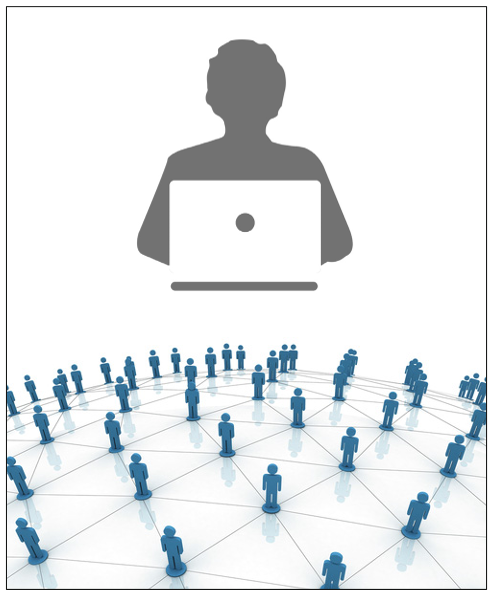 Figure 1: Comparison between (a) Macro-level global observation and (b) Micro-level distributed estimation.
The Algorithm Logic
The process follows a sequence:
- Initialization: Assume neighbors are like you.
- Observation: Capture "wall activities" or interactions.
- Velocity Check: Use the "velocity" of interactions (time between events) as a stopping criterion to decide when an estimation has enough data.
- Likelihood Estimation: Use Maximum Likelihood to find the degree that best fits the observed data.
Experiments and Results
The authors validated the algorithm using two distinct environments:
1. Synthetic scale-free networks
Using a Barabási-Albert model with 300 nodes, the algorithm showed remarkable convergence. Even when "noise" (random extra or missing observations) was introduced, the Mean Squared Error (MSE) remained remarkably low.
2. Facebook User Network
Using a real-world dataset of 60,867 nodes and wall communication logs:
- Challenge: Only 26.9% of actual connections were visible through wall posts.
- Result: A simple count would only be 26.9% accurate. The proposed algorithm reached 92.14% accuracy.
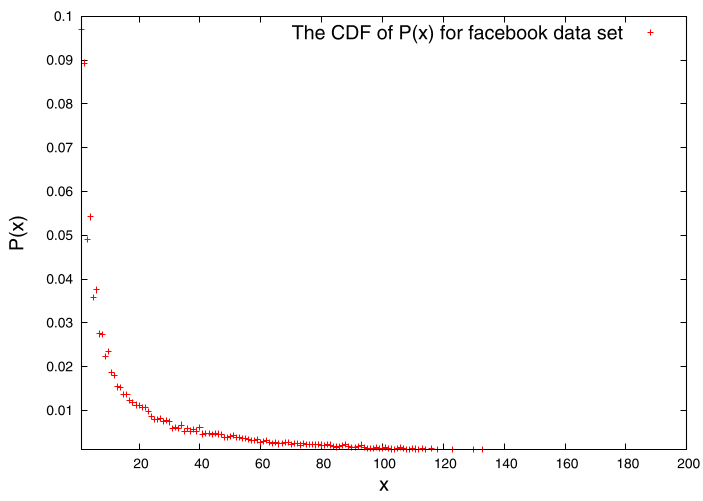 Figure 2: Proof that the Facebook data follows a Power-law distribution, justifying the algorithm's internal assumptions.
Critical Insight & Conclusion
The true value of this work lies in the Inductive Bias provided by the Power-law assumption. By "knowing" that the world is scale-free, a single node can make extremely accurate guesses about parts of the network it can never see.
Limitations:
- The algorithm struggles with "Small Degrees" (nodes with < 5 neighbors) because the statistical signal is too weak.
- It assumes a positive correlation between activity and degree, which may fail for "celebrity" accounts that have millions of followers but only interact with a inner circle.
Future Outlook: This micro-level reasoning is a stepping stone for truly decentralized social apps where privacy is paramount—allowing you to find the most influential path for a message without ever "peeking" at your friends' private connection data.