
AdjustedWalk: Fixing Classifier Bias in Social Network Analysis
Estimating Group Properties in Online Social Networks with a Classifier
The paper introduces AdjustedWalk, a novel framework for obtaining unbiased estimates of group properties (such as demographic proportions and homophily) in unknown online social networks. By combining Re-Weighted Random Walk (RWRW) sampling with post-hoc quantification learning adjustments, the authors effectively eliminate the systematic bias introduced by imperfect node classifiers.
TL;DR
Predicting "who is who" in a social network using AI is common, but these AIs are biased, leading to wrong conclusions about group sizes and social behavior. AdjustedWalk is a new framework that combines clever mathematical "walking" through a network with a post-hoc error correction step to provide perfectly unbiased estimates of social group properties, even when the AI makes frequent mistakes.
The Problem: The Bias Paradox
Social scientists love online data for its behavioral richness, but it lacks demographic labels (age, gender, ethnicity). To fix this, we use classifiers. However, a classifier with 80% accuracy doesn't just mean 20% "noise"—it creates systematic bias. For instance, if a minority group is small, a classifier is mathematically likely to mislabel them as the majority, making the minority seem even smaller or invisible. When you combine this with the fact that we usually only see a "convenience sample" of a network, the resulting social statistics (like "how much do people talk to their own group?") are often fundamentally wrong.
Methodology: The Core of AdjustedWalk
The authors argue that we must integrate the sampling process with the error-correction process.
1. The Re-Weighted Random Walk (RWRW)
Since we can't see the whole network, we "walk" it. RWRW ensures that even though high-degree "influencer" nodes are more likely to be hit by a random walk, we can mathematically re-weight the data to represent the "average" user.
2. The Matrix Inversion Trick
If we know how often our AI confuses Group A for Group B (the confusion matrix ), we can treat the biased result () as a linear transformation of the truth (). By inverting the matrix: We can recover the true population proportions.
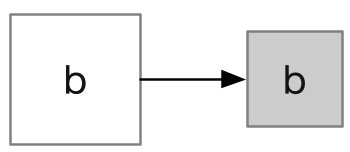 Figure 1: The process flow from random walking to ground-truth labeling and final bias adjustment.
Experiments: Breaking the Bias
The researchers tested this on the Pokec social network and simulated graphs. They focused on "Visibility" (representation in the top 20% of status) and "Coleman’s Homophily."
- Without Correction: Homophily estimates were off by 83%, potentially making a segregated community look like it was mixing perfectly.
- With AdjustedWalk: Bias was eliminated. Even when the classifier's error rate was as high as 30%, the mean estimate hit the "bullseye" of the true value.
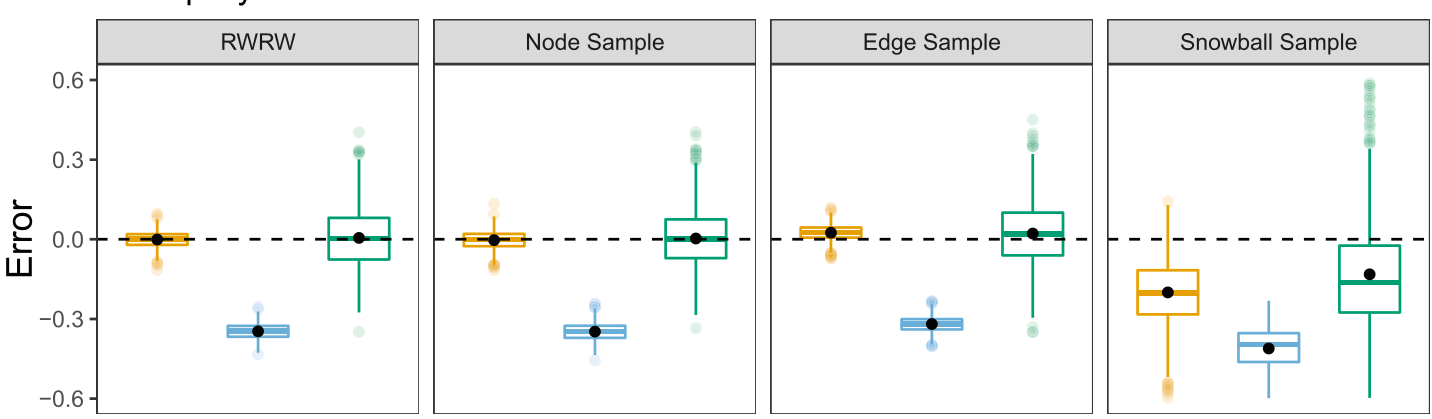 Figure 2: Comparison showing that corrected RWRW estimates (circles) stay centered on the true value (0) regardless of the error rate, while uncorrected estimates (pluses) drift significantly.
Critical Insight: The Cost of Truth
The "Catch-22" discovered here is Variance. While AdjustedWalk makes your average answer "correct" (unbiased), the spread of possible answers (variance) increases as your classifier gets worse.
The authors provide a crisp mathematical proof: the variance increases by a factor of . In plain English: The more your AI confuses groups, the larger the sample size you need to stay certain of your results. If your classifier's recall drops below 0.8, the "noise" (variance) explodes, making the correction less "stable" for small samples.
Conclusion & Future Outlook
AdjustedWalk is a vital tool for the "Digital Demography" era. It proves that we don't need perfect AI to get perfect social statistics—we just need to be honest about the AI's error rates and use the right math to work backward.
Future Directions: As social networks become more fragmented, applying these methods to multidimensional attributes (e.g., intersecting race, gender, and political alignment simultaneously) will be the next frontier in understanding the digital social fabric.