
Elite-WTS: Optimizing Sensor Memory via Social Tie Analytics
Estimating memory requirements in wireless sensor networks using social tie strengths
This paper introduces Weighted Tie-Strength (WTS), a novel metric for quantifying relationships in Wireless Sensor Networks (WSNs) by mimicking human social interactions. It leverages this metric to estimate memory requirements for sensor nodes, achieving a significant reduction in stored encounter history by focusing on "Elite" social ties.
TL;DR
In the era of ubiquitous mobile sensing, devices are overwhelmed by the sheer volume of peer-to-peer encounters. This paper presents WTS (Weighted Tie-Strength), a social-aware mechanism that analyzes encounter frequency, duration, and regularity to identify "Elite" nodes. By storing only the top 0.5% of strongest ties, sensor nodes can drastically reduce memory requirements without compromising network dissemination efficiency.
Background: The Memory Bottleneck in Mobile WSNs
As sensors become increasingly integrated with human movement (smartphones, wearables), their encounter patterns mirror human social networks. Conventional Wireless Sensor Networks (WSNs) attempt to track all encounters, leading to memory overflow. When memory is full, new (and potentially more critical) encounters are lost, breaking the data dissemination chain.
The authors argue that we don't need to remember everyone. Just as humans maintain a finite number of strong and weak social ties, sensors should prioritize their "social elite."
Methodology: Beyond Simple Frequency
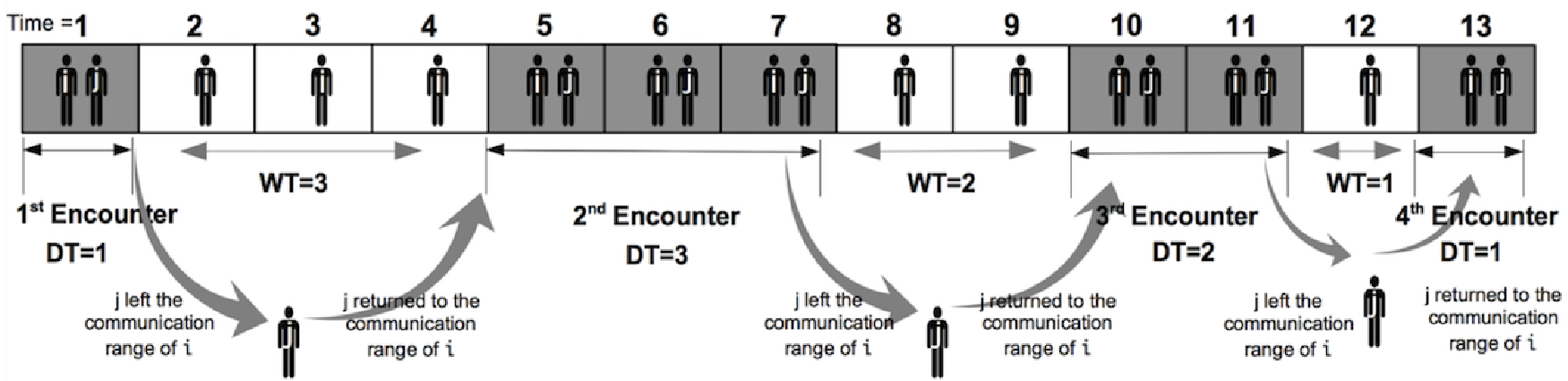
The core contribution is the WTS metric. Unlike prior works (like STBF) that only look at how many times nodes meet, WTS evaluates three dimensions:
- Frequency (): Total count of encounters.
- Duration (): How long the communication link persists.
- Regularity (): The consistency of the waiting time between encounters.
By combining these into a weighted formula, , the system calculates a holistic "bond" between sensors.
The Elite Strategy
The authors apply Elite Theory to the dissemination phase. Instead of flooding or using all neighbors, the "Elite-WTS" version restricts information transfer to sensors with the highest weights. Through Gaussian distribution analysis (the 68-95-99.7 rule), they identified that only the top 2.5% of weights (the critical region) effectively represent meaningful ties.
Experimental Insights
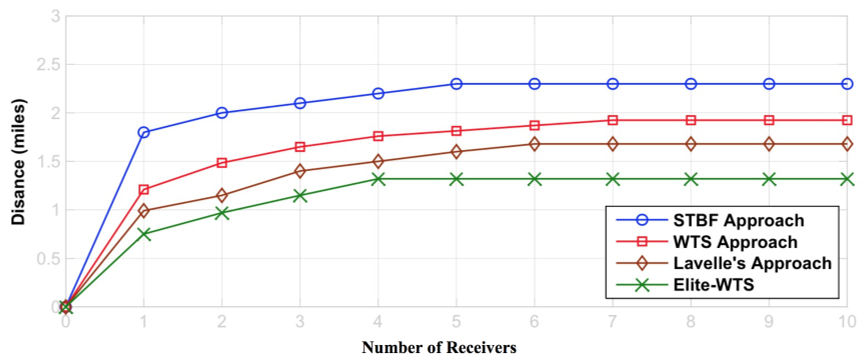
Using the Song Mobility Model (a realistic human movement simulator), the researchers compared Elite-WTS against STBF and Lavelle’s metrics.
- Dissemination Control: Elite-WTS restricted information to nearby locations more effectively than any other baseline, which is a key requirement for localized sensor tasks.
- Statistical Superiority: ANOVA and Tukey’s Honest Significance Tests confirmed that Elite-WTS consistently outperforms competitors with less variance.
Memory Estimation: The "0.5% Rule"
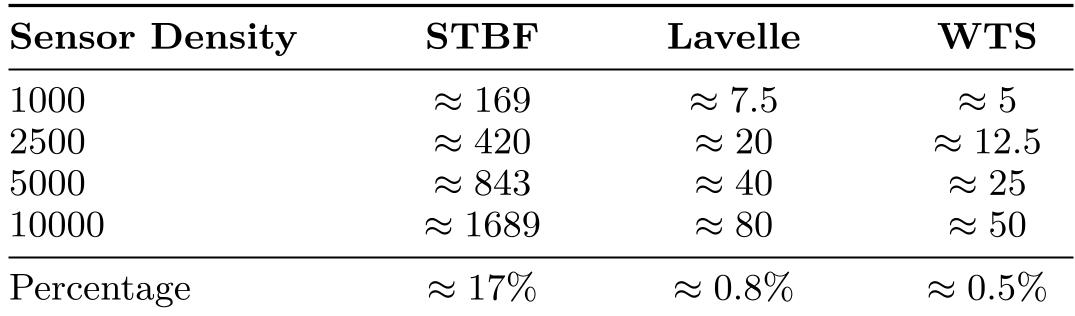
The most practical takeaway of this research is the estimation of memory limits. As shown in the table below, while older methods like STBF suggested sensors need to remember 17% of the population, WTS reduces this requirement to a mere 0.5% for strong ties.
Critical Analysis & Conclusion
Takeaway
The study successfully bridges sociology and network engineering. By proving that weights follow a Gaussian distribution, it provides a mathematical basis for selective forgetting in sensor nodes.
Limitations
- Dynamic Environments: While the Song model is robust, the paper does not deeply explore scenarios with extreme node churn or "socially isolated" sensors.
- Replacement Policy: The paper identifies how many to keep but leaves the replacement strategy (when memory is full of strong ties) for future work.
Future Outlook
This work paves the way for "Socially-Aware Memory Management." Future sensor OS architectures could implement WTS as a background service to prune encounter histories, ensuring that devices only dedicate resources to the relations that physically and logically matter most.