
UserRank: Quantifying Peer Influence in Online Health Communities
Estimating User Influence in the MedHelp Social Network
The paper proposes UserRank, a weighted link-analysis algorithm designed to estimate user influence within online health social networks (specifically MedHelp). By incorporating message similarity and response immediacy into a weighted graph, it identifies influential users more accurately than standard topology-based methods like PageRank.
TL;DR
In online health communities like MedHelp, not all active users are truly influential. This paper introduces UserRank, a specialized algorithm that identifies health "influencers" by looking beyond simple connection counts. It blends content relevance (what you say) and response speed (how fast you say it) to create a weighted social graph, proving far more effective than Google’s PageRank in identifying the real leaders of medical forums.
Background: Beyond the "Power Law"
Most social networks follow a "Power Law" where a tiny fraction of users generates the vast majority of content. In health settings, these "e-patients" are vital—they provide emotional support, share treatment experiences, and even influence others' medical decisions. However, identifying the right influencers is critical: while they can propagate positive health habits, they can also inadvertently spread medical misinformation.
The Problem: The Blindness of Topology
Prior methods like PageRank treat a social network like a collection of webpages. If User A replies to User B, a link is formed. The more replies you get, the higher your "authority."
The authors argue this is flawed for medicine:
- Topic Drift: A reply might be a "spam" post or a complete change of subject.
- Temporal Value: In a health crisis (like the H1N1 flu), a response that comes three weeks late is far less influential than one that arrives in minutes.
Methodology: The UserRank Formula
The core innovation is the weighting of the social graph. Instead of a binary "link or no link," every interaction between users and is assigned a weight based on two factors:
- Message Similarity: Using Cosine Similarity to ensure the responder is actually addressing the original post's topic.
- Response Immediacy: An exponential decay function that gives higher weight to faster replies.
The influence is then calculated iteratively, where a user's rank is the sum of the weighted influence passed to them by others.
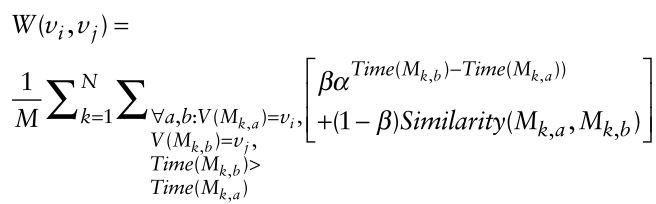 The weight function combining temporal decay ( and ) and semantic similarity.
Experiments & Results
The researchers crawled three distinct MedHelp communities: Swine Flu (small), Smoking Addiction (medium), and Alcoholism (large). They compared UserRank and PageRank against a "Gold Standard" (GS) created by human experts who manually rated user influence based on message quality.
Using the Kendall’s tau () metric—where a lower score indicates a closer match to the human "Gold Standard"—the results were clear:
| Forum | UserRank Distance () | PageRank Distance () |
|---|---|---|
| Swine Flu (Top 5) | 3 | 2 |
| Smoking (Top 10) | 21 | 27 |
| Alcoholism (Top 10) | 24 | 37 |
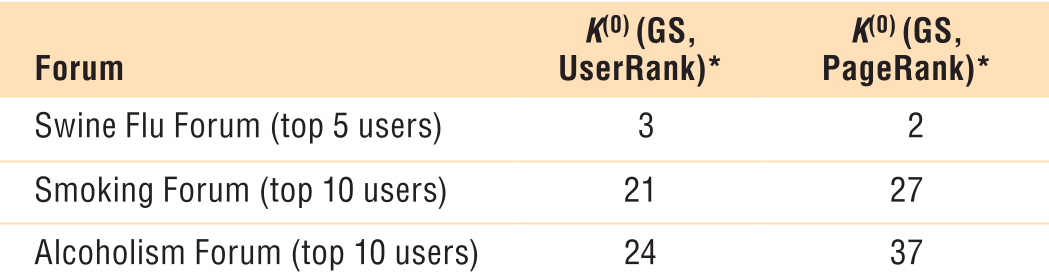
As the forum size and complexity grew, UserRank became significantly more accurate. In the Alcoholism forum, PageRank's performance degraded sharply (reaching a distance of 37), while UserRank remained robust (distance of 24).
Deep Insight: Why it Matters
The success of UserRank confirms an "Inductive Bias" specific to social support: Influence is earned through relevance and presence. In a medical context, an influential user isn't just someone who "talks a lot"; they are someone who provides timely, contextually appropriate advice that resonates with the seeker's needs.
Limitations & Future Work
The authors acknowledge that they haven't yet considered:
- Message Length: Longer, more detailed responses might indicate higher effort and influence.
- Sentiment Analysis: Understanding if the influence is positive or negative (e.g., a "troll" might be influential but harmful).
Conclusion
This work provides a vital tool for health organizations. By identifying these "super-users" through UserRank, organizations can effectively harness social networks to disseminate life-saving information more efficiently than ever before.