
Deciphering the Pulse of Social Media: A Bayesian Approach to User Activity Modes
Estimating users' mode transition functions and activity levels from social media
This paper introduces a Bayesian temporal model to estimate individual-scale social media user behavior by identifying discrete "activity modes" (e.g., engaged, casual, sleeping). By utilizing a Hidden Markov Model (HMM) framework with time-of-day dependent transition functions, the authors successfully capture diverse daily activity patterns from Twitter timestamp data.
TL;DR
Researchers from Sandia National Laboratories have developed a Bayesian temporal model that decomposes a social media user's behavior into discrete "activity modes." By analyzing the intervals between tweets and the time of day, the model can automatically identify when a user is "engaged" (high frequency), "casual" (medium frequency), or "sleeping" (low frequency), providing a realistic schedule for agent-based simulations in fields like epidemiology and network security.
Background: Beyond Simple Timestamps
Human behavior isn't a steady stream; it’s a series of bursts and pauses. Traditional models often treat event arrivals as simple stochastic processes, but these fail to capture the contextual shifts in behavior. Why does a user suddenly switch from replying to five tweets in ten minutes to being silent for eight hours? The answer lies in latent "modes" of activity governed by both social dynamics and the circadian rhythm.
The Problem & Motivation
Building accurate population models (e.g., for predicting electric power load or disease spread) requires high-fidelity models of individual behavior. Existing social media analysis often focuses on what is being said (content) rather than when it is said (temporal dynamics). The authors identified a gap: we need a way to quantify these temporal "modes" and, more importantly, the transitions between them, while accounting for the inherent noise and irregularity of human life.
Methodology: The Core Bayesian Model
The core of this research is a Bayesian graphical model designed to estimate hidden variables from observed tweet timestamps () and the intervals between them ().
1. Latent Modes
Each tweet is assumed to be produced by a mode . The interval leading up to that tweet follows a log-normal distribution defined by and .
- Mode 1 (Engaged): Short , high consistency.
- Mode 2 (Casual): Moderate , typical daily updates.
- Mode 3 (Sleeping): Large , spanning hours.
2. Time-Varying Transitions
Unlike a standard Markov Model where transition probabilities are constant, this model uses a transition function that shifts based on the time of day. This allows the model to learn, for instance, that a "Casual" tweet at 11:00 PM is much more likely to transition into a "Sleeping" mode than a "Casual" tweet at 11:00 AM.
 Figure: The Bayesian plate notation illustrating the dependencies between observed intervals () and latent coefficients ().
Experimental Insights
The authors applied their model to 29 distinct users. A standout example is "User 28," whose behavior perfectly illustrates the three-mode structure.
SOTA Comparison & Visualization
Using "Time Maps" (logarithmic scales of current vs. previous intervals), the authors visualized how modes cluster. The Bayesian model successfully separated these clusters even when they overlapped in the raw data.
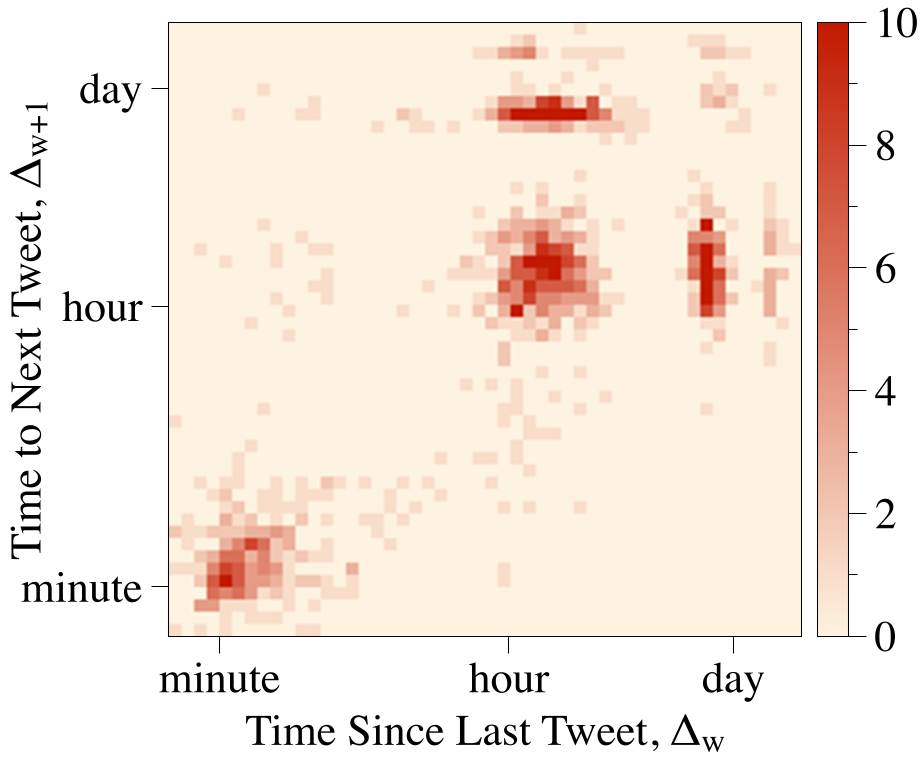 Figure: The Time Map for User 28 showing three uncharacteristically distinct clusters: Engaged (bottom-left), Casual (center), and Sleeping (top-right).
Handling "Bots" and Automated Accounts
One of the most interesting findings was the model's performance on automated accounts. While it could handle basic "bots," highly precise automated accounts (tweeting at exactly 5, 10, or 15-minute intervals) caused the log-normal variance () to collapse toward zero, identifying a limitation in the current distribution choice for non-human entities.
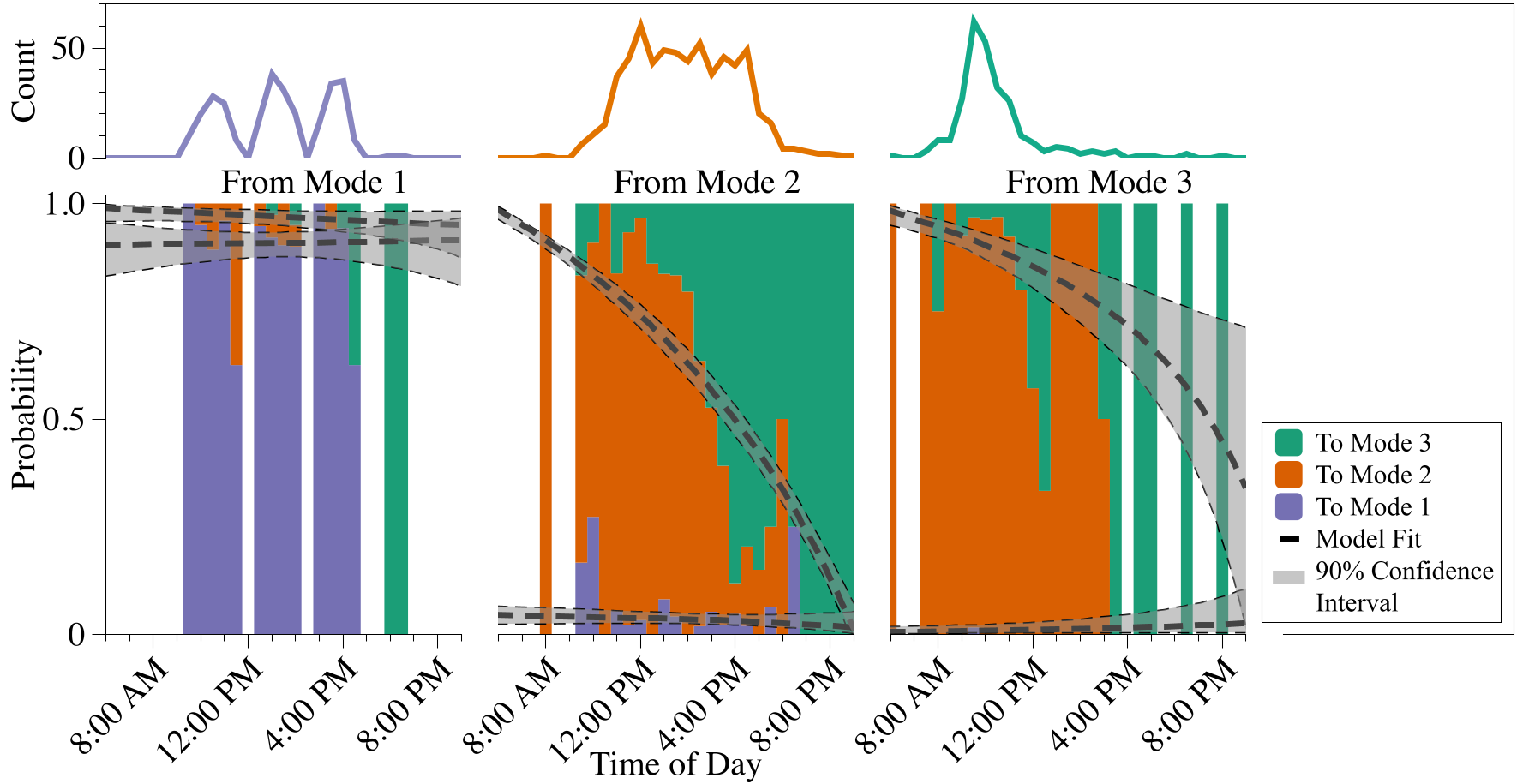 Figure: Transition fits for User 28, showing how the probability of entering the 'Sleeping' mode (Mode 3) increases as the day progresses.
Critical Analysis & Conclusion
Takeaway
The model's ability to extract structured schedules from messy, timestamped data is a major win for simulation scientists. It moves us closer to "digital twins" of human social behavior.
Limitations
- Priors Matter: The model is sensitive to initial assumptions (priors). If the priors are too strong, the model may fail to "see" a second or third mode in sparse datasets.
- Deterministic Behavior: The log-normal assumption struggles with the "Dirac delta" nature of bots.
Future Outlook
The authors suggest that future iterations could automatically identify user classes (e.g., distinguishing a celebrity from a bot) by clustering these temporal parameters across a whole population. This could revolutionize how we monitor public health or detect large-scale coordinated influence operations in real-time.
Paper Title: Estimating users’ mode transition functions and activity levels from social media Authored by: Hamilton Link, Jeremy D. Wendt, Richard V. Field, Jr., and Jocelyn Marthe (Sandia National Laboratories)