
Nonlinear System Identification via Occupation Measures: A Convex Optimization Breakthrough
Estimation of consistent parameter sets for continuous-time nonlinear systems using occupation measures and LMI relaxations
The paper introduces a convex optimization framework for the set-based estimation of consistent parameters and initial conditions in nonlinear continuous-time polynomial systems. By utilizing occupation measures and Liouville's equation, it transforms nonlinear dynamics into an infinite-dimensional Linear Program (LP), which is solved using a hierarchy of LMI (Linear Matrix Inequality) relaxations via semi-definite programming.
TL;DR
This paper presents a rigorous mathematical framework to solve the "inverse problem" of dynamical systems: given noisy/bounded measurements, what are the possible initial states and parameters? By shifting from individual trajectories to occupation measures, the authors replace difficult nonlinear simulations with a hierarchy of Linear Matrix Inequalities (LMI). The result is a method that provides guaranteed inner and outer bounds for consistent parameter sets without ever needing numerical integration.
Background & Motivation: The Discretization Trap
In fields like system identification and fault diagnosis, we need to know the set of all parameters consistent with observed data. Historically, researchers faced a dilemma:
- Discretize the system: Convert the ODE to a discrete-time model. However, discretization errors can cause the estimated set to diverge from the true continuous set, leading to "wrong conclusions" about model validity.
- Differential Inequalities: Hard to scale and often yield loose bounds.
- Barrier Certificates: Powerful but often lack "if and only if" (converse) guarantees for set approximation.
The authors' insight is to bypass the trajectory-level view entirely and look at the "distributional" history of the system.
Methodology: From ODEs to Measures
The core of the methodology lies in Occupation Measures and Liouville's Equation.
1. The Physics Choice
Instead of tracking a single state , we track a measure that describes where the system "spends its time" in the state space. The nonlinear dynamics are then embedded into a linear partial differential equation (PDE) in the space of measures: This is known as the continuity equation. It is linear, even if the underlying is a highly nonlinear polynomial!
2. Handling Pointwise Measurements
A major contribution here is how the authors handle measurements at specific timestamps . They partition the total occupation measure into "arcs" corresponding to the time intervals between measurements.
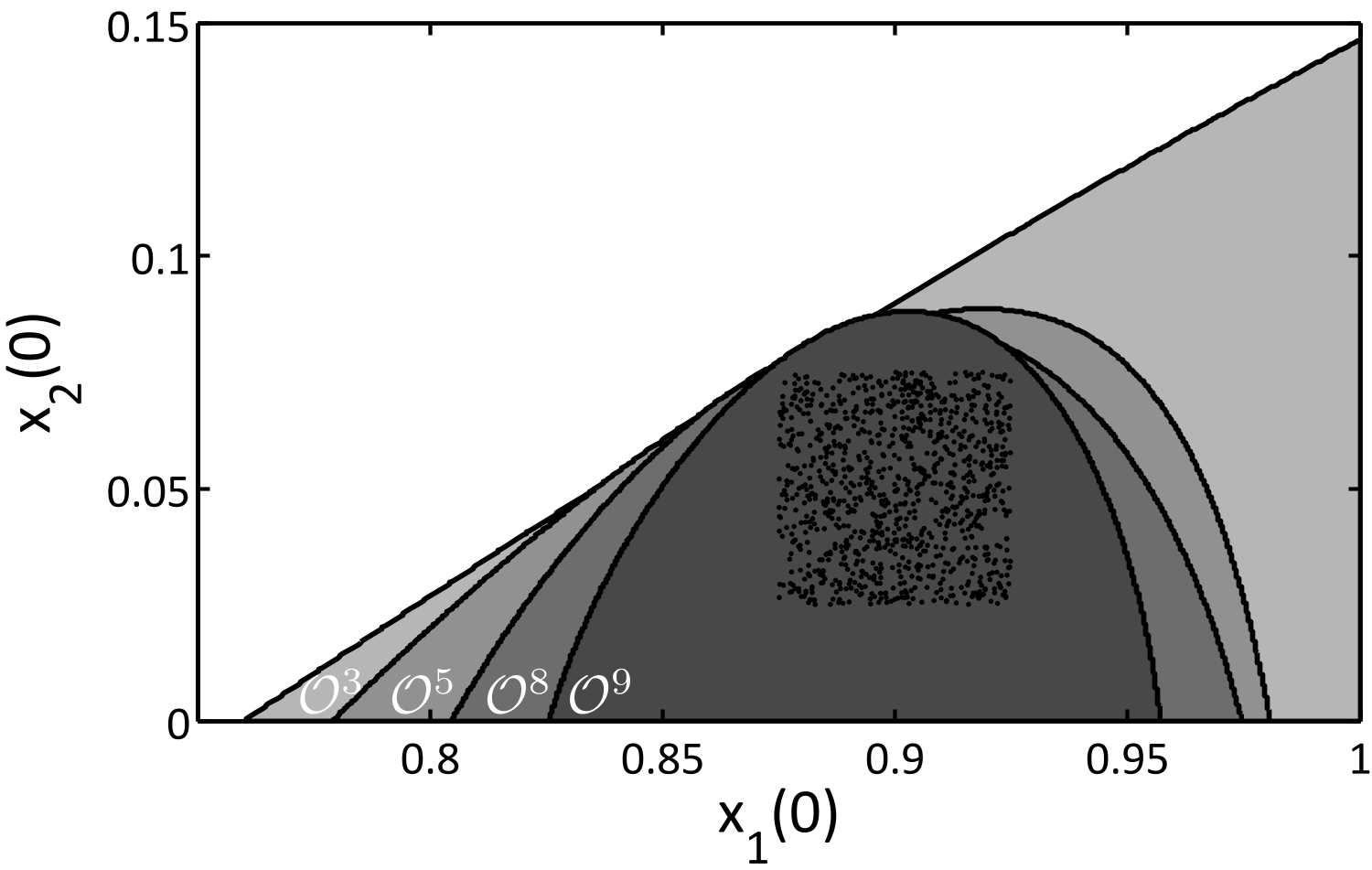 Figure 1: Illustration of how increasing the relaxation order tightens the outer-approximation around the true consistent parameter set (black dots).
3. The Optimization Ladder
The infinite-dimensional problem is solved via a Hierarchy of Relaxations. By looking at the moments of these measures, the problem becomes a sequence of Semi-Definite Programs (SDPs). As the degree of the polynomials increases, the approximations converge (almost uniformly) to the true set.
Experimental Results: The Biochemical Testbed
The authors validated their approach using a biochemical reaction network (Enzyme-Substrate conversion).
- Outer-approximations: Effectively narrowed down the range of unknown parameters.
- Inner-approximations: Found regions of the parameter space that are guaranteed to be consistent with the data. This is achieved by finding initial conditions that "violate the violations."
- Inconsistency Certificates: If no parameter set works, the dual LMI provides a mathematical "certificate" that the model is invalid.
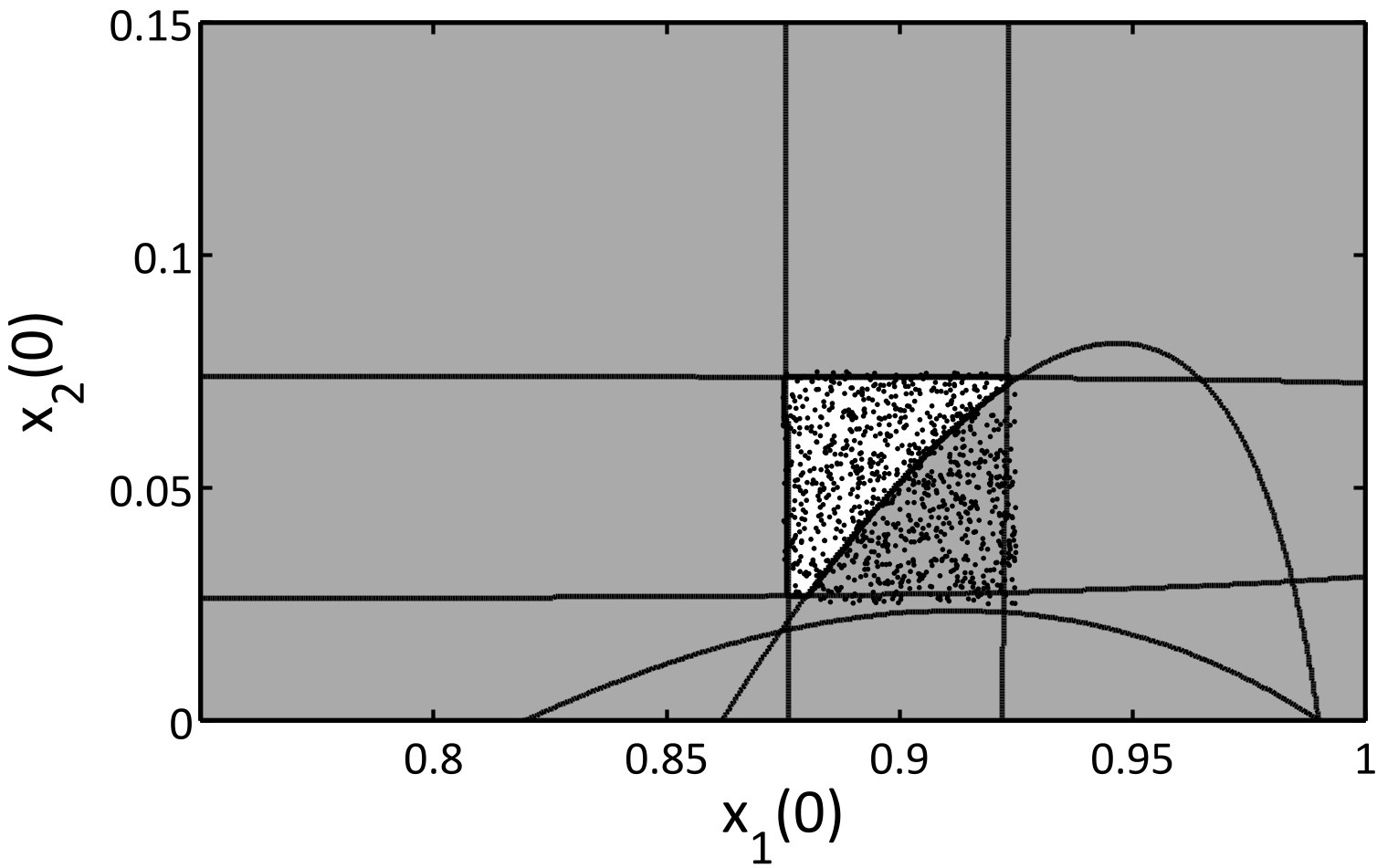 Figure 2: The white area represents the guaranteed inner-approximation, while the grey areas are successfully excluded via inconsistency certificates.
Critical Analysis & Future Directions
The "Curse" of SDP
While mathematically elegant, the approach hits a computational wall. As the state dimension or the relaxation order increases, the size of the LMI matrices grows combinatorially. For large systems (e.g., states), the current state of SDP solvers like SeDuMi makes this method difficult to apply directly.
The Takeaway
The value of this paper isn't just in the algorithm, but in the theoretical guarantee of convergence. It proves that we can treat nonlinear parameter estimation as a convex problem. Future work utilizing Sparsity-exploiting SDPs or Alternative Basis Functions may bridge the gap between this rigorous theory and large-scale engineering applications.
Summary
This work provides a robust framework for continuous-time system identification. By leveraging occupation measures, the authors turn a high-stakes "search" problem into a structured "optimization" problem, providing the community with a tool for both model validation and guaranteed parameter bounding.