
Beyond Heart Rate: Accurate Instantaneous VO2 Estimation via Cardio-Electromechanical Sensing
Estimation of Instantaneous Oxygen Uptake During Exercise and Daily Activities Using a Wearable Cardio-Electromechanical and Environmental Sensor
This paper introduces a chest-worn wearable patch designed to estimate instantaneous oxygen uptake (VO2) during both treadmill exercise and uncontrolled outdoor activities. By fusing Seismocardiogram (SCG), Electrocardiogram (ECG), and Atmospheric Pressure (AP) signals with an XGBoost regression model, the system achieves a significant correlation with gold-standard metabolic measurements (R2 up to 0.77).
TL;DR
Researchers have developed a small, mid-sternum wearable patch that estimates oxygen uptake (VO2) in real-time without the need for restrictive oxygen masks. By combining Seismocardiogram (SCG), ECG, and Atmospheric Pressure (AP) data with advanced XGBoost machine learning, the system provides a low-cost, unobtrusive way to monitor metabolic health and fitness in both the gym and the great outdoors.
The Missing Link in Wearable Tech
While your smartwatch is excellent at telling you your heart rate, its ability to estimate "calories burned" or energy expenditure (EE) is often notoriously inaccurate. The reason? Heart rate is only one piece of the metabolic puzzle. It doesn't tell the model how hard the heart is actually pumping (Stroke Volume) or if you are struggling against a steep incline.
To solve this, the authors moved the sensor to the chest and added a mechanical dimension: the Seismocardiogram.
Methodology: The Fusion of Mechanical and Environmental Context
The core innovation lies in the triplet of sensors embedded in the 7cm patch:
- ECG (The Electrical): Tracks the timing of the heart's cycles.
- SCG (The Mechanical): Uses a high-precision accelerometer to measure the micro-vibrations of the chest caused by blood being ejected into the aorta.
- AP (The Environmental): Uses atmospheric pressure to detect altitude changes (stairs or hills), providing crucial context for why the VO2 might be spiking.
Architecture and Signal Processing
The pipeline involves filtering data to remove T-wave interference and motion noise, followed by Moving Ensemble Averaging. This technique aligns the last 10 heartbeats to "cancel out" random movement noise while preserving the consistent cardiac signal.
 Fig 1: Sensor placement (mid-sternum) and the experimental protocol covering both controlled treadmills and uncontrolled outdoor routes.
Experiments and Results
The study compared the patch against the COSMED K5—the gold-standard metabolic mask.
Key Findings:
- Frequency Matters: Frequency-domain features of the SCG signal were the strongest predictors of VO2. This is because physiological stress shortens heart contraction times, shifting signal power to higher frequencies.
- The AP Advantage: In outdoor settings, adding Atmospheric Pressure data significantly reduced estimation error, as it accounted for the increased effort required for uphill climbs.
- Superior to HR-only Models: Simple linear regression using only Heart Rate achieved an R2 of only ~0.44, whereas the multi-modal XGBoost approach reached 0.77.
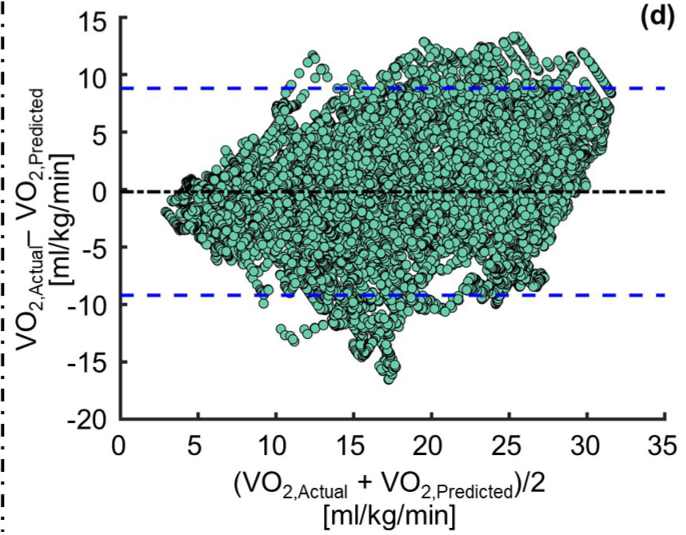 Fig 2: The high correlation (left) and tight agreement (right) between the wearable's estimates and the gold-standard metabolic measurements demonstrate the model's accuracy.
Why This Matters: Deep Insight
The real breakthrough here isn't just "higher accuracy"—it's ubiquity. Current "Gold Standard" equipment is intrusive and expensive ($30k+), making it impossible for daily use. This patch weighs only 38 grams and can run for 45 hours.
From an academic standpoint, the paper proves that Inductive Bias (knowing that heart mechanics and altitude matter) combined with powerful non-linear regressors (XGBoost) can outperform the generic algorithms used in current consumer wearables.
Critical Analysis & Future Outlook
- Limitations: The study was conducted on a relatively young, healthy group (average age 26.8). How the model performs on elderly patients or those with heart failure (where SCG morphology is different) remains a key area for future validation.
- Future Work: The authors suggest integrating respiration rate and skin temperature to push accuracy even further.
Conclusion
By looking at the heart as a mechanical pump—not just an electrical timer—and considering the environment of the user, this research bridges the gap between clinical metabolic testing and everyday wearable convenience.