
Behind the Digital Veil: The Ethics and Reality of Global Crowdwork
Understanding the Crowd: Ethical and Practical Matters in the Academic Use of Crowdsourcing
This paper provides a multi-dimensional analysis of the crowdsourcing ecosystem, focusing on Amazon Mechanical Turk (AMT), Microworkers, and Crowdee. It combines demographic surveys and ethnographic insights to characterize the global workforce and establish ethical guidelines for academic research.
TL;DR
Crowdsourcing is not a technological miracle—it is a labor market. This paper dismantles the "solutionist" view of platforms like Amazon Mechanical Turk (AMT), revealing a workforce that is highly educated, often works full-time, and relies on microtasks to pay for basic necessities like rent and food. The authors argue for a shift from seeing "the crowd" as a service to treating them as professional collaborators within an ethical framework.
Contextual Positioning
In the hierarchy of academic HCI (Human-Computer Interaction) and CSCW (Computer-Supported Cooperative Work), this paper serves as a critical bridge between quantitative demographics and qualitative ethnomethodology. It moves beyond the outdated "who are the workers" catalogs of 2010 to address the "why" and "how" of a precariously positioned global workforce in 2016 and beyond.
The Hidden Face of the Crowd (Demographics)
The study highlights a stark contrast between "Western" and "Developing" nation demographics.
- Education Paradox: Contrary to the "low-skill" stereotype, Indian Turkers are significantly more likely to hold Bachelor's or Master's degrees compared to their US counterparts. This is often a byproduct of the digital divide: in developing nations, only the highly educated have the English literacy and hardware access required for global crowdwork.
- Gender Gap: While US AMT populations are more gender-balanced, global platforms like Microworkers are heavily male-dominated (up to 80% in developing regions).
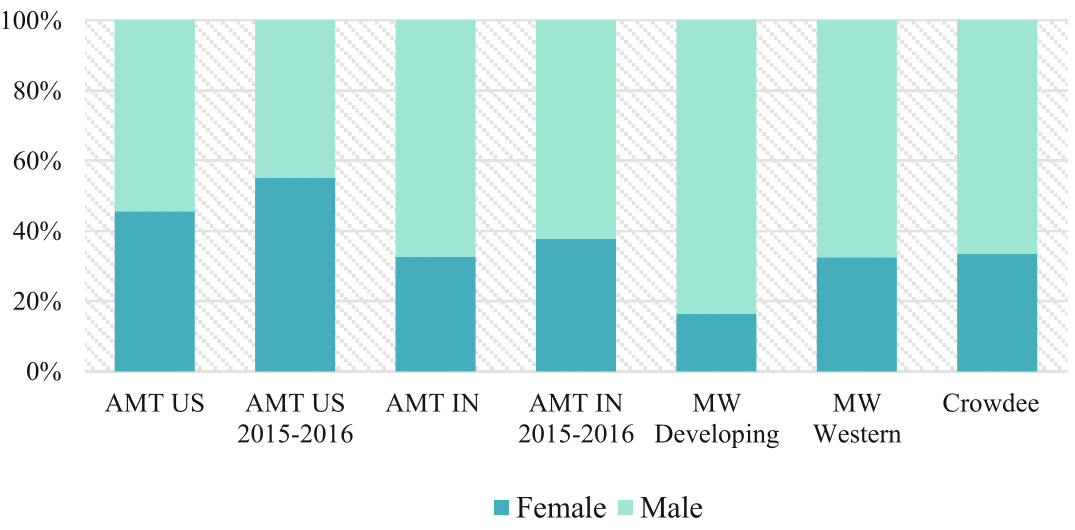 Fig 1: Gender distribution across various platforms shows significant skew in global/developing contexts.
Motivation: It’s All About the Money
The authors aggressively debunk the "fun and leisure" narrative promoted by some early researchers (e.g., Antin & Shaw, 2012).
- The Survival Factor: For over half of the Turker population, this is not "pocket change." It covers gas, groceries, and bills.
- Internalized Motivation: While money is the primary driver, the authors use Self-Determination Theory (SDT) to show that workers perform better and have higher well-being when tasks have "societal value" or contribute to academic research.
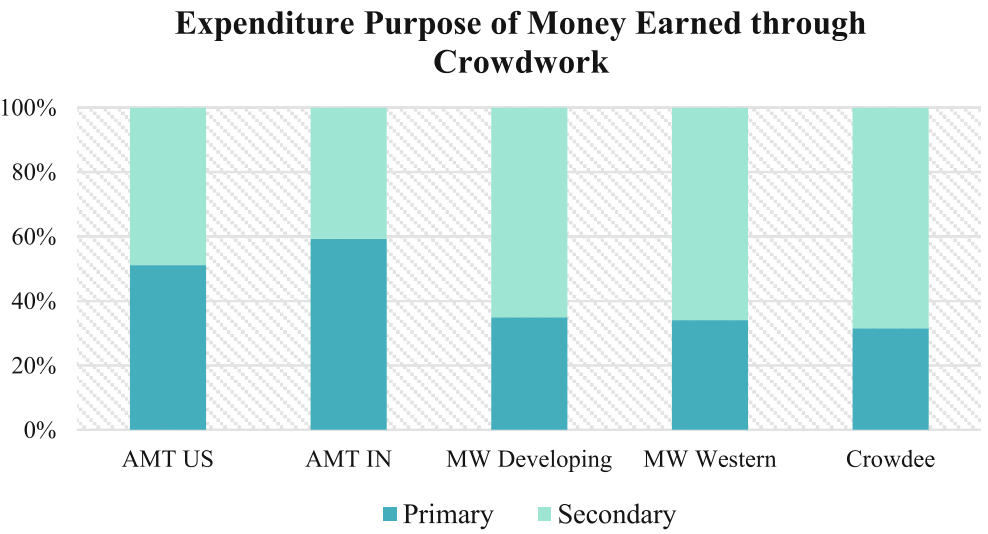 Fig 2: Comparison of expenditure purposes between AMT (primary needs) and Crowdee (secondary/hobbies).
Methodology: How the Crowd Actually Works
The "How" section provides a fascinating look at the Invisible Infrastructure of crowdwork:
- Workspaces: Most workers operate from home offices, but in India, Internet cafes remain vital, facilitating socialized, cooperative "Turking" where workers share accounts and tips.
- The Tool War: Expert Turkers don't use the standard AMT interface. They use a "bricolage" of scripts, browser plug-ins (like TurkOpticon), and real-time scrapers (like Turk Alert) to grab high-paying HITs within seconds.
- The Information Deficit: Requesters hold all the power. They can reject work and keep the results without paying. Workers mitigate this "information asymmetry" through external forums and reputation-tracking tools.
Critical Insight: The Ethical Imperative for Researchers
The paper concludes with a call to action for the academic community. Crowdsourcing lives in a "legal grey area" where workers lack the protections of full-time employees or the high-pay of independent consultants.
The "Researcher’s Code of Conduct":
- Pay the Floor: Aim for at least $7.25/hr (US Minimum Wage) regardless of the worker's location.
- Design for Infrastructure: Many workers (especially in developing nations) face intermittent electricity and slow connections. Design tasks that are "lightweight" and don't penalize for connection drops.
- Respect the "Expert": Understand that your sample may be skewed toward "Expert Turkers" who use advanced tools.
Conclusion
This work is a necessary reality check for "Technological Solutionism." It reminds us that behind every "cheap data" point is a human being navigating a complex, often unfair, global market. For researchers, ethics in crowdsourcing isn't just a checkbox—it's a commitment to recognizing the dignity of digital labor.