
Mapping the Invisible: How Knowledge Networks Solve Interdisciplinary Deadlocks
Exploring an Ethnography-Based Knowledge Network Model for Professional Communication Analysis of Knowledge Integration
This paper introduces an ethnography-based "knowledge network" model designed for analyzing professional communication in interdisciplinary teams. By mapping researchers to specific technical terms via self-reported expertise, the authors move beyond traditional social network analysis (SNA) to visualize intellectual misalignment and integration potential in complex team science.
TL;DR
High-stakes scientific collaboration often fails not because people don't talk, but because they use the same words to mean different things. This paper proposes a transition from Social Network Analysis (who talks to whom) to Knowledge Network Analysis (who knows what). By mapping human agents to specific technical terms, professional communicators can visualize intellectual "blind spots" and strategically bridge the gap between disparate fields like Deep Earth science and Geobiology.
Background: When Shared Language is a Trap
In modern "Team Science," researchers from different disciplines are often grouped together under a single grant. They theoretically share a professional language—in this case, Geosciences. However, the authors argue that this "shared language" is often an illusion.
For example, a "Deep Earth" scientist might define oxygen fugacity through electrochemical potential, while a "Surface Earth" scientist views it through ideal gas laws. Traditional social network maps would show these two scientists communicating frequently, but they wouldn't reveal that the two are actually talking past each other.
Methodology: From Ethnography to Bipartite Graphs
The researchers spent 16 weeks embedded in a large-scale geoscience project. Their process followed a rigorous data reduction pipeline:
- Observation: 16 weeks of diary studies to identify "oxygen-related" jargon.
- Corpus Building: Distilling 350 phrases down to a 220-term survey.
- Surveying: Agents (scientists) rated their understanding of these 220 terms.
- Modeling: Constructing a Bipartite Agent × Term Network.
The Architecture of Knowledge
Unlike a standard social graph, a bipartite network has two types of nodes. A link only exists if a scientist claims "Expert/High" understanding of a specific term.
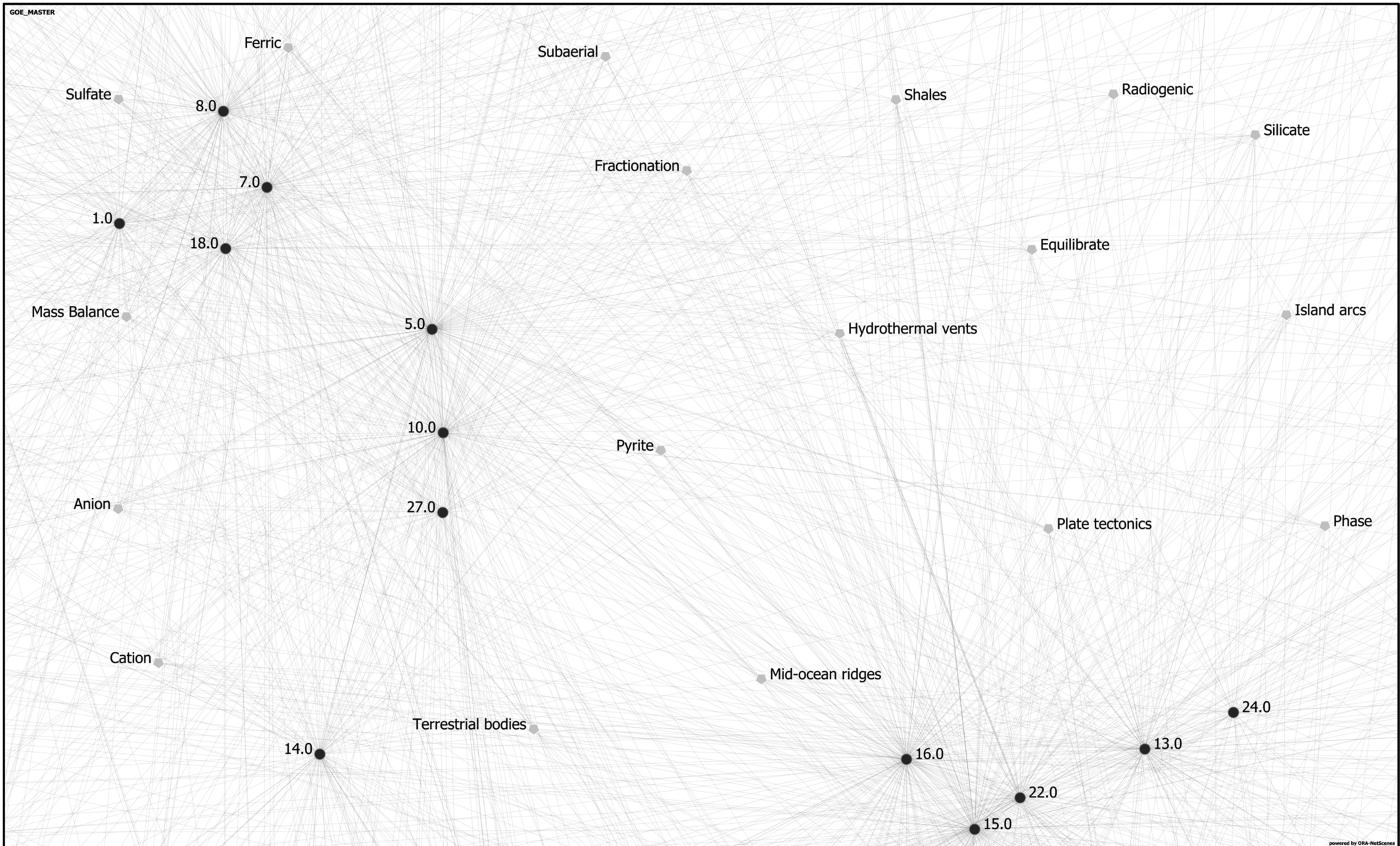 In this figure, dark circles represent human agents and light pentagons represent knowledge concepts. The split in the graph reveals the natural "fault lines" between sub-disciplines.
Key Insights: Brokering and Incommensurability
By "folding" the network into a Term × Term view based on shared expertise, the authors could perform "Ego Network" analysis on specific words.
1. The "Sedimentary" Bridge
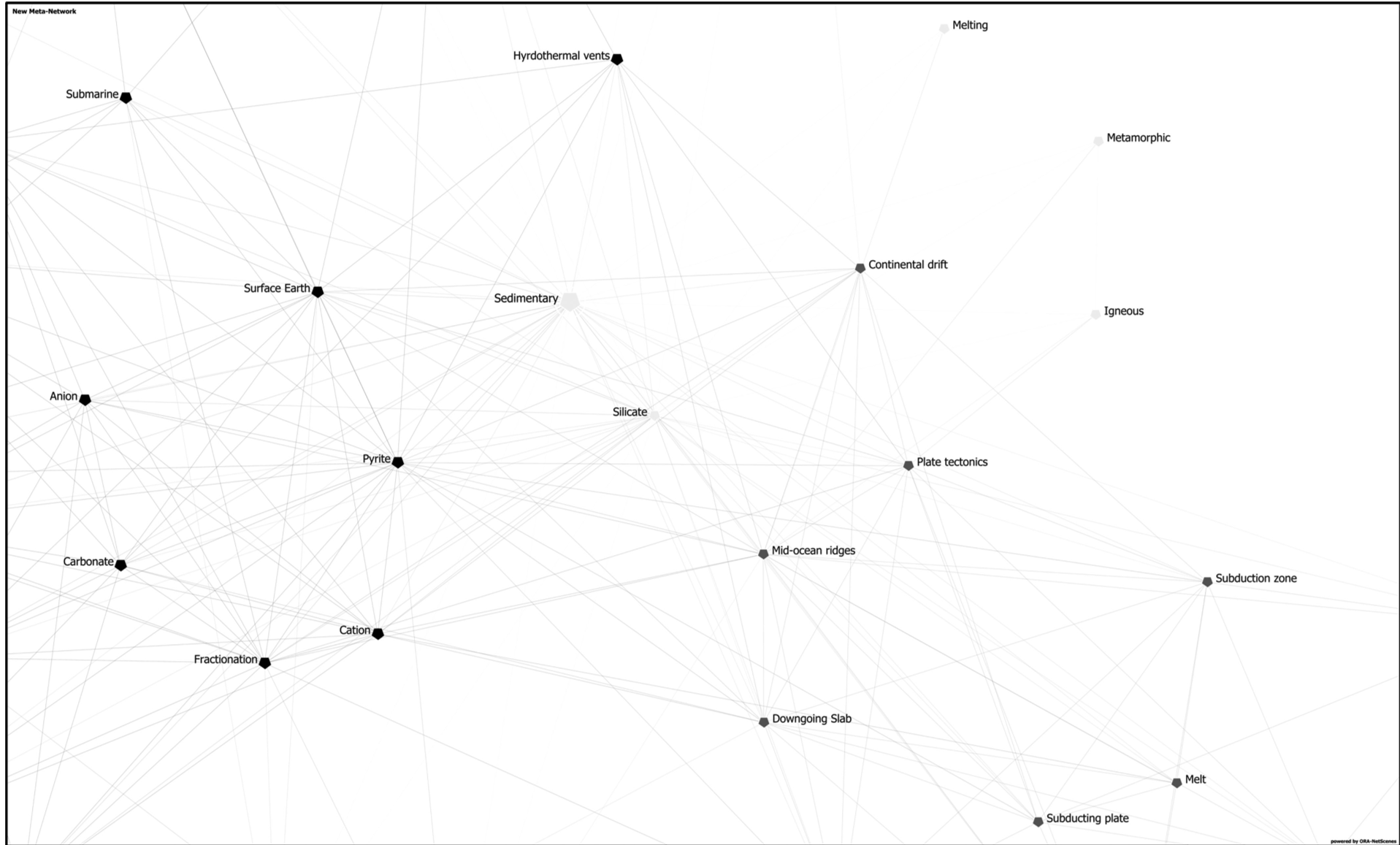
The term "sedimentary" showed a high Newman Modularity score (0.234). It acted as an intersection for two distinct groups of correlated knowledge. This is a point of incommensurability: while many scientists claim to know "sedimentary," the context of their other related knowledge suggests they are conceptualizing it in wildly different ways.
2. The "Subducting Plate" Island
Conversely, "subducting plate" showed lower modularity and a smaller population. This indicates a more stable, unified understanding within a specific clique, making it a candidate for "brokering"—intentional communication efforts to explain this concept to the other side of the network.
Critical Analysis & Professional Impact
This work shifts the role of the professional communicator from a "secretary of flow" to a "strategic knowledge consultant."
- Value-Add: It provides a visual proof of why teams struggle, allowing for evidence-based interventions (like storytelling or jargon-busting workshops).
- Limitations: The reliance on self-reporting is a classic ethnographic weakness. One might "claim" high understanding of a term they actually misunderstand. Additionally, the manual process of building the corpus is resource-intensive.
- Future Outlook: The next logical step in this research is integrating Automated Content Analysis. If we can use AI to build these networks from email archives or Slack logs, we can perform real-time "health checks" on interdisciplinary collaboration.
Conclusion
The "Knowledge Network" model is a breakthrough for organizational communication. It proves that who you know is important, but what you joinly understand is the real catalyst for innovation.