
Beyond Hofstede: How Schwartz’s Polar Dimensions Decipher the Cultural DNA of Social Media
An imposed etic approach with Schwartz polar dimensions to explore cross-cultural use of social network services
This study investigates the cross-cultural usage of Social Network Services (SNS) between the US and China using Schwartz’s Polar Dimensions (SPD) as a theoretical lens. By integrating SPD into a model of trust, privacy, and social capital, the research demonstrates how cultural values moderate user perceptions, specifically showing that perceived reputation impacts US users more significantly, while network centrality is a stronger motivator for Chinese users.
Executive Summary
TL;DR: This research challenges the long-standing "Hofstede hegemony" in tech research by applying Schwartz’s Polar Dimensions (SPD) to understand why Americans and Chinese users engage with Social Network Services (SNS). The study reveals that while Westerners are driven by individual reputation, Eastern users are more heavily influenced by their position within a social network (Centrality).
Positioning: This work is a theoretical pivot, moving the Information Systems (IS) field away from national stereotypes toward individual-level cultural trait analysis, effectively addressing the "Ecological Fallacy" that has plagued cross-cultural studies for decades.
Problem & Motivation: The Dual Fallacy
For years, IS researchers have relied almost exclusively on Hofstede’s cultural dimensions. However, the authors identify two critical gaps:
- Theoretical Fallacy: The "Unitarianism" of sticking to one theory (Hofstede) limits the perspective of how culture interacts with artifacts.
- Ecological Fallacy: Using country-level scores to predict individual behavior often results in poor model fit because individuals within a country are not a monolith.
The motivation for this study was to find a more "individual-ready" framework—Schwartz’s Polar Dimensions—to explain the explosive but culturally divergent growth of platforms like Facebook versus WeChat.
Methodology: The Imposed Etic Approach
The authors utilize the SPD framework, which categorizes cultural values into clusters like Autonomy, Hierarchy, Conservatism, and Mastery.
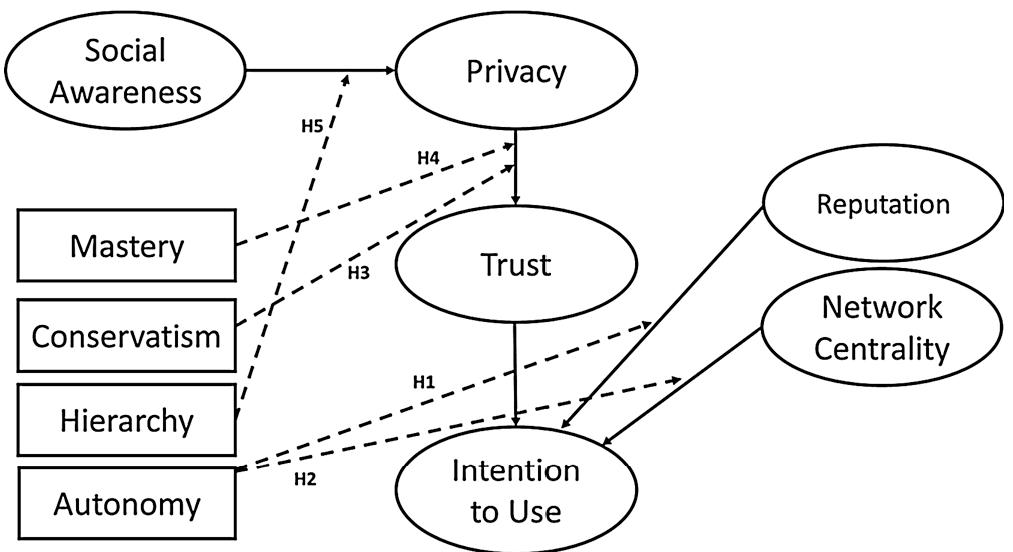
The Imposed Etic Approach was operationalized through iterative steps:
- Culture A (US): Instrument born from Western social settings.
- Culture B (China): Cross-cultural validation through semantic and conceptual translation.
- Moderation Analysis: Testing how Autonomy/Conservatism changes the strength of the relationship between Social Capital and Use Intention.
Deep Dive: Reputation vs. Centrality
The core of the methodology lies in how these cultural "pillars" moderate behaviors:
- Autonomy: In high-autonomy cultures (US), individuals prioritize internal attributes. Paradoxically, the study found the effect of Reputation was stronger in the US, likely because "engineered reputation" (like 'water armies') has diluted trust in Chinese digital spaces.
- Hierarchy & Centrality: In China, the value of Network Centrality (your position in the structural web) was a significantly more powerful predictor of use intention, aligning with the "Guanxi" paradigm.
Experimental Results: A Tale of Two Contexts
The structural equation modeling (SEM) results provided striking quantitative evidence of cultural divergence.
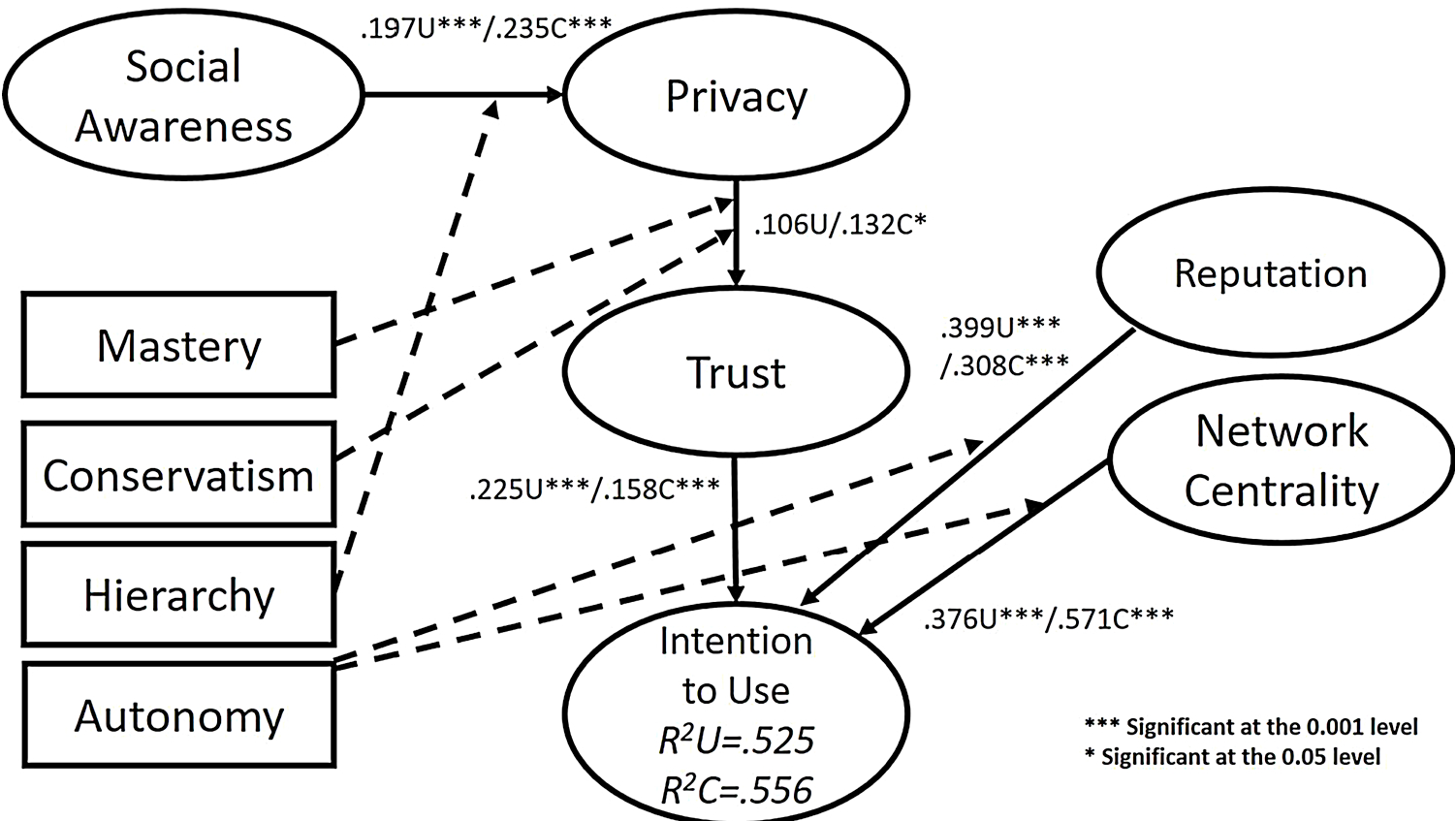
- Predictive Power: The model accounted for 55.6% (US) and 52.5% (China) of the variance in intention to use SNS.
- The SOTA Edge: By separating findings by cultural subgroup (High vs. Low Autonomy), the researchers proved that SPD captures nuances that broad national labels miss. For example, Social Awareness had a stronger link to Privacy Concerns in China than in the US, suggesting different regulatory expectations.
Critical Insight & Future Outlook
Takeaway
The paper proves that "Digital Globalization" does not mean "Cultural Homogenization." A platform’s success depends on whether it rewards the user’s specific cultural value—be it the individual "Expertise" valued in autonomous cultures or the "Connectivity" valued in hierarchical ones.
Limitations
- Sample Bias: The use of university students may not represent the broader aging population.
- Methodological Rigidity: The "Imposed Etic" approach remains inherently influenced by the researcher's own cultural grounding.
Future Work
The authors suggest that future research should look at the GDPR and similar regulatory shifts through the SPD lens to see if legal frameworks can bridge the "Trust-Privacy" gap found in this study.