
Engineering the Future Clinic: A Multi-Methodology Approach to Strategic Workforce Planning
European journal of operational research
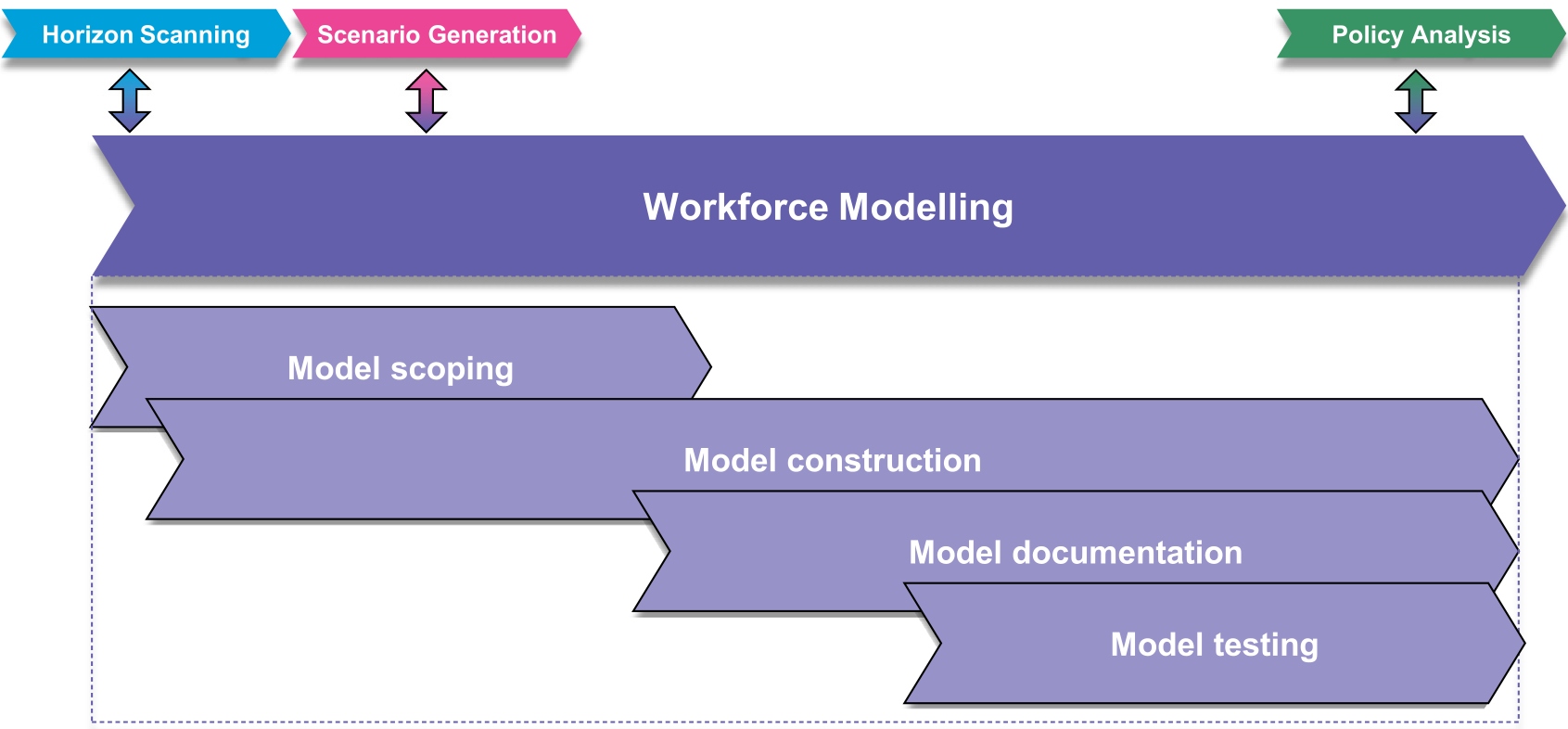
The paper introduces the "Robust Workforce Planning Framework" (RWP), a multi-methodology approach using System Dynamics (SD) to support national-level healthcare workforce strategy in England. Developed by the Centre for Workforce Intelligence (CfWI), it integrates horizon scanning, scenario generation, and SD modeling to achieve SOTA-level policy advice for complex healthcare professions like doctors and pharmacists.
TL;DR
The healthcare workforce is a high-inertia system where decisions made today take 15 years to manifest. This paper details the Robust Workforce Planning Framework (RWP), a sophisticated amalgamation of System Dynamics (SD), Horizon Scanning, and Expert Elicitation. Used at a national level in England, it provides a roadmap for managing the "dynamic complexity" of medical labor markets under deep uncertainty.
The "Dynamic Complexity" Trap
Why is planning a healthcare workforce harder than managing a supply chain? The authors point to three primary killers:
- Extreme Time Delays: Training a GP takes 10+ years; a specialist surgeon even longer. The "pipeline" is incredibly long.
- Combinatorial Complexity: Thousands of career paths, specialties, and sub-specialties interact, creating a "leaky bucket" effect through attrition and retirement.
- Uncertainty: How will AI affect the demand for radiologists in 2035? Static forecasts cannot answer this.
Traditional OR methods often try to optimize based on a single "most likely" future. This paper argues that such an approach is dangerous in healthcare—it’s better to be robust than optimal.
Methodology: The RWP Framework
The framework is a bridge between "Soft OR" (qualitative/messy) and "Hard OR" (mathematical/rigorous).
1. Horizon Scanning & Scenarios
Instead of starting with numbers, the team starts with weak signals. They use the TEEPSE framework (Technology, Economy, Environment, Politics, Society, Ethics) to build micro-narratives about the year 2040. These are then filtered into a nested matrix to create divergent scenarios.
2. The Engine: System Dynamics (SD)
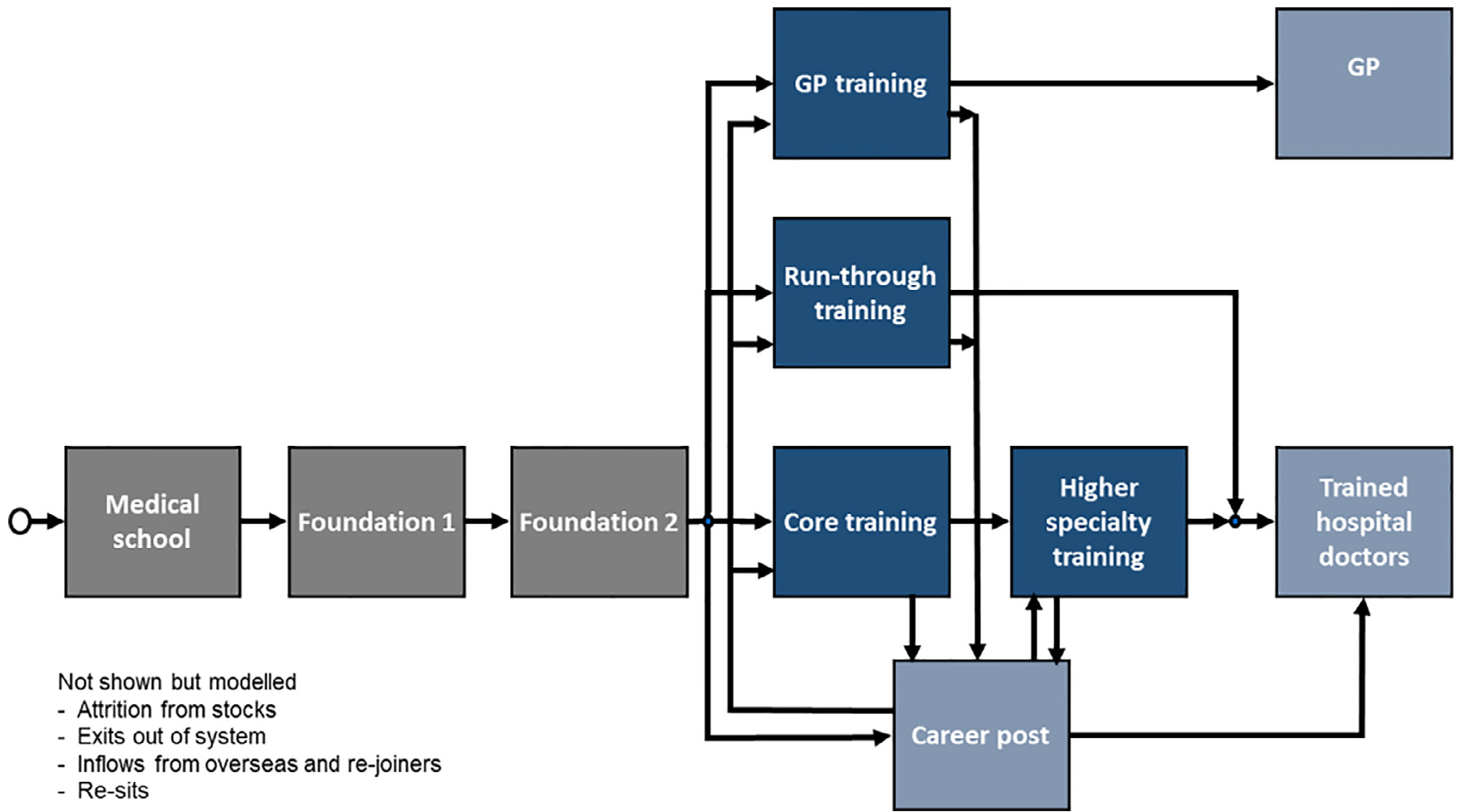
At the core of the framework is an SD Aging Chain Model. This isn't just a spreadsheet; it's a series of stocks (staff at a specific grade) and flows (recruitment, promotion, attrition).
 In the figure above, the model segments the workforce by age and gender to capture specific attrition behaviors (e.g., maternity leave or early retirement trends).
3. Quantifying the "Unquantifiable"
How do you put a number on a 20-year technology trend? The authors adopted the SHELF (Sheffield Elicitation Framework). This facilitated process pushes experts to define probability distributions (quartiles) for uncertain variables, reducing the "over-confidence bias" typical in expert forecasts.
Critical Results: Informing National Policy
The framework hasn't just lived in textbooks; it was the primary tool for the Centre for Workforce Intelligence (CfWI).
- Medical Intakes: The model suggested a 2% reduction in medical intakes to prevent a massive oversupply, saving taxpayers significant training costs.
- Pharmacy Surplus: Analysis revealed a staggering projected surplus of up to 19,000 pharmacists due to changes in medicine supply technology (internet pharmacies).
 Fan charts (illustrated above) were crucial for communicating to policy-makers that "the answer" isn't a single line, but a range of possibilities depending on the scenario.
A Senior Editor’s Perspective: Why This Matters
This work represents a "Double-Loop Learning" success story. Most OR papers focus on the algorithm. Willis et al. focus on the facilitated process.
The Takeaway: In the era of LLMs and Big Data, we often forget that strategic planning is a social process. The RWP framework excels because it uses SD as a "boundary object"—a visual tool that allows stakeholders with conflicting interests (budget holders vs. medical unions) to agree on the underlying structure of the system and test their assumptions safely.
Limitations: The model is highly dependent on the quality of expert elicitation. If the experts suffer from collective "groupthink" during the Horizon Scanning phase, the SD model will simply provide a rigorous simulation of a flawed premise. Future work should look at integrating real-time Big Data signals to "re-anchor" these long-term simulations more frequently.
Conclusion: For practitioners, the message is clear: Stop trying to predict 2040. Instead, build a laboratory (an SD model) where you can stress-test your policies against a dozen different 2040s.