
[arXiv 2026] EVA: Bridging the Executability Gap in Video World Models
This paper introduces Executable Video Alignment (EVA), a reinforcement learning framework that aligns video world models with robotic constraints. By using an Inverse Dynamics Model (IDM) as a reward provider, EVA ensures that generated visual rollouts translate into smooth, kinematically feasible robot actions, achieving a 52.6% success rate on the RoboTwin benchmark.
TL;DR
Video generative models are great at "imagining" the future, but they often lack a sense of physics. Executable Video Alignment (EVA) fixes this by using a robot's own "motor brain" (an Inverse Dynamics Model) to grade the videos. If the imagined video requires the robot to teleport its arm or move at infinite speed, it gets a low score. This creates video planners that aren't just pretty—they're actually executable.
The Problem: The "Executability Gap"
The current fashion in robotics is the decoupled paradigm:
- A Video World Model generates a "movie" of the robot completing the task.
- An IDM looks at that movie and figures out which button to press/joint to move.
The problem? General video models don't know that robot arms shouldn't stretch like rubber or snap across the screen in 0.01 seconds. We call this the Executability Gap. Even if a video looks "okay" to a human, the minute an IDM tries to decode it, it produces "jittery," dangerous, or impossible commands.
Methodology: The Action-Space Reward
Instead of just training on more data (Supervised Fine-Tuning), the authors use Reinforcement Learning (RL) to align the model.
1. The IDM as a Judge
The core insight is using the IDM not just as a tool to execute, but as a Reward Model. Since the IDM knows how pixels translate to joint angles, it can detect "hidden" physical errors in the video.
2. Dense Kinematic Rewards
EVA applies a multi-part penalty to the action sequences decoded from the generated videos:
- Smoothness: Penalizes high acceleration and "jerk" (the rate of change of acceleration) using a Huber loss.
- Embodiment Constraints: Penalizes any command that asks the robot to go faster than its motors allow or reach beyond its physical workspace.
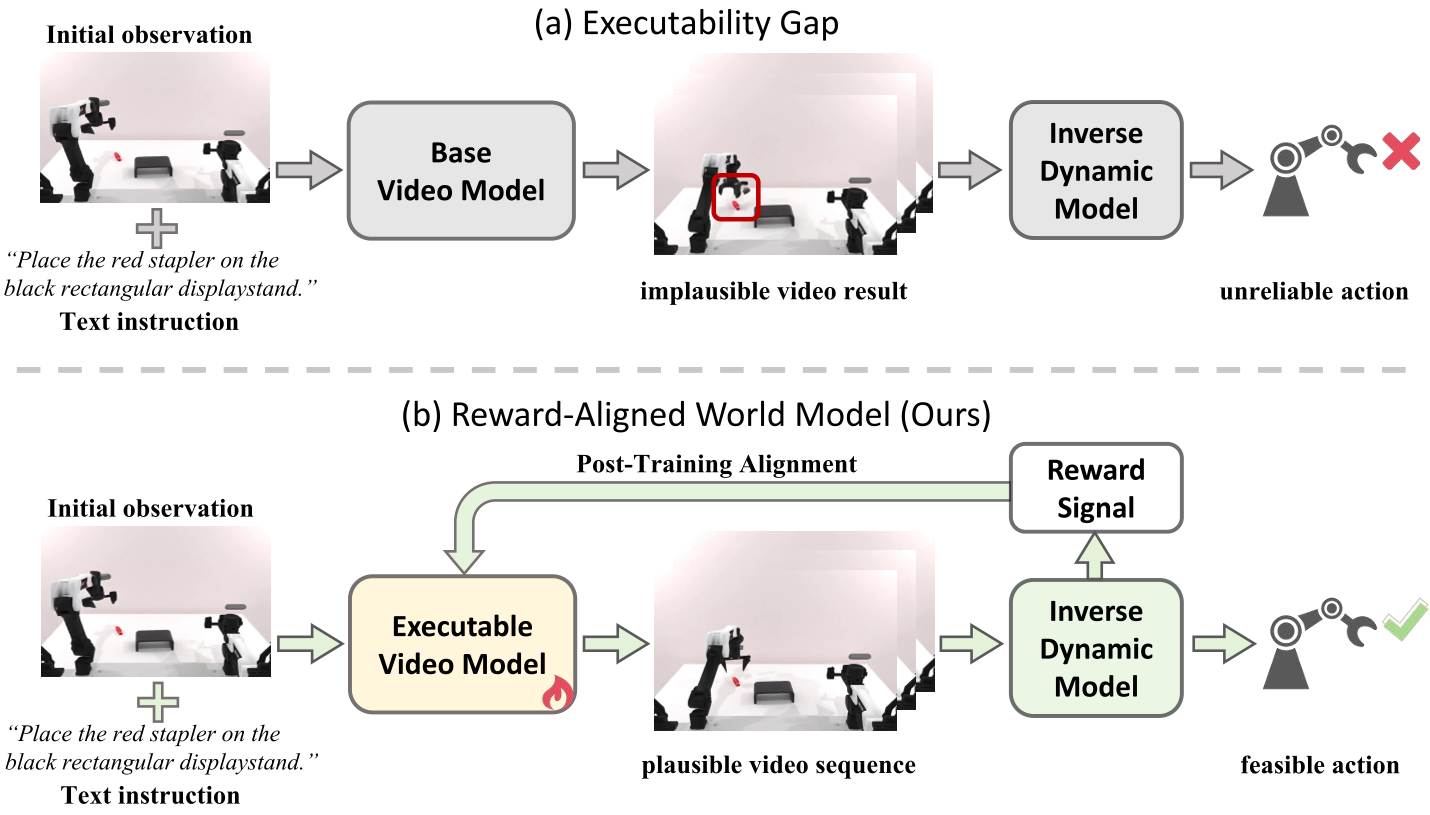 Figure 1: The EVA framework uses the IDM to convert generated frames into actions, which are then evaluated for feasibility to provide RL feedback.
Experiments & Results
The researchers tested EVA on the RoboTwin benchmark and a real AgileX CobotMagic bimanual platform.
Performance Gains
- Visual Realism: Human raters found that RL-aligned videos had significantly fewer "glitches" (Kinematic Plausibility jumped from 70.5% to 91.4%).
- Simulation: In the RoboTwin 2.0 benchmark, EVA boosted the average success rate from 46.2% to 52.6%.
- Real-World Robustness: Most impressively, on Novel (OOD) Tasks, EVA achieved a 60% success rate, nearly doubling the performance of basic video diffusion models (around 34%).
 Table 1: Real-world success rates showing EVA's superior generalization to novel tasks.
Why It Works: The Spatial Softmax Logic
In their ablation study, the authors found that how the IDM "sees" the video matters. Using a Spatial Softmax layer—which acts like a "keypoint detector"—was far more effective than general global pooling. This suggests that for world models to be useful, they must preserve the precise spatial relationships of the robot's links.
Critical Analysis & Conclusion
Takeaway: Action-space priors are the missing link in video-based robotics. By forcing the world model to "think" about the motor consequences of its visual predictions, we get more reliable planners.
Limitations:
- Reward Hacking: Long training sessions sometimes led to "static" behaviors where the robot did nothing (because a still robot is a very smooth robot!).
- Speed: Diffusion-based video generation is still slow, making it hard to use for high-speed, reactive tasks.
Future Outlook: EVA paves the way for "Foundation World Models" that understand physics not just through observation, but through the lens of their own physical capabilities.
Referenced Paper: Wang et al., "Aligning Video World Models with Executable Robot Actions via Inverse Dynamics Rewards", arXiv:2603.17808v1.