
BENCHPRESS: Why You Don’t Need to Run Every LLM Benchmark
You Don't Need to Run Every Eval
The paper introduces BENCHPRESS, a system that predicts Large Language Model (LLM) benchmark scores using a logit-space rank-2 matrix completion method. By analyzing a curated matrix of 84 frontier models across 133 benchmarks, the authors demonstrate that model performance is primarily determined by just two latent factors, reaching SOTA scorecard recovery with as few as five probe benchmarks.
TL;DR
Evaluating a modern AI model is like putting a student through 100 different exams just to find out they are "good at everything." This paper introduces BENCHPRESS, a tool that proves the LLM "scorecard" is mostly redundant. By running just five specific benchmarks, BENCHPRESS can predict a model's performance on over 100 others with a median error of less than 4 points.
Background: The Evaluation Explosion
We are currently in a "Benchmark Arms Race." Models like Qwen 3.5 or Claude 3.7 report scores on 40+ benchmarks to prove their worth. For researchers, this represents thousands of dollars and days of compute time. The authors of "You Don't Need to Run Every Eval" asked a simple, provocative question: Is model performance actually high-dimensional, or are we just measuring the same two things over and over again?
The "Rank-2" Insight: Model Performance is Simpler Than It Looks
The most striking discovery in this paper is the Rank-2 Geometry of the score matrix. After compiling a matrix of 84 frontier models and 133 benchmarks, the authors used Singular Value Decomposition (SVD) to analyze the underlying patterns.
They found that two factors explain over 90% of the variance between models. In physical terms, most of what makes a model "good" boils down to two axes:
- General Intelligence: The rising tide that lifts all boats.
- Reasoning/Math Specialty: The extra "kick" found in chain-of-thought and reasoning-heavy models.
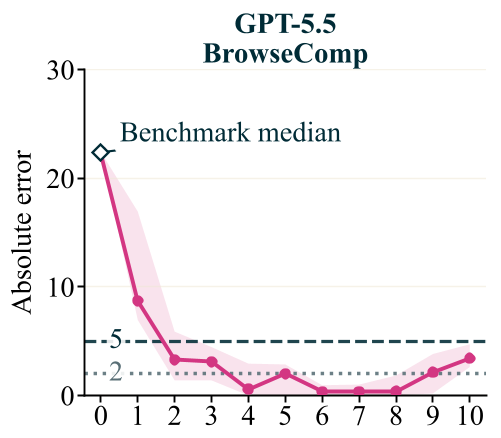 Figure 1: BENCHPRESS predicts unseen benchmark scores from a handful of revealed ones.
Methodology: How BENCHPRESS Predicts the Unknown
To turn this insight into a tool, the authors developed a matrix completion method called Logit Bias ALS.
- Logit Space: Since benchmark scores (0-100%) are non-linear (it’s harder to go from 98% to 99% than 50% to 51%), they transform the data into "Logit Space" to linearize it.
- Bias Decomposition: The model accounts for the fact that some benchmarks are naturally harder (benchmarking offset) and some models are naturally smarter (model offset).
- Low-Rank Correction: It then uses the rank-2 residual to fine-tune the interactions between a specific model and a specific type of task.
Results: The "Five-Benchmark" Scorecard
One of the most practical outputs of this research is identifying the "Probe Set." If you have a brand-new model and a limited budget, which tests should you run?
The authors found a "Golden Five" set: {GPQA-D, HLE, Codeforces, MMLU-Pro, ARC-AGI-1}. Running just these five allows BENCHPRESS to fill in the rest of a 133-benchmark scorecard to within 3.93 points of accuracy.
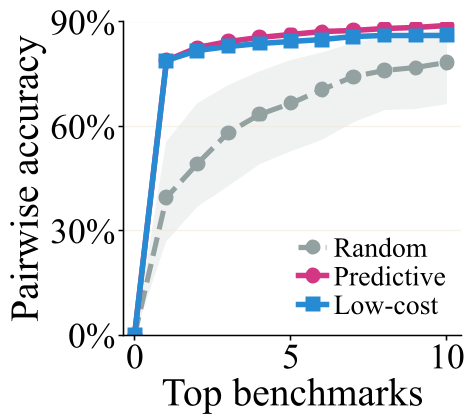 Figure 5: Error drops sharply as specific "probe" benchmarks are revealed, allowing for high-accuracy reconstruction.
Critical Insight: When Should You Trust the Prediction?
The authors didn't just build a predictor; they built a Confidence Layer. Through a hybrid reliability estimator, BENCHPRESS can tell you when it's guessing.
- High Trust: If the model has a "neighbor" in the matrix (e.g., GPT-4.5 vs GPT-4) and the benchmark has lots of previous data.
- Low Trust: If the model is a completely new architecture or the benchmark is a "lone wolf" with low correlation to others.
Conclusion: A New Era of "Inferred Evaluation"
This paper is a wake-up call for the AI industry. It suggests that while benchmarks are necessary for science, they are often redundant for selection and tracking training progress.
The Takeaway: Instead of wasting thousands of dollars on 100 benchmarks for every checkpoint, engineers can use BENCHPRESS to run a "Lite" version of their evaluation suite and infer the rest with statistical confidence.
Limitations: As the authors note, this rank-2 geometry is a snapshot of today's models. If a future model discovers a "third dimension" of intelligence (e.g., true social emotional intelligence or novel physical reasoning), the matrix will need to be re-calculated.