
Beyond the Score: Evaluating Voice Biomarkers in the AVEC 2019 Depression Challenge
Evaluating Acoustic and Linguistic Features of Detecting Depression Sub-Challenge Dataset
This paper evaluates the performance of acoustic and linguistic features in detecting depression using the AVEC 2019 Detecting Depression Sub-Challenge (DDS) dataset. The authors utilize traditional machine learning models and feature extraction tools like COVAREP and openSMILE to predict depression severity (PHQ-8 scores).
TL;DR
Depression affects over 300 million people, yet diagnosis remains largely dependent on subjective self-reporting. This paper dives into the AVEC 2019 Detecting Depression Sub-Challenge (DDS), investigating how acoustic and linguistic features can serve as objective "digital biomarkers." The researchers highlight critical flaws in current datasets—such as interviewer noise and data imbalance—and propose a methodology to refine audio features, achieving a Mean Absolute Error of 5.77 in predicting depression severity.
The "Ellie" Problem: Noise and Bias in Clinical Data
One of the most profound insights of this research is the critique of the DAIC-WOZ dataset. In these interviews, participants interact with "Ellie," a robotic agent.
The authors identified two major hurdles:
- Acoustic Contamination: Standard feature extraction often includes Ellie’s voice, which can bias the model or introduce extraneous noise.
- Dataset Imbalance: In the 2019 dataset, non-depressed participants outnumber depressed ones 3:1. This skew makes "Accuracy" a deceptive metric; a model could predict everyone as "not depressed" and still achieve high accuracy while failing those in need.
Methodology: Isolating the Signal
To combat these issues, the team at the University of Washington developed a pipeline to isolate participant speech.
1. Acoustic Refinement
Using the pydub and SoX (Sound Exchange) libraries, they sliced the audio based on timestamps to create "participant-only" files. They then compared two feature sets:
- COVAREP: Used for the 2017 data (79 features).
- eGeMAPS: Used for the 2019 data (88 features, focusing on physiological voice parameters).
2. Linguistic Markers
The researchers looked specifically for "Absolutist" language and pronoun shifts. Their hypothesis, supported by correlation analysis, was that depressed individuals use significantly more first-person singular pronouns ("I", "me") compared to plural ones ("we"), reflecting a state of "self-focused attention."
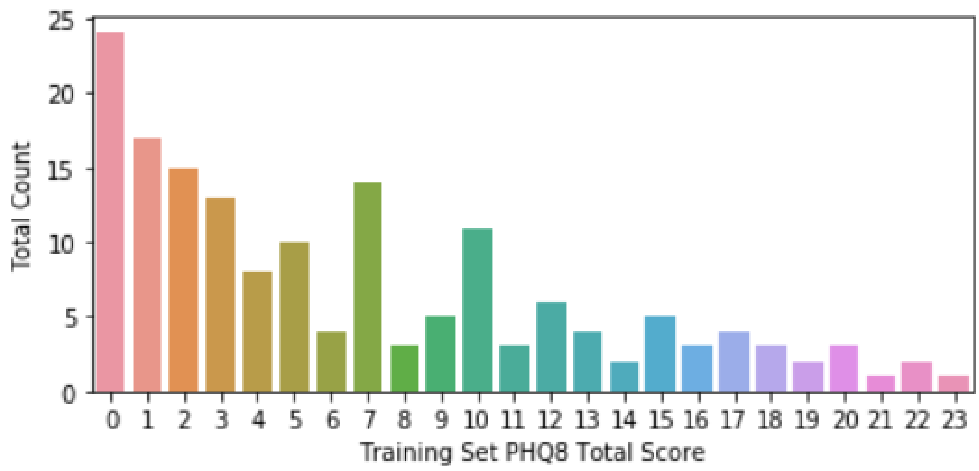 Figure 1: Distribution of PHQ-8 scores showing the heavy skew towards non-depressed (lower score) participants.
Key Results and Correlations
The study found that the presence of the interviewer's voice (Ellie) drastically changed which features the model deemed important. For instance, Pitch (50th percentile) showed a strong negative correlation (-0.38) in audio with Ellie, but this effectively disappeared in participant-only audio.
| Model | Set | MAE | RMSE |
|---|---|---|---|
| Random Forest (w/ Ellie) | Test 2019 | 5.77 | 6.78 |
| Random Forest (w/o Ellie) | Test 2019 | 5.84 | 6.85 |
| Ridge Regression (Text) | Test 2019 | 6.43 | 8.18 |
While the error rates remain relatively high, the Random Forest model consistently outperformed Logistic Regression. Notably, the linguistic models found that negative-valence words were highly correlated with both Depression and PTSD severity.
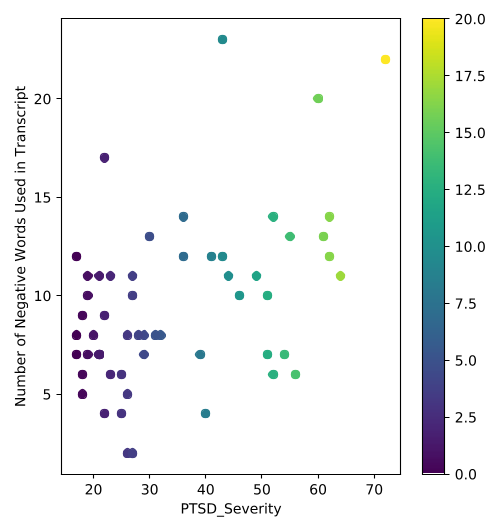 Figure 2: Correlation analysis confirming that negative word frequency is a robust predictor for PHQ-8 severity.
Critical Insight: Why "Participant-Level" Modeling Matters
The authors argue against "question-level" analysis. In many studies, each response is treated as an independent data point. However, this ignores Identity Confounding—the fact that a single person’s voice has inherent acoustic properties regardless of their mental state. By modeling at the participant level, the researchers ensure the model learns the change in voice associated with depression rather than just the person's unique vocal signature.
Conclusion and Future Outlook
This paper serves as a cautionary tale for AI in healthcare: Data quality is as important as model architecture.
- Diarization is Mandatory: We cannot build reliable biomarkers if the "noise" (the interviewer) is treated as "signal."
- Focus on Symptoms: Future work should move away from total PHQ scores and toward specific symptoms like psychomotor retardation (slowing of speech), which have clearer biological roots.
As datasets grow and preprocessing becomes more rigorous, voice-based AI stands to become a vital tool for early, objective depression screening.