
Decoding Emotions: Evaluating Classifiers for EEG-Based Affective Computing
Evaluating Classifiers for Emotion Recognition Using EEG
This paper evaluates five machine learning classifiers (KNN, SVM, BN, RT, and ANN) for emotion recognition using EEG signals. Utilizing the IAPS dataset for stimuli and extracting temporal features (Min, Max, Mean, SD), the study achieves a peak accuracy of 77.78% for small groups and 83.33% for individuals.
TL;DR
Recognizing human emotions through brainwaves is a technical "holy grail" for Human-Computer Interaction (HCI). This study compares five traditional machine learning algorithms—KNN, SVM, RT, BN, and ANN—on EEG data. While individual recognition is highly successful (up to 83.33%), the research reveals a critical "Generality Gap": as more people are added to the dataset, classifier accuracy drops significantly, highlighting the challenge of human physiological diversity.
Background: Tuning into the Brain
Traditional emotion recognition often relies on facial expressions or speech. However, these are easily masked. Electroencephalography (EEG) offers a passive, non-intrusive, and more "honest" window into the emotional state. By measuring the asymmetry between brain hemispheres and focusing on the Valence (positive vs. negative) and Arousal (calm vs. excited) dimensions, we can theoretically map the electrical landscape of feelings.
The "Person Stereotype" Challenge
The core problem identified by the authors is the Person Stereotype. Different individuals express the same emotion through wildly different physiological patterns.
- Prior Work Issues: Most studies report high accuracy but often on very small, homogeneous groups.
- The Scalability Wall: A feature that works for "Subject A" may act as noise for "Subject B," making it difficult to train a single universal classifier for general populations.
Methodology: From Raw Waves to Emotion Labels
The researchers employed a rigorous pipeline to move from raw voltage fluctuations to emotional classification:
- Stimuli: Subjects viewed images from the International Affective Picture System (IAPS).
- Preprocessing: Using EEGLAB and ICA (Independent Component Analysis) to filter out "artifacts" like eye blinks or muscle movements.
- Feature Extraction: They focused on four statistical markers—Minimum, Maximum, Mean, and Standard Deviation—across six key electrode positions (Fp1, Fp2, C3, C4, F3, F4).
- Classification: Five algorithms were tested using the WEKA data-mining tool with 10-fold cross-validation.
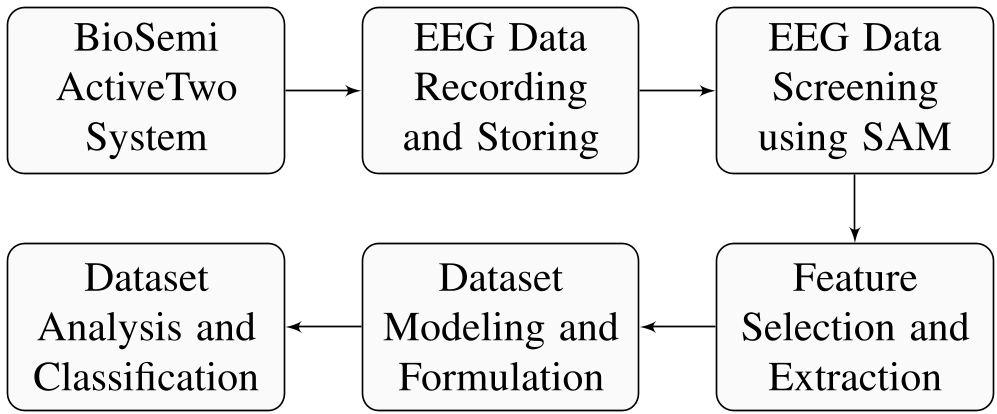 Figure 1: The workflow from EEG capture to final emotion classification.
Experiments & Results: The Specificity Reward
The results confirm that the "closer" the model is to the individual, the better it performs.
1. Large Scale (15 Subjects)
The performance here was underwhelming. SVM performed best but only reached 56.10%. This indicates that the selected features (Min, Max, etc.) were not robust enough to bridge the gap between 15 different brains.
2. Medium Scale (5 Subjects)
When the group size was reduced, accuracy jumped. SVM and KNN both surpassed 70%, with a peak of 77.78%.
3. Individual Scale (Single Subject)
This is where the algorithms shined. KNN reached a high of 83.33%. Interestingly, SVM, which was the leader in larger groups, struggled on individual data, suggesting that KNN’s distance-based approach is better at capturing the unique "cluster" of an individual's emotional signature.
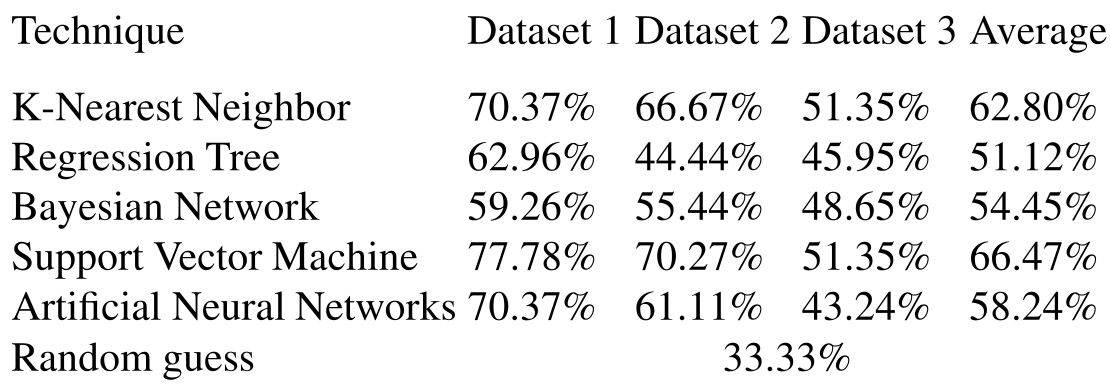 Table 2: Comparison of classifiers across three datasets of five subjects each.
Critical Insight & Future Outlook
The study proves that while KNN and SVM are robust choices, the real bottleneck isn't just the algorithm—it's the feature engineering.
Takeaways:
- Subjectivity is King: EEG patterns are like fingerprints. A "one-size-fits-all" model is currently ineffective for high-stakes emotion recognition.
- Feature Evolution: Moving beyond simple statistical means to more complex features (like Wavelet Transforms or Power Spectral Density) may be necessary for group-wide models.
- The Future: To make this viable for real-world products, we need Adaptive Classifiers that can start with a general template and "calibrate" specifically to the user's brain over time.
Conclusion
This work serves as a sobering reminder of the complexity of the human brain. While we can successfully "read" an individual's emotions with >80% accuracy, creating a system that understands everyone remains a significant hurdle in the field of Affective Computing.