
Quantification of Crisis: Measuring Emergency Team Coordination via Fuzzy Logic and SNA
Evaluating coordination in emergency response team by using fuzzy logic through social network analysis
This study presents a novel framework for evaluating the coordination level of Emergency Response Teams (ERT) by integrating Social Network Analysis (SNA) with Fuzzy Logic. By measuring trust, information interchange, and member involvement, the authors quantify team cohesion and coordination readiness, providing a mathematical assessment of operational effectiveness in high-stakes environments.
TL;DR
In a life-or-death crisis, the bottleneck isn't usually individual skill, but the coordination between teams. This paper introduces a hybrid model that uses Social Network Analysis (SNA) to measure "connectedness" and Fuzzy Logic to handle the ambiguity of trust and involvement. The findings show a stark contrast: frontline teams (Fire/Rescue) coordinate beautifully (0.79 score), but once you look at the whole organization, the system breaks down into silos (0.33 score).
The "Coordination Triangle" Challenge
Emergency response is often managed under the assumption that if each unit (Fire, Medical, Security, Logistics) is well-trained, the whole machine will work. The authors argue this is a fallacy. True coordination is built on three pillars: Trust, Information Interchange, and Involvement (ITI).
The difficulty lies in how to measure these. Trust is a "fuzzy" concept—you don't just have "0" or "1" trust. Information flow is a network property. By ignoring the mathematical structure of these relationships, organizations fail to predict where their response systems will snap under pressure.
Methodology: Bridging Math and Human Behavior
The authors utilize a two-pronged approach to feed a Fuzzy Inference System (FIS).
1. Social Network Analysis (SNA) - The Density Metric
Using structured interviews, the research maps the actual connections versus the possible connections. The Density Indicator acts as a proxy for cohesion.
- Trust Network: Measures the reliance of members on others' abilities.
- Information Network: Measures the frequency and depth of pre-emergency role clarification.
2. The Fuzzy Logic Controller
Because human perception ("low," "medium," "high") is imprecise, the authors use Fuzzy Sets to convert these words into mathematical membership functions.

Fig 1: The holistic evaluation process integrating SNA data and questionnaires into the Fuzzy system.
The system applies 100 "If-Then" rules (e.g., IF Trust is Low AND Information is Medium...) to produce a crisp Coordination Level output using the Center-of-Maximum (COM) defuzzification method.
Critical Results: The "Silo Effect"
The experiment conducted at a refinery refinery yielded sobering data.
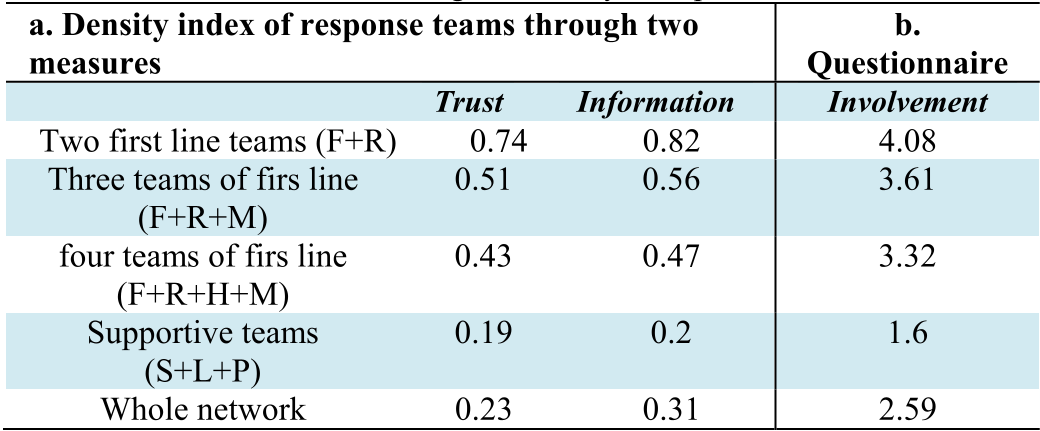
- The Frontline Paradox: Firefighting and Rescue teams achieved a coordination score of 0.79. They share 82% of possible information links and have high internal trust.
- The Systemic Collapse: When including the entire network—Medical, HSE, Logistics, and Security—the coordination score plummeted to 0.33.
- The Problem Area: Supportive teams (Security, Logistics) showed a density of only 0.19 to 0.20, indicating they are almost entirely disconnected from the operational core until a crisis occurs.
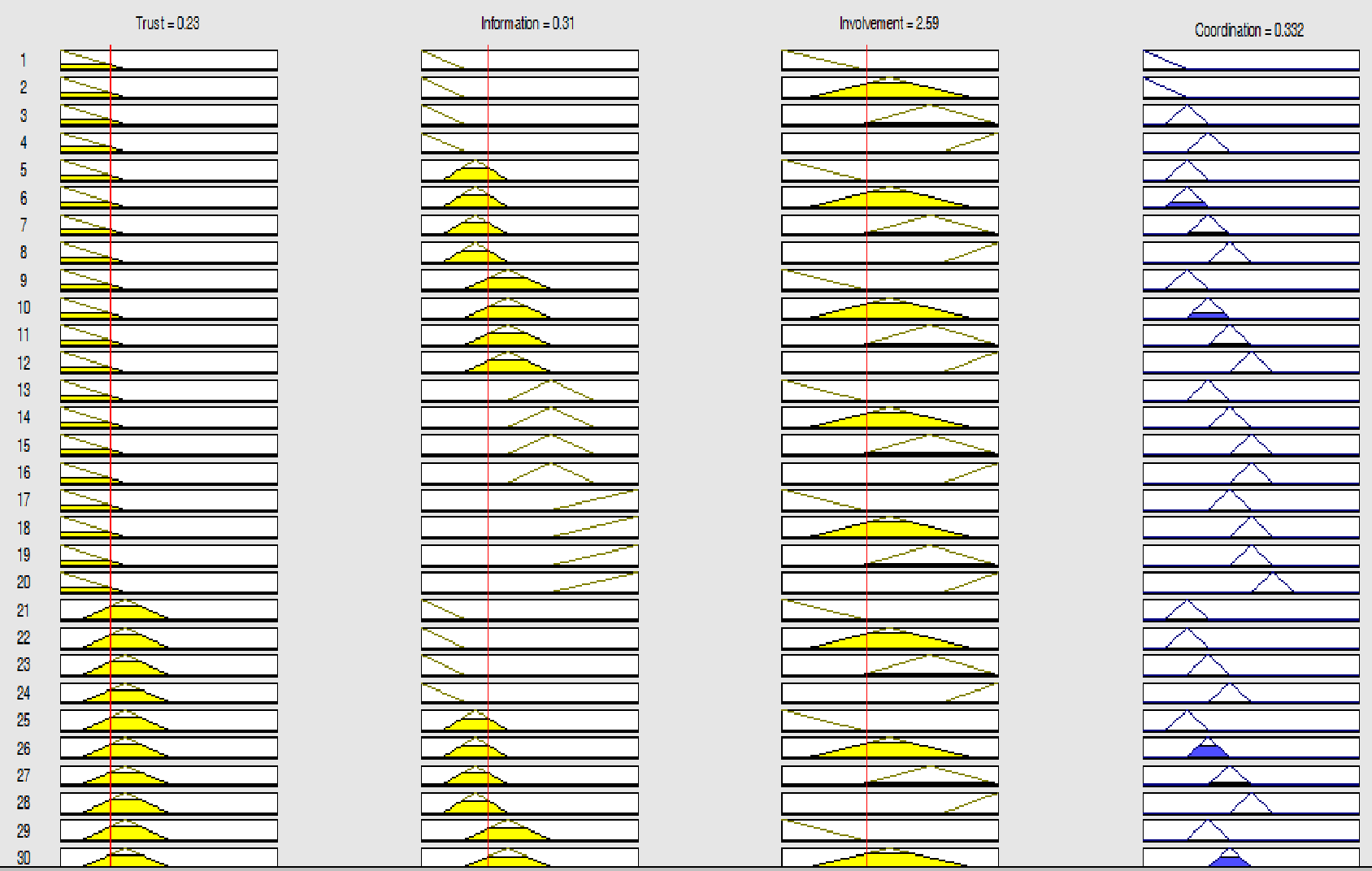
Fig. 2: The FIS rule viewer showing how the low input values for trust and information result in a "Low" coordination output of 0.332.
Deep Insight & Conclusion
This paper serves as a technical warning: Cohesion is not scale-invariant. A "heroic" firefighting unit cannot compensate for a "disconnected" logistics or medical team in a large-scale disaster.
Takeaway for Practitioners:
- Move beyond siloes: Drills must focus on the edges of the network (e.g., how Logistics talks to Firefighters), not just the nodes (skills within a single team).
- Institutionalize Trust: Trust isn't an "extra"; it is a functional requirement. Using Fuzzy Logic allows managers to see the "gray areas" of preparedness that standard Checklists miss.
Limitations: The study is localized to a single refinery and relies on self-reported data for trust. Future work should incorporate real-time communication logs (e.g., radio traffic metadata) to objectively validate the SNA density scores.