Beyond Search: Evaluating Knowledge Creation in Cultural Heritage Systems
Evaluating Cultural Heritage Information Access Systems - (Panel)
This paper synthesizes a panel discussion on "Evaluating Cultural Heritage Information Access Systems" (CHIAS) from IRCDL 2013, integrating perspectives from archival science, computer science, and digital humanities. It introduces a multifaceted evaluation framework using Visual Analytics and data modeling to move beyond simple retrieval metrics toward knowledge creation.
TL;DR
Digital Libraries are more than just repositories of raw files; they are active ecosystems for knowledge creation. This paper, based on the IRCDL 2013 panel, argues that evaluating Cultural Heritage Information Access Systems (CHIAS) requires a multidisciplinary shift. By combining Archival Context, Visual Analytics, and Digital Humanities modeling, the authors move evaluation from simple precision/recall metrics toward a comprehensive assessment of "interoperability, provenance, and user sense-making."
The "Flattening" Problem in Digital Archives
A significant tension exists between massive-volume digitization and meaningful access. In Italy alone, there are approximately 8,000 km of unique analogue records. Current digital libraries often "flatten" this data, treating complex archival records as isolated files while stripping away the provenance—the "who, where, and why" that gives an artifact its historical value.
The authors argue that current systems fail because:
- Lack of Collaboration: Digital curators and archivists are rarely involved in the technical communication process.
- Granular Solutions: Systems focus on individual files rather than the hierarchical relationships between them.
- Evaluation Blindness: Traditional metrics don't account for the "interpretive" value of curated presentations vs. raw material.
Methodology: Visual Analytics and The TME Cube
To solve the complexity of evaluation data, the paper introduces Visual Analytics (VA). VA is a semi-automated analytical process where human intuition and machine processing cooperate.
The TME Cube
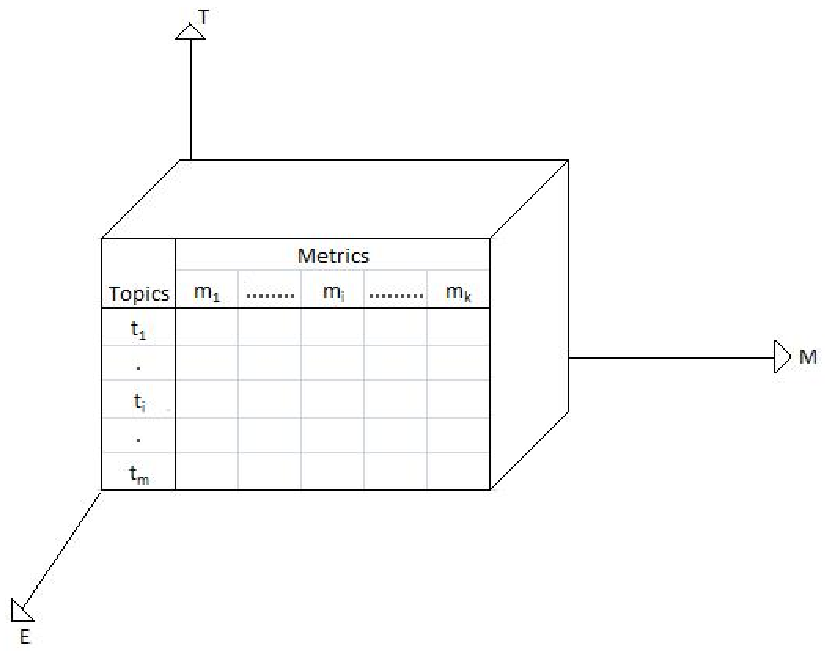
The cornerstone of their experimental evaluation is the Topics-Metrics-Experiment (TME) cube. This model allows evaluators to slice data across three dimensions:
- Topics: The specific themes or search queries.
- Metrics: Quantitative indicators (e.g., Mean Average Precision).
- Experiments: The different search engines or algorithms being tested.
Visual Analysis Patterns
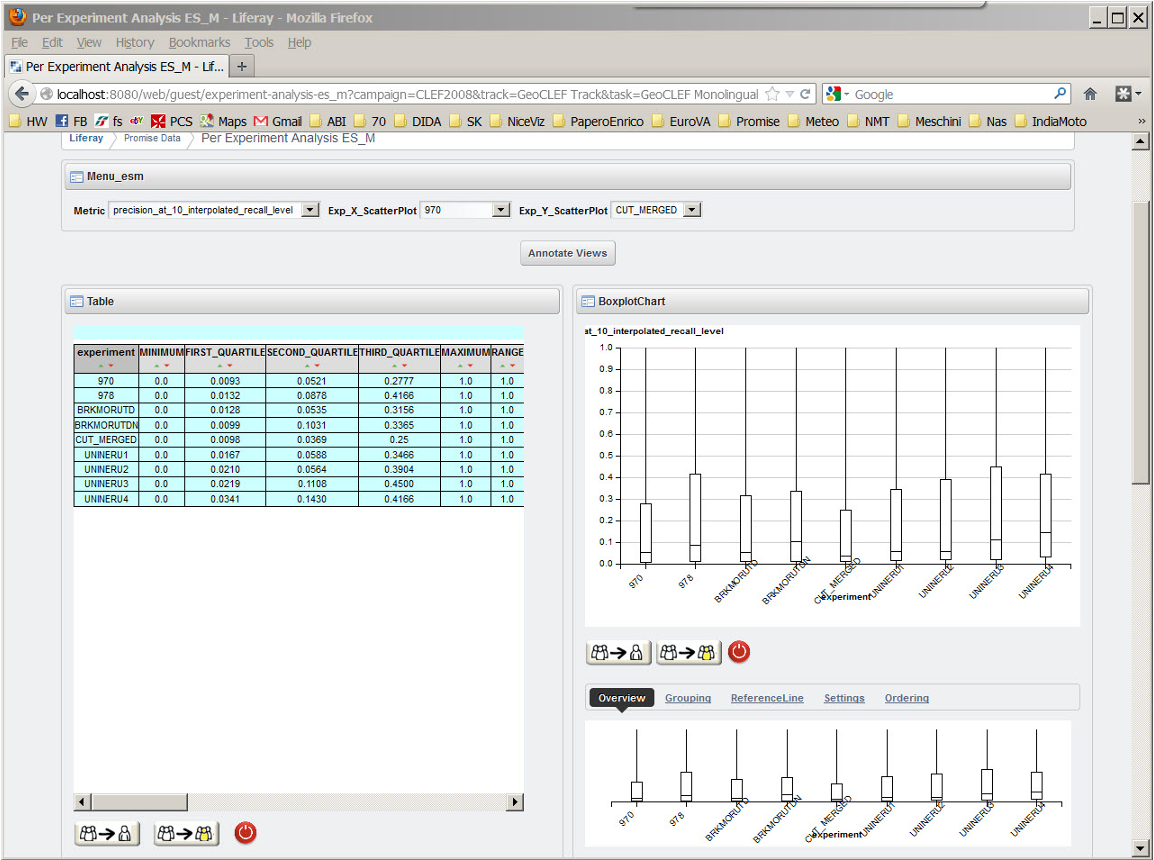
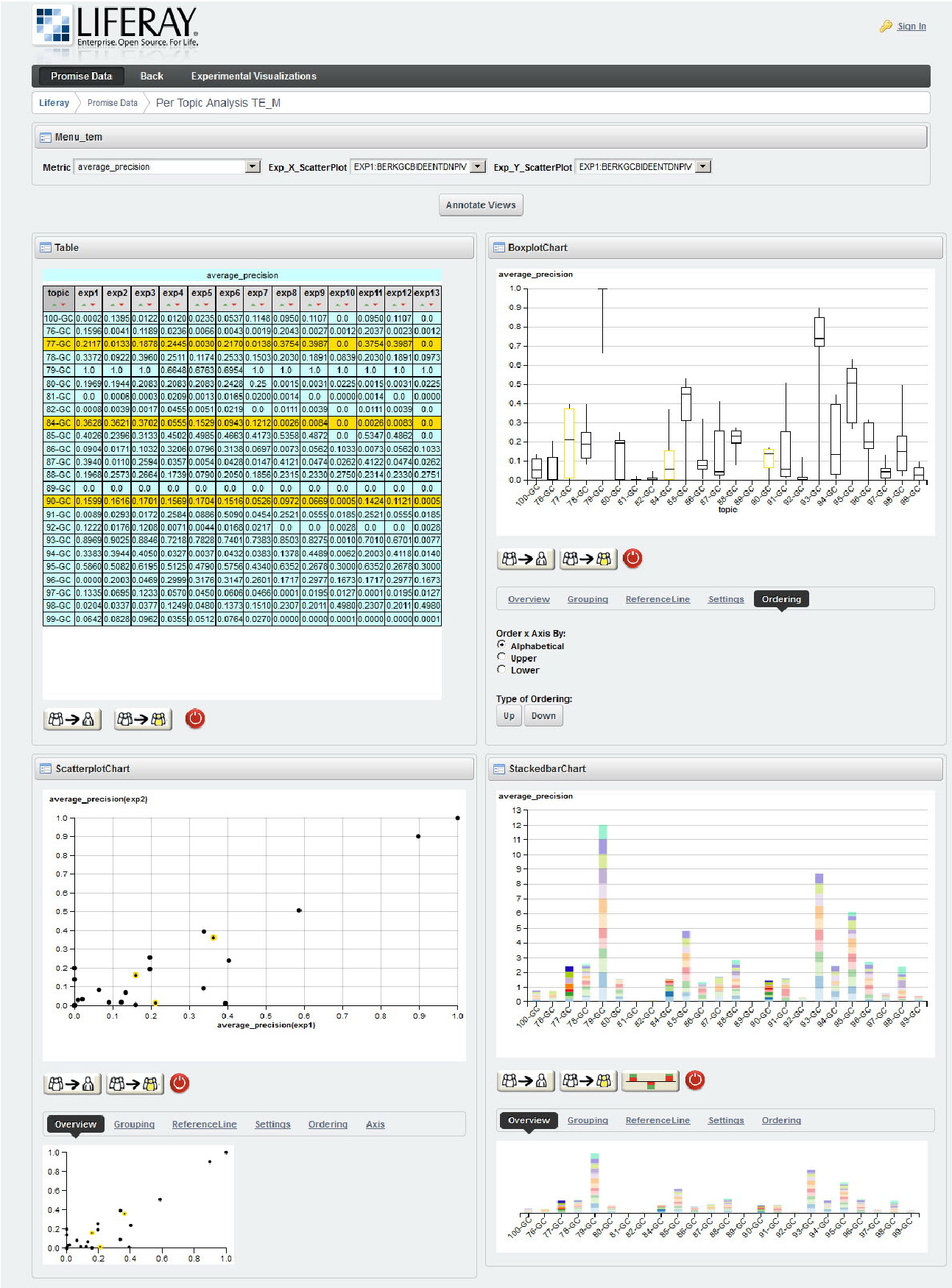
The PROMISE prototype implements two primary analysis patterns:
- Per Topic Analysis: Uses box plots and scatter plots to see how a specific search engine behaves across different queries.
- Per Experiment Analysis: Compares the macro-performance of different systems to determine which is more robust as a whole.
Digital Humanities: Modeling for "Faceted Navigation"
From a Digital Humanities (DH) perspective, the user experience is only as good as the underlying Data Model. The goal is not just to provide a search bar, but to enable "browsing by relationships."
The authors categorize these relationships into three tiers:
- Lexical Networks: Synonyms and related terms.
- Structural Connections: Linking paratext, hypertext, and metatext.
- Concepts/Topics: Overlapping meanings and professional contexts.
This modeling allows for Faceted Navigation, where users can filter heterogeneous media (photos, audio, manuscripts) through specific "facets" or semantic classes, fulfilling complex research needs rather than just keyword matches.
Critical Insight & SOTA Comparison
Compared to standard Information Retrieval (IR) systems, which prioritize speed and high-volume matching, a CHIAS must prioritize Integration over Convergence. While many Italian projects (like SIAR or the Sapienza Digital Library) attempt to use national standards, the authors note a critical "lack of financial resources" and a tendency toward "static representation" that hinders international interoperability like Europeana.
Conclusion: The Path Forward
The panel concludes that the future of Cultural Heritage access lies in Intermediation. We need tools that don't just "show" the data, but help the user "make sense" of it.
Takeaways for Researchers:
- Provenance is non-negotiable: If a digital library loses the context of an item, it loses its scientific value.
- Visualization is the Bridge: Large-scale evaluation data is too complex for spreadsheets; Visual Analytics is mandatory for interpreting system performance.
- User Logs as a Gold Mine: Future systems should analyze navigation behavior (how facets are used) to refine the underlying data model.