
Designing for Self-Control: How UI Interventions Can 'Hack' Social Media Distraction
'I Just Want to Hack Myself to Not Get Distracted': Evaluating Design Interventions for Self-Control on Facebook
This study evaluates the effectiveness of two design interventions—goal reminders and newsfeed removal—intended to mitigate "Problematic Facebook Use" (PFU) among university students. Using a mixed-methods approach combining usage logging, surveys, and interviews, the researchers demonstrate that both interventions significantly improve perceived self-control and reduce distractibility on the platform.
TL;DR
Facebook is a double-edged sword: essential for social coordination but a massive "time sink" for the prefrontal cortex. This study explores whether we can re-engineer the Facebook UI to support self-control. By testing goal reminders and newsfeed removal, the researchers found that while both reduce mindless scrolling, they carry distinct psychological trade-offs—annoyance versus the fear of missing out.
Problem & Motivation: The Struggle for the 'Digital Self'
In the academic world, "Problematic Facebook Use" (PFU) isn't just a buzzword; it’s a quantified decline in student wellbeing and academic achievement. The core issue is a failure of Self-Control, defined here as the conflict between:
- System 1: Habitual, automatic responses triggered by a red notification dot or an infinite scroll.
- System 2: Conscious, goal-directed intentions (e.g., "I just need to check the time for that group meeting").
Most existing solutions either demand total "social media sobriety" (deactivation) or offer tools without any data to prove they work. This study bridge that gap by looking at how specific UI "frictions" affect the battle between these two cognitive systems.
Methodology: Engineering Frictions
The researchers deployed three versions of a Chrome extension to 58 students:
- Cgoal (The Goal Reminder): Asks "What are you here for?" and periodically pops up a banner reminding you of your answer.
- Cno-feed (The Eradicator): Simply hides the newsfeed, leaving only the utility functions (Messages, Groups, Events).
- Ccontrol: Changes the background to white (a "placebo" to check for the Hawthorne effect).
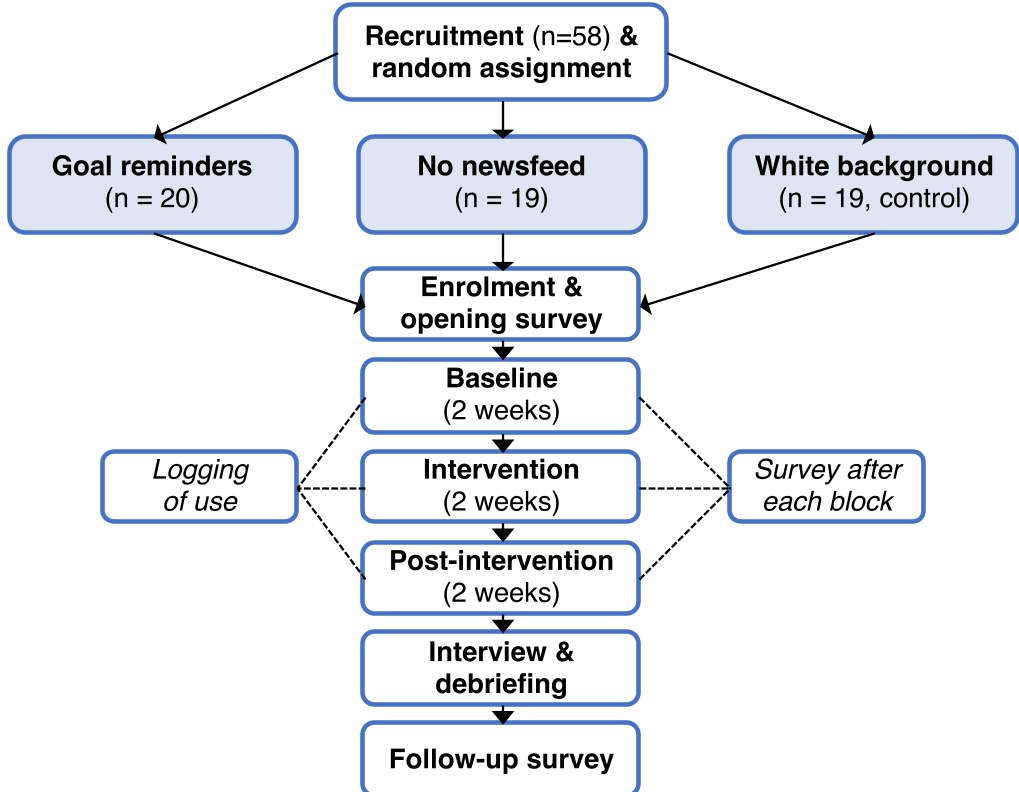
The genius of the study lies in its triangulation: they didn't just ask users if they felt better; they logged every click, scroll, and "Like" via the ROSE tracking extension.
Core Insight: Snapping Out vs. Preventing the Trigger
The results reveal a fascinating divergence in how we "hack" our brains:
1. Goal Reminders: The System 2 'Alarm'
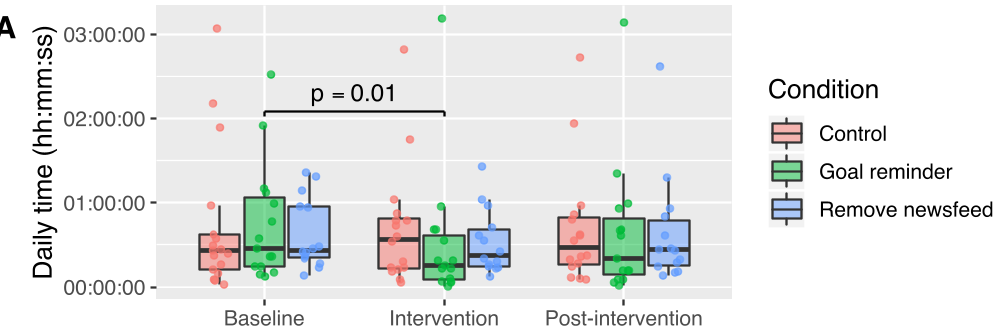
Goal reminders acted as a cognitive "snap." Participants noted it helped them snap out of an automatic trance.
- Impact: Daily visits plummeted from 29 to 10.
- Side Effect: It felt like a "guilty conscience" or an annoying parent, leading some users to type gibberish into the prompt just to bypass it.
2. Newsfeed Removal: The System 1 'Shield'
Removing the feed changed the "information landscape" entirely.
- Impact: Scrolling was reduced by 73%. Visits became shorter and more purposeful.
- Side Effect: FOMO. Users felt they were missing out on the "social peripheral vision" that the newsfeed provides.
Deep Insight: The Cross-Device Escape Hatch
One of the most revealing findings was that 86% of the Cgoal group and 57% of the Cno-feed group changed how they used their smartphones. When the laptop experience became "too difficult" or "too boring," users often migrated to their phones. However, even this move was sometimes deliberate—the "friction" on the laptop forced them to consciously decide if a check-in was worth the effort of getting up and finding their phone.
Critical Analysis & Conclusion: The Future of 'Duty of Care'
The study concludes that there is no "one size fits all" for digital self-control.
- The System 1 Approach (Feed Removal) is likely more effective long-term because it reduces the need for willpower.
- The System 2 Approach (Reminders) helps build awareness but risks "intervention fatigue."
The Takeaway for Product Designers: We should stop viewing "engagement" as the only metric of success. This paper provides a blueprint for "Harm Reduction" in UI design—allowing users to set their own boundaries and creating tools that respect the user's "past self" (the one who wants to study) over their "present self" (the one who wants to watch cat videos).
Limitations: The study was limited to laptop use. As we saw, the "Conservation of Procrastination" suggests that if you block one hole, the water might just leak out of another (the smartphone). Future research must track the "Global Digital Budget" across all devices to see the true impact of these interventions.