
Beyond "Likes": A Systematic Framework for Evaluating Hotel Facebook Pages
Evaluating Facebook pages for small hotels: a systematic approach
The paper introduces a systematic two-tier evaluation model designed for "small" hotels to assess and optimize their Facebook pages. It combines an expert inspection-based quantitative table with a user-rating-based qualitative questionnaire, validating the approach through an exploratory study of twenty Italian hotels.
TL;DR
Social media presence is no longer optional for the hospitality industry, but for small hotels, "being there" isn't the same as "doing it well." This paper by Luisa Mich and Rodolfo Baggio provides a systematic, validated model to evaluate Facebook pages using a dual-track approach: objective quantitative metrics (Interactivity, Content, Media) and subjective user ratings. The study proves that simple, "dichotomized" checklists are surprisingly accurate in predicting user satisfaction.
The Problem: The Ambiguity of Web 2.0 Quality
In the era of Web 1.0, evaluation was simple: does the site load? Is the information accurate? However, Web 2.0—and Facebook specifically—introduced a layer of human dynamics that traditional models struggle to measure. Small hotels often suffer from the "resource bottleneck," where they lack the expertise to know if their social media activity is actually generating value or just creating "digital noise." Prior research has been either too abstract (theoretical frameworks) or too narrow (focusing only on conversion rates), leaving a gap for a practical, mid-level diagnostic tool.
Methodology: The Two-Table Model
The authors argue for Parsimony—the idea that a model should be as simple as possible but no simpler. They developed a dual-tier system:
- Quantitative Inspection (The "What"): A checklist of 25+ factors ranging from post frequency to the presence of booking forms. To make it usable for non-experts, they converted raw numbers (e.g., number of likes) into Boolean (Yes/No) values based on median industry thresholds.
- Qualitative User Rating (The "How"): A 5-point Likert scale questionnaire focusing on "sentiment," "perceived Target-Suitability," and "likelihood to recommend."
System Architecture and Factor Logic
The model categorizes quality into three pillars: Interactivity-Communication, Content-Information, and Media-Graphic Design.
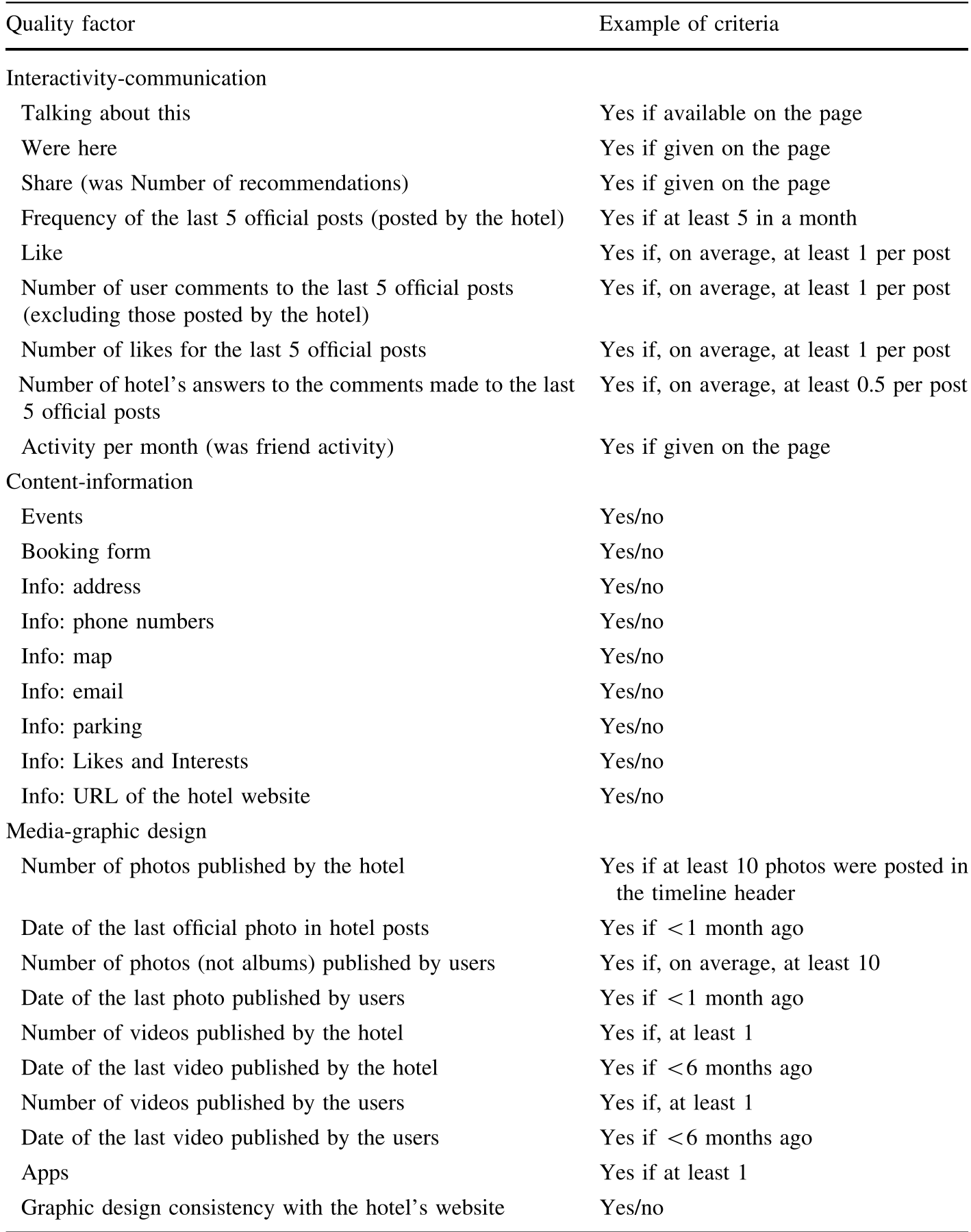 The quantitative factors focus on measurable engagement and the presence of critical business utilities like maps and booking links.
Experiments and Deep Insights
The researchers tested the model on 20 Italian hotels. The findings were revealing:
- The Interactivity Gap: Even "award-nominated" hotels scored poorly in interactivity. Frequency of posts is the #1 pain point for small operators.
- Invisible Utilities: Surprisingly, 75% of the sampled hotels failed to provide a map or mention parking facilities—basic information that travelers need "on the go."
- Validation of the "Boolean" Approach: The study found a strong correlation between the simple "Yes/No" quantitative scores and the complex user-rating scores (R² = 0.464). This means that a manager can get a very good sense of their "brand sentiment" just by looking at their internal engagement numbers.
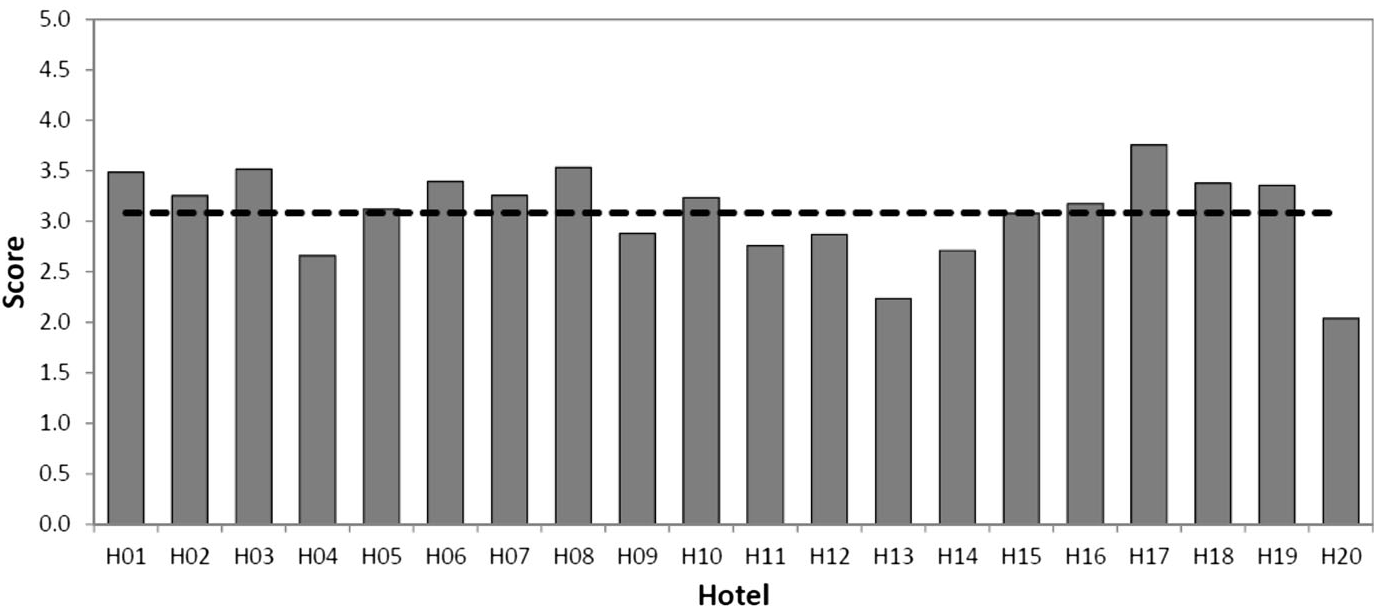 Figure: Average score for qualitative characteristics. Note the low scores for 'Videos' and 'Interactive Apps', indicating these remain untapped opportunities for differentiation.
Critical Analysis & Conclusion
Takeaway
The paper’s core contribution is the democratization of social media auditing. By providing a validated, low-cost framework that requires no specialized software beyond an Excel sheet, the authors empower small hotel owners to benchmark themselves against "Best-in-Class" competitors.
Limitations
The social media landscape moves faster than academic publishing. The "Timeline" layout mentioned in the paper has since evolved. Furthermore, the model relies on manual "inspection," which is time-consuming.
Future Outlook
The next logical step is Automation. As the authors suggest, using Facebook's APIs to feed these tables automatically would allow for real-time competitive Intelligence. This framework remains a foundational template for any business—not just hotels—looking to move beyond vanity metrics toward a structured digital strategy.