
Virtual Crowds and Emotional Contagion: Does the Background Change How We See Individuals?
Evaluating the perception of group emotion from full body movements in the context of virtual crowds
The paper investigates how social context—specifically the emotional state of a background virtual crowd—influences the perception of emotions expressed by foreground individuals. Using animated androgynous mannequins and motion-captured data, the researchers demonstrated that task-irrelevant background emotions can significantly bias the rating of task-relevant characters, particularly in negative valence scenarios.
TL;DR
In the world of computer graphics, we often assume that an "animation" is a static asset—if a character looks happy in isolation, they should look happy anywhere. This research by Carretero et al. proves otherwise. By placing expressive virtual agents in varied crowd contexts, they found that the background crowd's emotional state significantly skews our perception of foreground characters, with a particular sensitivity to negative (sad) contexts.
Contextual Blindspots in Animation
While high-fidelity rendering and path-finding for virtual crowds have reached impressive heights (think AAA games and blockbuster VFX), the social perception of these crowds is a frontier. Most prior work deals with the "What" (the motion) rather than the "Where" (the environment). The authors argue that if emotion perception is context-dependent, simply transferring a "Happy_Walk_01" animation from a festive scene to a funeral scene might cause it to be misperceived, leading to a breakdown in narrative immersion.
Methodology: The Science of "Vibe"
To isolate full-body movement from facial expressions (which often dominate perception), the team used androgynous mannequins.
The Setup:
- Stimuli: 200 background characters (static groups and mobile walkers).
- Variables: Foreground emotion (Happy, Neutral, Sad) × Background emotion (Happy, Neutral, Sad).
- Apparatus: A Tobii X1 Light Eye Tracker was used to ensure participants weren't just "looking at the background" by mistake.
 Figure 1: The experimental setup showing the central foreground group (task-relevant) and the surrounding crowd (task-irrelevant).
The study utilized motion-capture data from the CMU and UCLIC databases, ensuring that the "Neutral," "Happy," and "Sad" labels were rooted in established affective research.
Key Finding: The Negativity Bias
The most striking result was the asymmetry of influence. While a happy background slightly uplifted neutral characters, a sad background had a more robust negative pull.
When participants were asked to rate the foreground, the background's "sadness" consistently dragged the valence scores down. This aligns with a psychological phenomenon known as Negativity Bias, where human brains weigh negative information more heavily than positive information.
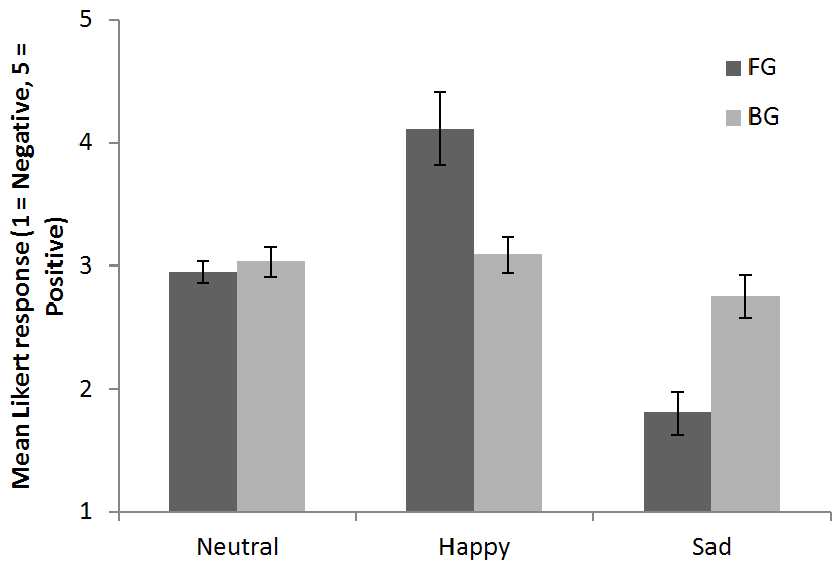 Figure 2: Statistical breakdown showing how background valence (BG) shifts the perceived valence of the foreground (FG).
Eye-Tracking: Overt vs. Covert Attention
One might argue that participants were simply looking at the background. However, the eye-tracking "heat maps" proved that participants kept their eyes locked on the foreground protagonists.
Their brains, however, were performing ensemble representation—unconsciously averaging the emotional "temperature" of the entire scene and applying that bias to the specific individuals they were evaluating.
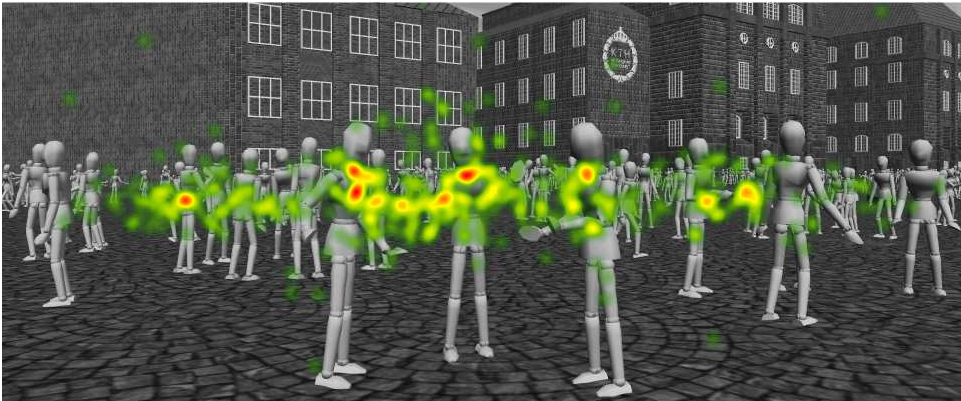 Figure 3: Heat maps confirming that even when overt attention (fixation) is focused on the center, the perceived emotion is influenced by the surrounding context.
Critical Insight & Industry Value
This paper serves as a warning to technical animators and game designers: Emotion is not a property of an FBX file; it is a property of the final composition.
Takeaways for Future Research:
- Asset Reuse: We cannot assume a motion-captured behavior is "neutral" once placed in a high-intensity environment.
- Negativity Dominance: Designers should be extra careful when building depressing or low-valence environments, as they will "bleed" into the perception of every character within them.
- Limitations: The study used a fixed camera angle and generic textures. Future work should explore if high-detail facial rendering "overwhelms" this social context effect.
Conclusion
The perception of "the one" is inextricably linked to "the many." By proving that a virtual crowd functions as an emotional filter, Carretero and his team have opened a new chapter in how we design believable, socially-aware digital worlds.