
Green NetWork: Leveraging Social Media for Workplace Sustainability
Evaluating a social media application for sustainability in the workplace
This paper introduces "Green NetWork," a specialized social media application designed to promote energy awareness and sustainable behavior among office workers. It leverages social influence and normative feedback within the workplace to bridge the communication gap between building managers and occupants, aiming for a 5-15% reduction in energy consumption.
TL;DR
"Green NetWork" is a research-driven social platform developed at UC Berkeley that targets the "invisible" nature of energy consumption in office buildings. By integrating social networking—complete with newsfeeds, competitions, and data-driven "apps"—the project aims to turn passive office occupants into active energy-savers through peer influence and improved communication with facility managers.
Problem & Motivation: The "Information Gap" in Commercial Buildings
The authors identify a critical disconnect in how commercial buildings operate. While facility managers (expert users) have the data but lack the influence over individual habits, the occupants (general users) have the intent to save energy but lack the data and feedback loops to do so.
Key pain points include:
- Lack of Immediacy: Energy feedback is usually presented in monthly bills or administrative reports, not daily workflows.
- One-Way Communication: Historically, occupants only communicate with building managers when they are "too cold" or "too hot" (complaints), rather than discussing collaborative sustainability.
- Absence of Social Context: Individuals don't know if their conservation efforts are significant because they cannot see what their peers are doing.
Methodology: Designing a Persuasive "Societal Interface"
To solve this, the authors propose a Persuasive Technology approach. Green NetWork is designed as a private, campus-scale social network that utilizes several key modules:
- The Billboard & Newsfeed: A centralized hub for tips, problems, and surveys, allowing managers to communicate directly with occupants.
- Energy "Apps": Interactive modules titled "My Energy Use" and "Group Energy Use." These take real-time data from wattmeters and BEMS (Building Energy Management Systems) and visualize it for the user.
- Normative Comparisons: Users can see "Green Points" and "Badges," comparing their scores with others to trigger the psychological desire to conform to positive social norms.
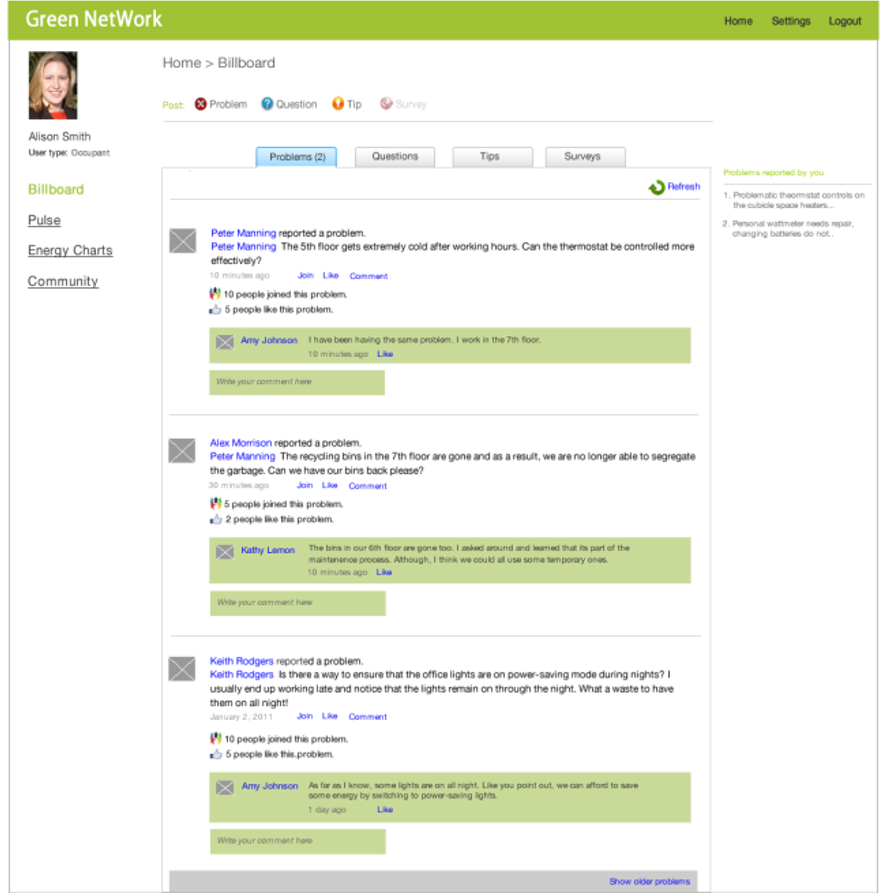 Figure 1: The Green NetWork homepage featuring a newsfeed integrated with sustainability updates.
Experimental Setup & Expected Results
The research moves through iterative design phases, moving from storyboards to clickable prototypes. The evaluation strategy involves:
- Expert Interviews: Gathering feedback from building managers on how the tool assists in building operations.
- Large-Scale Lab Testing: Utilizing the X-lab at UC Berkeley to measure how typical office workers perceive the usefulness of features like "Energy Competitions."
Previous residential studies suggest energy savings of 5-15% when feedback is effective. This research seeks to replicate and exceed these figures in the commercial sector by moving energy data from a spreadsheet into a social context.
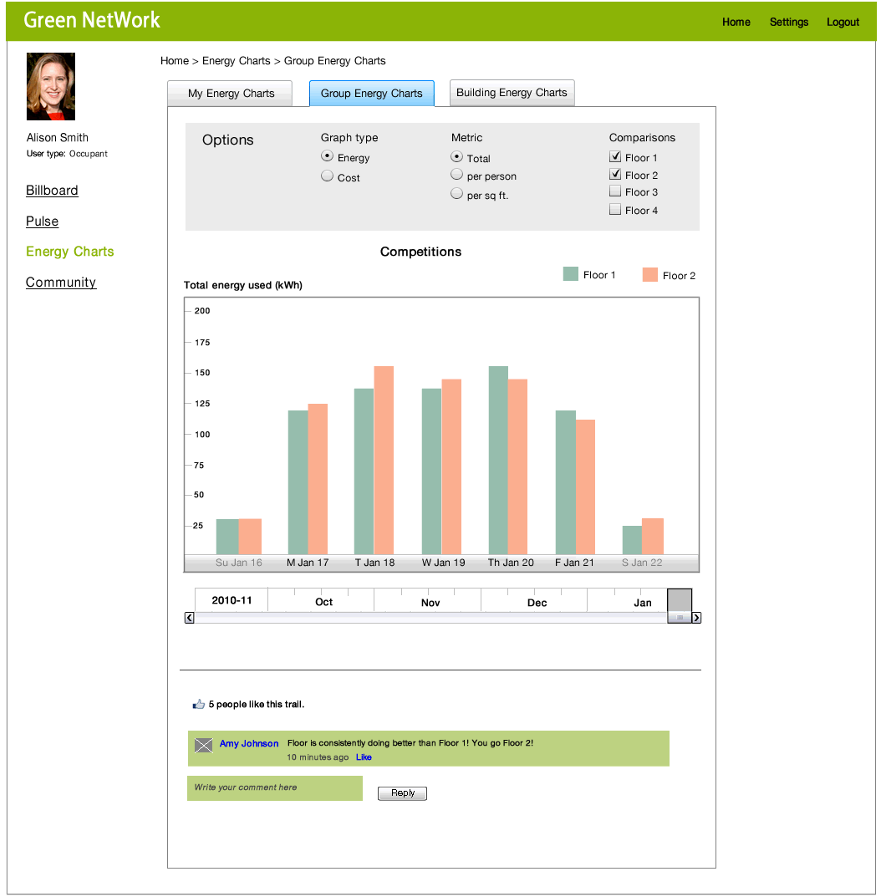 Figure 2: The "Energy Competitions" feature, designed to gamify sustainability through peer comparison.
Critical Insight & Future Outlook
The core value of this work lies in its definition of the "Societal Interface." It acknowledges that technology alone doesn't save energy—human behavior does. By creating a digital space where sustainability is a social currency (through badges and likes), the "Green NetWork" makes eco-behavior rewarding rather than a chore.
Limitations & Future Work
- Scale: The current prototype is tested in a lab; the next phase requires a pilot in buildings with 1,000+ occupants to measure real-world kilowatt-hour (kWh) reductions.
- Integration: While currently a standalone app, the authors suggest integrating these features into professional networks like LinkedIn to align corporate sustainability goals with employee professional profiles.
Conclusion
Green NetWork represents a shift from "monitoring systems" to "engagement systems." It proves that for sustainability ROI, we need to focus as much on the Human-Computer Interaction (HCI) and social psychology as we do on the engineering of the building itself.