
Can Surrogates Replace Simulations? Evaluating Approximations for Influence Maximization
Evaluating surrogate models for multi-objective influence maximization in social networks
2018-07-06
Summary
Problem
Method
Results
Takeaways
Abstract
This paper evaluates the effectiveness of surrogate models, specifically Expected Degree Value (EDV) and Probability Sorting (PS), for Multi-Objective Influence Maximization (MOIM) in social networks. It integrates these approximations into a Multi-Objective Evolutionary Algorithm (MOEA) to reduce the computational burden of Monte Carlo simulations.
## TL;DR
Finding the most influential nodes in a social network is a classic but computationally "expensive" problem. This paper investigates whether we can cheat the clock by using **surrogate models** (fast mathematical approximations) instead of slow **Monte Carlo simulations** within an Evolutionary Algorithm. The verdict? It's risky. While surrogates like **Expected Degree Value (EDV)** are 150x faster, they often point the algorithm in the wrong direction, leading to significantly worse results.
## The Scalability Wall
Influence Maximization (IM) seeks a "seed set" of nodes that triggers the largest cascade of information. The standard **Independent Cascade (IC)** model is stochastic, meaning to get a reliable estimate of a seed set's power, you must simulate the "flush" of information hundreds or thousands of times.
For Multi-Objective Evolutionary Algorithms (MOEAs), which need to evaluate thousands of candidate sets across many generations, this creates a **computational bottleneck**. The researchers aimed to break this wall by swapping simulations for two popular approximations:
1. **Expected Degree Value (EDV)**: A local heuristic that estimates influence based on the degrees of immediate neighbors.
2. **Probability Sorting (PS)**: A technique that converts a probabilistic graph into a single deterministic representative graph.
## Methodology: The GA-Surrogate Hybrid
The authors employed a specialized **NSGA-II** framework. Instead of just finding the best 50 nodes, the MOEA searches for the entire **Pareto front**, showing the trade-off between the number of seeds ($k$) and the total influence reaches ($\sigma(A)$).
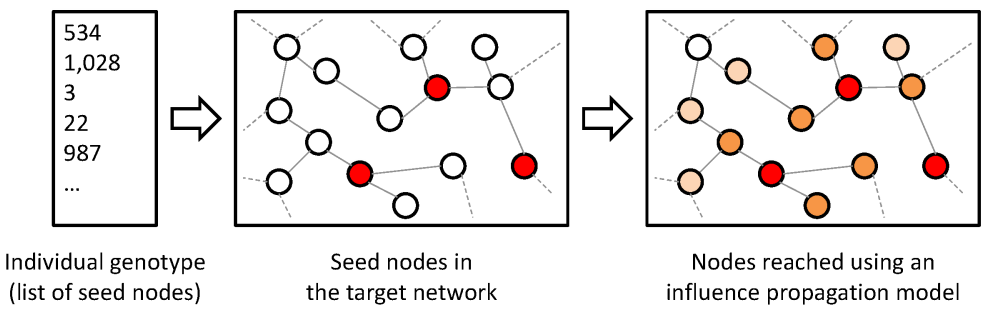
*Figure 1: Conceptual overview of the influence propagation logic where seed sets compete based on size and spread.*
The algorithm was enhanced with **Generalized Degree Discount (GDD)** for population initialization, ensuring the search didn't start from zero but from a "warm" state of already decent solutions.
## The "Fair Comparison" Trap
A critical insight of this paper is the **Pairwise Comparison Test**. For an Evolutionary Algorithm to work, it doesn't need the surrogate to be 100% accurate in absolute numbers; it just needs the surrogate to correctly identify which of two candidates is *better*.
The results were sobering. In tests on the **ego-Facebook** and **ca-GrQc** datasets:
* **EDV** showed error rates in pairwise rankings as high as **56.85%** on Facebook data.
* **PS** was surprisingly slow—sometimes even slower than the simulations it was meant to replace due to algorithmic overhead on smaller graph instances.
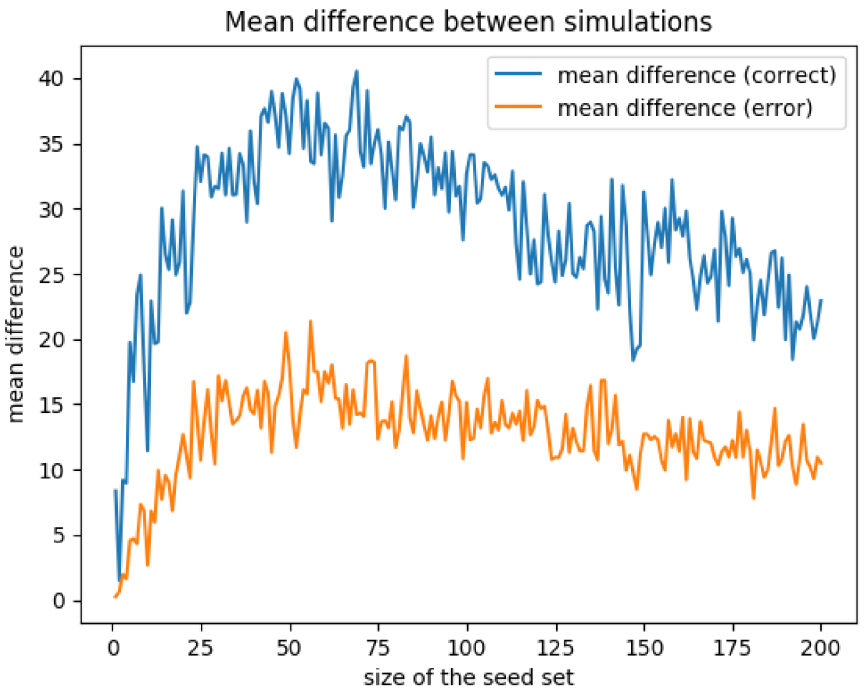
*Figure 2: The Pareto fronts generated by the MOEA. Note the gap between the "Simulated" truth and the "EDV" approximation in the lower graph.*
## Why Did it Fail?
The authors posit that while surrogates might be "good enough" for early exploration (finding the general area of good solutions), they fail during **exploitation**. When two seed sets are nearly identical in quality, the structural noise in the surrogate model leads the GA to make the wrong choice, effectively "drifting" away from the true optimal Pareto front.
## Deep Insights & Future Outlook
This research serves as a cautionary tale for "Surrogate-Assisted" optimization. Speed is not a substitute for rank-preservation.
**Key Takeaways for Practitioners:**
* **Graph Features Matter**: Surrogates performed differently on the dense Facebook graph versus the sparser collaboration graph (ca-GrQc).
* **Hybridization is the path forward**: The authors suggest a "Threshold" approach—using surrogates for speed but calling in a heavy-duty Monte Carlo simulation when the surrogate difference between two solutions is too small to be trusted.
* **Machine Learning Potential**: Traditional structural surrogates (like EDV) might be outdated. Future work should look into **Graph Neural Networks (GNNs)** to learn the diffusion patterns instead of relying on manually crafted heuristics.
Ultimately, while the surrogate-assisted MOEA promised efficiency, it proved that in the complex landscape of social influence, there are few shortcuts that don't come at a steep cost to accuracy.