
P2P Social Networks vs. The Sybil Army: Which Architecture Survives?
Evaluating Sybil Attacks in P2P Infrastructures for Online Social Networks
This paper evaluates the resilience of Decentralized Online Social Networks (DOSNs) against Sybil attacks. Utilizing the PeerSim simulator, the authors compare the performance of the Tribler social protocol when implemented over two distinct P2P architectures: the hybrid/super-peer based BitTorrent and the fully distributed Kademlia DHT.
TL;DR
Decentralized Online Social Networks (DOSNs) promise privacy and freedom from central control, but they face a lethal threat: the Sybil Attack. This research evaluates the Tribler social protocol over two backends—BitTorrent (hybrid) and Kademlia (distributed DHT). The verdict? While distributed systems are theoretically more "democratic," the hybrid BitTorrent model recovers significantly better from malicious infiltration due to more efficient reputation tracking.
Background: The Price of Decentralization
Current OSNs like Facebook are centralized silos. Moving to a P2P model (like Diaspora or Tribler) shifts power to the users but exposes the infrastructure to "Sybil" nodes—malicious entities that create thousands of fake identities to manipulate the network. The core challenge is: How does the underlying P2P topology dictate the system's ability to heal after an attack?
Methodology: Simulating the Battlefield
The researchers used PeerSim to model a 2,500-node network. They compared two distinct approaches:
- The Hybrid Approach (BitTorrent): Uses a "Tracker" (Super-peer) to coordinate and log peer behavior.
- The Distributed Approach (Kademlia): Uses a Distributed Hash Table (DHT) where every node is responsible for a portion of the routing and reputation management.
The Reputation Shield
In both models, a reputation score was implemented. Peers who share resources gain points; "leechers" or malicious actors who provide no value see their scores drop to zero and are eventually isolated.
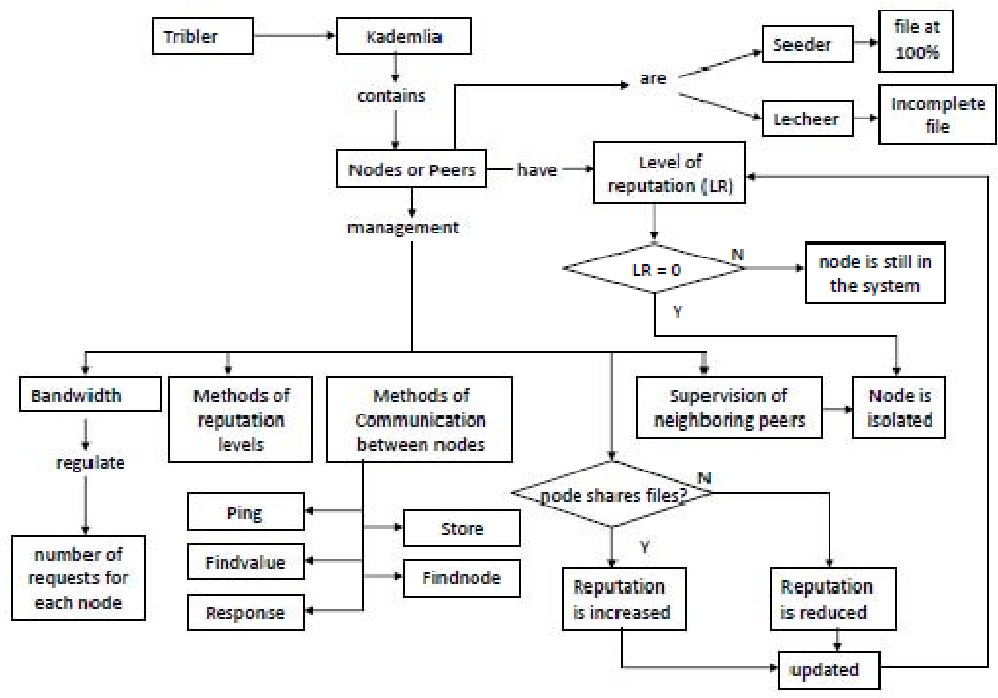 Figure: The task execution flowchart for Tribler over Kademlia, highlighting distributed reputation management.
Experimental Results: The Resilience Gap
The study simulated a scenario where 10 malicious nodes each generated 5 Sybil identities to exploit the network's upload capacity.
1. Recovery Speed
In BitTorrent, there was a temporary "chaos" period where leecher counts spiked and seeder counts dropped. However, the system's tracker quickly identified the skewed behavior, slashed the reputations of the Sybil nodes, and isolated them. The network returned to a "healthy" state relatively quickly.
2. The Kademlia Collapse
In Kademlia, the attack was much more devastating. Because there is no central authority to verify the "global" state of a node's behavior, the Sybil nodes were able to isolate legitimate nodes.
- Node Departure: Legitimate nodes left the network because their requests went unanswered.
- Reputation Loss: Good nodes lost reputation simply because they couldn't find anyone to share with in a fractured network.
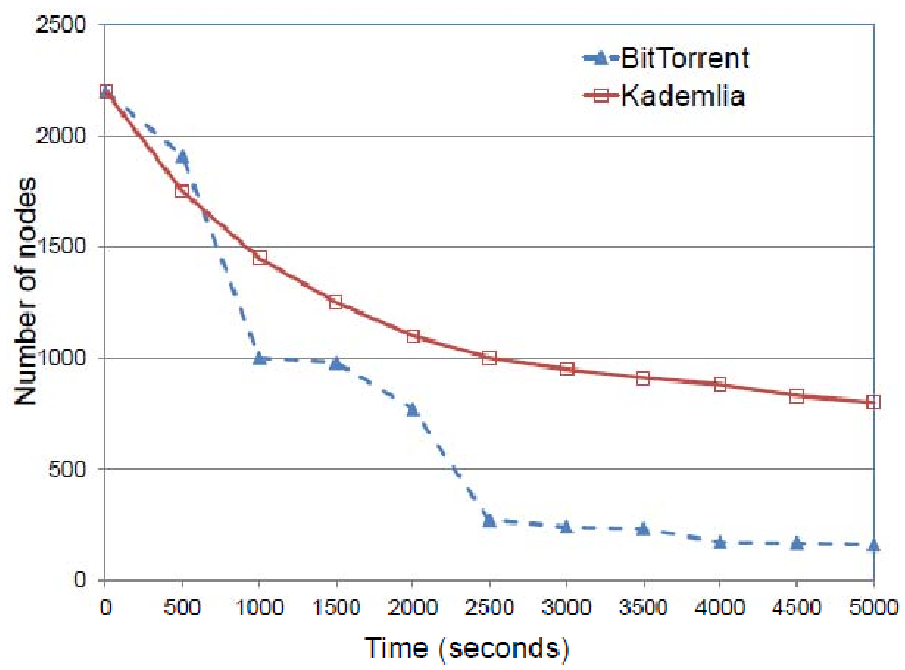 Figure: Comparing the increase of leecher peers. BitTorrent (solid) stabilizes faster than Kademlia (dashed) during a Sybil attack.
Deep Insight: Why BitTorrent Won
The "weakness" of BitTorrent—its reliance on a tracker—turned out to be its greatest strength in security. The tracker acts as a vantage point, allowing for a more accurate calculation of reputation. Kademlia’s XOR-metric-based routing is elegant for discovery but makes it difficult to distinguish a "cluster of new nodes" from a "coordinated Sybil army" without a global view.
Critical Analysis & Conclusion
Takeaway
While "fully decentralized" is a popular mantra in the Web3 space, this paper proves that topology matters. A hybrid P2P structure provides a "chokepoint" for security logic that is much harder expressed in a purely flat DHT.
Limitations
- Small Scale: The simulation used 2,500 nodes; real OSNs have millions.
- Static Attack: The study modeled basic Sybil behavior; it did not account for "Smart Sybils" that might strategically provide some good data to maintain a medium reputation (Bit-reputation).
Future Outlook
To reach the scale of Facebook without the central control, future P2P OSNs might need to look toward Social Graph-based Defenses (like SybilGuard) or Blockchain layer-2s to provide a verifiable identity without a centralized tracker.